Treating a Bupa patient without recognition is not an option. Bupa does not reimburse treatment provided before a healthcare professional or facility becomes formally recognised. Providers must complete the recognition process and receive confirmation before treating Bupa UK-funded patients, as recognition is not applied retrospectively. That single rule shapes the entire application process, and it is why every Bupa Healthcare Provider in the United Kingdom, whether a consultant, a therapist, a hospital, or a clinic, has to work through a formal application before seeing a single Bupa patient.
The recognition network is extensive. Around 21,000 consultants, 11,000 therapists, and more than 1,000 hospitals and clinics currently hold Bupa Health provider recognition. The process looks different depending on the type of provider. A consultant works through an online application built around GMC or GDC status and NHS or MOD post history. A hospital or clinic instead builds toward a Healthcare Services Agreement, backed by quality assessment documents and CQC-style regulatory registration. What stays constant across every route is the sequence: confirm eligibility, gather documents, apply, wait for verification, and only then start treating Bupa patients.
This guide walks through that sequence in full. It covers what recognition actually means, who needs to apply and under which route, the exact documents each provider type needs, the six-step application process, realistic timeframes for each stage, and where a service like MantraComply fits in to keep the paperwork moving without delays.
What Is Bupa Health Provider Recognition?
Bupa provider recognition is the formal process that lets a healthcare provider become a recognised Bupa Healthcare Provider in the United Kingdom and get reimbursed for treating Bupa’s insured patients. Bupa describes recognition as a quality signal, not just a paperwork step:
As Bupa states in its provider recognition guidance, “Bupa Health provider recognition is a mark of quality.”
Recognition covers several kinds of providers, and the benefits look slightly different depending on which one applies:
- Consultants get access to a large share of the UK health insurance market and a personal page on Finder, Bupa’s provider directory
- Therapists get promotion through Finder and access to Bupa’s insured patient base
- Hospitals and clinics get a Healthcare Services Agreement that enables them to treat Bupa-funded patients and receive agreed prices for their services
- All recognised providers get access to Providers Online, Bupa’s free portal for managing invoices, statements, and profile details
Finder is one of Bupa’s main provider directories and receives more than 100,000 visits each week from customers, GPs, and members of the public looking for recognised healthcare providers. Payment is built to be predictable too: approved online invoices are paid within seven days through the secure BACS system, and recognised providers are not expected to bill Bupa customers directly.
Who Needs to Register as a Bupa Healthcare Provider in the United Kingdom?
Any healthcare professional or facility wishing to treat Bupa UK-funded patients must obtain the appropriate Bupa recognition before providing care. Recognition routes differ for consultants, therapists, hospitals, and clinics, with each provider type required to meet Bupa’s eligibility, professional, and quality standards before recognition is granted.
| Provider Type | Recognition Requirement | Recognition Route |
|---|---|---|
| Consultants | GMC or GDC registration, NHS/MOD post history or equivalent eligibility, and supporting professional documentation. | Online consultant recognition application |
| Therapists | Professional registration, qualifications, and compliance with Bupa’s therapist recognition standards. | Online therapist recognition application |
| Hospitals & Clinics | Healthcare Services Agreement, governance documentation, regulatory registration, and pricing proposals. | Healthcare Services Agreement (HSA) |
A few additional points are worth noting for each recognition route:
- Consultants who once held an NHS or MOD post but no longer do can still apply, as long as they document the previous post
- Honorary or senior lecturer appointments can qualify if the consultant sits on the Specialist Register for that specialty
- Consultants without a Certificate of Completion of Specialist Training, but with an equivalent overseas qualification, can apply using a clinical CV plus three references
- Facilities need the ability to submit invoices electronically, and certain services, including cataract treatment, outpatient MRI, outpatient CT, endoscopy, and physiotherapy, sit under separate network agreements rather than the standard HSA
Documents Required for Bupa Health Provider Registration
Document requirements differ sharply between an individual applying for Bupa consultant recognition and a facility applying for a Healthcare Services Agreement. Bupa is direct about this condition:
As Bupa notes in its application guidance, “Without them we are unable to accept your application.”
For consultants:
- Proof of professional qualifications and a Certificate of Completion of Training
- A confirmation-of-post form, endorsed by the medical staffing or HR department
- Current indemnity insurance certificate
- Photographic proof of identity (passport, photo card driving licence, national identity card, or Electoral Office ID for Northern Ireland)
- Enhanced DBS certificate, or the Disclosure Scotland/AccessNI equivalent, arranged and paid for by the applicant
- For overseas-qualified applicants: a clinical CV and three references, from a Responsible Officer, a Clinical Director or MAC chair, and a Bupa recognised consultant in the same specialty
- For honorary/senior lecturer routes: a recent appraisal, two references from Bupa recognised consultants, and a reference from the applicant’s NHS medical director
For hospitals and clinics:
- A completed Recognition form and Pricing Request form
- Management and organisation structure documentation
- Clinical governance policy
- Incident management policy
- Complaint policy or procedure
- Customer satisfaction survey
- Safeguarding policies
- Patient consent process
- Pricing proposals mapped to the correct CCSD codes from Bupa’s Schedule of Procedures
Fixed price surgical procedure packages, where they apply, need to be fully inclusive of accommodation and theatre fees, consumables, drugs, pathology, and histology, with surgeon and anaesthetist fees and prostheses billed separately. Facilities should also check the Business Rules document alongside the pricing form, since it sets out the detailed charging rules behind each procedure code before submission.
Steps to Become a Bupa Healthcare Provider in the United Kingdom
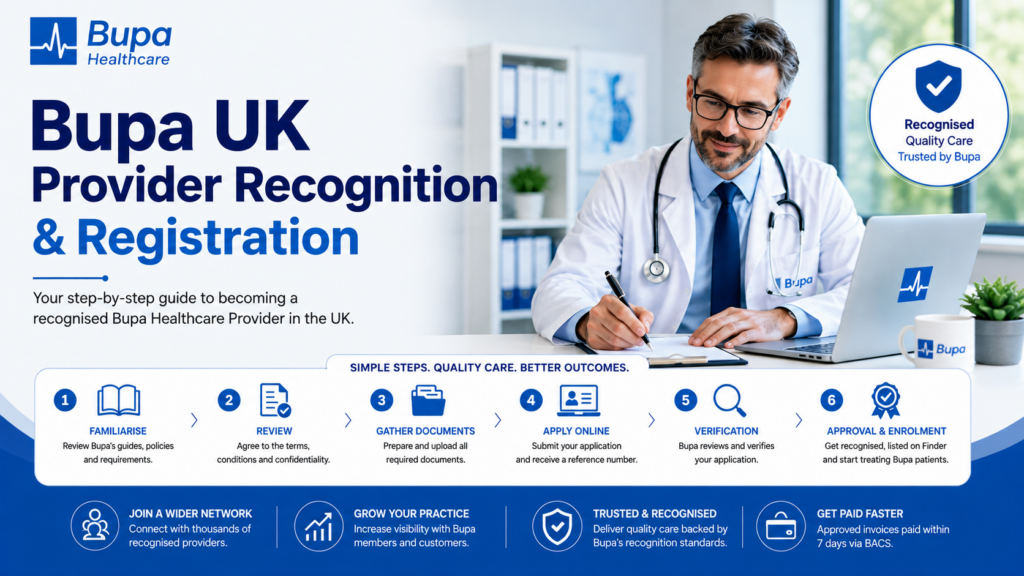
Bupa UK follows a structured recognition process to verify that healthcare professionals and facilities meet its clinical, regulatory, and quality standards before treating Bupa-funded patients. Preparing the required documentation in advance and completing each stage carefully can help minimise delays and support a smoother application experience.
Step 1 – Familiarise Yourself with the Requirements
Before starting your application, review the guidance relevant to your provider type. Consultants should read Bupa’s recognition guide, the Questions and Answers booklet, and the Schedule of Procedures to understand eligibility requirements and reimbursement policies. Hospitals and clinics should review the Business Rules document and the Healthcare Services Agreement template to understand contractual obligations, governance standards, and pricing requirements before submitting an application.
Step 2 – Review the Terms and Conditions
Every applicant must read and accept Bupa’s terms and conditions before submitting a recognition application. These terms explain the responsibilities that recognised providers must follow, including professional conduct, confidentiality, and compliance requirements. Certain provider groups, such as oral surgeons, use a modified version of the agreement.
Key areas to review include:
- Provider recognition terms and obligations.
- Confidentiality and information-sharing preferences.
- Provider-specific agreements where applicable.
Understanding these requirements before applying helps avoid delays later in the recognition process.
Step 3 – Gather Supporting Documents
Collect all required documentation before beginning the online application. Consultants should prepare qualifications, proof of identity, indemnity insurance, DBS documentation, and any additional references required for their eligibility route. Hospitals and clinics should assemble governance policies, regulatory documentation, pricing proposals, and quality assessment information. Reviewing every document before submission helps ensure the application is complete and reduces requests for additional information during verification.
Step 4 – Apply Online for Bupa Provider Registration
Complete the online Bupa provider registration application using the appropriate recognition route for your profession or organisation. Provide accurate information and ensure it matches your supporting documentation. Once the application has been submitted successfully, Bupa issues a unique reference number that allows applicants to track the progress of their recognition request. This submission officially begins Bupa’s provider verification and assessment process.
Step 5 – Wait for Bupa’s Verification
After receiving your application, Bupa reviews the submitted information and verifies your professional credentials, supporting documentation, and eligibility. Applications are prioritised according to customer needs and may require additional clarification if information is incomplete. Recognition remains subject to Bupa’s ongoing quality standards even after approval.
During verification, Bupa may review:
- Professional registration and qualifications.
- Supporting documentation and references.
- Compliance with applicable recognition standards.
Providing complete and accurate information from the outset helps minimise unnecessary delays.
Step 6 – Receive Final Approval and Complete Enrolment
Once Bupa approves your application, you will receive a confirmation email stating the effective date of your provider recognition. Recognised providers are then added to Finder, Bupa’s online provider directory, making them visible to members searching for recognised healthcare professionals and facilities. Eligible consultants, including Platinum consultants where applicable, gain access to patients covered under the relevant Bupa policies and schemes, allowing them to begin treating and billing Bupa-funded patients in accordance with Bupa’s requirements.
How Long Does Bupa Consultant Recognition Take?
| Stage | Typical Timeframe |
|---|---|
| Application Submission | Depends on when all required documents are complete and submitted. |
| Application Verification | Varies based on document verification, eligibility checks, and application volumes. |
| Recognition Approval | After successful verification and formal confirmation from Bupa. |
| Provider Listing on Finder | Following recognition approval. |
| Invoice Payment | Approved online invoices are generally paid within seven days via BACS. |
| Ongoing Recognition | Continuous, subject to maintaining professional registration and compliance with Bupa’s recognition standards. |
Bupa UK does not publish a fixed turnaround time for provider recognition because processing depends on the completeness of the application, document verification, regulatory checks, and current application volumes. Straightforward consultant applications with all required documentation typically move through the process more quickly than applications requiring additional references or eligibility checks. Hospital and clinic applications may take longer because they involve reviewing governance documentation, pricing proposals, and Healthcare Services Agreement requirements. Providers should wait until they receive Bupa’s formal confirmation of recognition before treating Bupa-funded patients, as recognition is not applied retrospectively and claims cannot be backdated.
How Are Consultant Fees Determined?
Consultant recognition and fee setting are separate processes. Bupa UK benchmarks consultant fees against rates agreed with other recognised providers, taking into account specialty, treatment setting, and market conditions. It also reviews its Benefit Maxima periodically and may consult providers before making changes to reimbursement rates. As a result, a consultant can remain recognised while the fees payable for certain procedures are reviewed or updated over time.
Billing Rules, CCSD Codes, and Payment Requirements
Recognition alone does not guarantee payment. Once recognised, providers must also follow Bupa’s billing requirements, use the appropriate CCSD procedure codes, and submit invoices through Bupa’s approved electronic systems. Accurate coding and complete billing information help reduce delays, while invoices that do not comply with Bupa’s Schedule of Procedures or Business Rules may require clarification before payment can be processed.
For consultants, approved online invoices are generally paid within seven days through the BACS payment system, provided they are submitted correctly. Hospitals and clinics must align their pricing with Bupa’s Schedule of Procedures and Business Rules, using the correct CCSD codes when submitting claims. Certain services, including cataract surgery, outpatient MRI, outpatient CT, endoscopy, and physiotherapy, are managed under separate network agreements rather than the standard Healthcare Services Agreement. Providers should therefore review the latest billing guidance regularly to ensure claims continue to meet Bupa’s reimbursement requirements.
How MantraComply Can Help You
Becoming a Bupa Healthcare Provider in the United Kingdom means tracking multiple document sets, deadlines, and standards at once, whether the applicant is an individual consultant or a hospital preparing a Healthcare Services Agreement. MantraComply supports healthcare providers through the entire Bupa Health provider registration process:
- Verifying GMC or GDC status, indemnity insurance, and DBS checks
- Organizing references, identity documents, and post-confirmation forms
- Assembling facility quality assessment paperwork and pricing proposals
- Tracking application status from submission through to final enrollment
MantraComply helps providers move through Bupa consultant recognition without missing a requirement or losing time to back-and-forth corrections. For any healthcare provider aiming to join the Bupa network, MantraComply keeps the process organized, accurate, and on schedule.
Conclusion
Becoming recognised as a Bupa Health provider in the United Kingdom is a structured process, not a quick sign-up. Consultants work through GMC or GDC verification, post history, indemnity insurance, and references. Hospitals and clinics work through a Healthcare Services Agreement, regulatory registration, and a full set of quality assessment policies. Both routes share the same underlying logic: Bupa checks credentials and standards first, confirms recognition by email, and only then allows a provider to treat and bill for Bupa patients. Getting the documents right the first time is what keeps that timeline short, whether the goal is Bupa provider registration as an individual consultant or Bupa consultant recognition alongside a hospital’s facility application. Providers who treat the application as a one-time compliance exercise, rather than a box-ticking formality, tend to move through verification with fewer queries and less back-and-forth.
Frequently Asked Questions
Bupa pre-authorisation usually begins with a GP referral, although some conditions qualify for Direct Access. Before treatment, the patient or provider requests a pre-authorisation code from Bupa. Once approved, the code allows recognised providers to deliver treatment and bill Bupa directly.
Bupa members benefit from fast access to GPs and specialists, digital consultations through the My Bupa app, and comprehensive cancer and mental health cover, depending on their policy. As a not-for-profit organisation, Bupa reinvests its profits into improving healthcare services and member care.
Bupa offers two individual health insurance policies: Comprehensive and Treatment and Care. Members can choose from Essential Access, Extended Choice, or Extended Choice with Central London hospital networks. Business customers can also select tiered plans designed for organisations of different sizes.
Bupa generally covers new medical conditions immediately if the policy includes them. Pre-existing conditions follow moratorium or full medical underwriting rules. Under a moratorium, cover may resume after two symptom-free years, while full medical underwriting applies permanent exclusions confirmed when the policy begins.
Bupa doesn’t offer a standalone policy called “Essential.” Instead, Essential Access is one of its hospital network options available with Comprehensive and Treatment and Care policies. Business plans use similar tiered hospital networks, with higher levels providing access to a broader range of hospitals.