
Recognition comes first; treatment comes second.
That order never reverses for any AXA Health provider in the United Kingdom. Practitioners must obtain recognition before treating AXA Health members. Facilities must also secure a signed agreement before providing care. Otherwise, AXA Health may not reimburse the treatment. Understanding this requirement before applying helps prevent unnecessary delays and payment issues.
AXA Health, the trading name of AXA PPP Healthcare Limited, recognises practitioners across dozens of specialties, from surgery and psychiatry through to physiotherapy, osteopathy, and dietetics. It also recognises hospitals, day-patient units, and outpatient clinics, though under a very different set of criteria than individual clinicians face. What makes the system work in practice is a web of shared infrastructure – Healthcode’s Private Practice Register, ISCAS complaint adjudication, Cyber Essentials certification – that AXA Health leans on rather than building from scratch.
This guide explains the AXA Health provider registration process, eligibility requirements, required documents, supporting infrastructure, and typical recognition timelines.
What Is AXA Health Provider Recognition?
At its core, recognition is AXA Health’s confirmation that a practitioner or facility meets the standards it requires before funding treatment. Recognition is never automatic or retrospective. AXA Health only reimburses treatment provided after confirming provider recognition. Like most UK private medical insurers, AXA Health recognises providers before they treat members or submit claims. This allows the insurer to verify professional standards before authorising reimbursement.
For an individual, recognition typically brings:
- Treat AXA Health members and receive payment under agreed billing terms.
- A profile on the AXA Healthcare Finder platform (powered by Doctify), through which members search for and book recognised specialists
- Electronic invoicing through Healthcode, the clearing system AXA Health and virtually every other UK private medical insurer uses to process claims
For a hospital or clinic, recognition brings a formal agreement that sets out which services AXA Health will fund at that site, plus the same Healthcode billing access individual practitioners rely on.
One important point is that the AXA Health Finder only lists recognised providers. This helps members choose specialists and facilities covered under their policy, reducing the risk of unexpected bills or rejected claims. By limiting the directory to recognised providers, AXA Health improves the member experience while ensuring patients access eligible care.
Eligibility Requirements for AXA Health Providers
Eligibility isn’t a single checklist for becoming an AXA Health provider in the United Kingdom – it changes by specialty and, separately, by whether the applicant is an individual or a facility. It’s worth understanding both dimensions before assuming a given qualification or post automatically clears the bar.
Consultants applying to become an AXA Health provider in the United Kingdom need to satisfy one of three routes:
| Provider Type | Recognition Requirement | Recognition Route |
|---|---|---|
| Consultants | GMC Specialist Register, eligible NHS/academic route, practising privileges, indemnity insurance, and Healthcode registration. | Healthcode Private Practice Register (PPR) |
| Allied Healthcare Professionals | Relevant professional registration, specialty-specific accreditation, practising privileges where required, and indemnity insurance. | Healthcode Private Practice Register (PPR) |
| Hospitals & Clinics | Regulatory registration, ISCAS membership, Cyber Essentials certification, facility indemnity insurance, and Healthcode billing capability. | Facility Recognition Agreement |
Alongside whichever route applies, consultants must be on the GMC’s Specialist Register in a specialty AXA Health funds, with no active restrictions, warnings, conditions, or supervision requirements on their practice. This last point is strict and non-negotiable – even a minor active restriction, regardless of its underlying cause, will stop an application before it goes further.
Allied specialties follow separate eligibility rules. Medical acupuncturists need full GMC registration and British Acupuncture Council membership. Psychotherapists must hold accreditation with recognised bodies such as BABCP, UKCP, or BACP, depending on their training. Podiatric surgeons require a substantive NHS post in podiatric surgery. Most applicants also need practising privileges at an AXA Health-listed hospital, appropriate indemnity insurance, and Healthcode billing capability before they can invoice.
Facilities follow different eligibility rules. AXA Health recognises inpatient and day-patient hospitals, outpatient surgical and diagnostic clinics, mental health clinics, and outpatient oncology clinics that provide consultant-led care. It does not recognise GP practices, cosmetic or aesthetic clinics, dental implant clinics, fertility clinics, pharmacies, pathology labs, or gyms and health spas, as these fall outside its consultant-led healthcare model.
What Documents Are Needed for AXA Health Recognition?
The paperwork differs enough between an individual and a facility that it’s worth listing separately, and worth understanding what each requirement is actually checking for, rather than treating it as an arbitrary hoop to jump through.
Individual practitioners are generally asked for:
| Stage | Typical Timeframe |
|---|---|
| Eligibility Review | Before submitting an application. |
| Document Preparation | Depends on how quickly supporting documentation is gathered. |
| Application Submission | Once the Healthcode PPR or facility application is completed. |
| AXA Health Review | Varies depending on provider type, application complexity, and third-party verification. |
| Recognition Approval | After successful verification and confirmation from AXA Health. |
| Ongoing Recognition | Continuous while eligibility, registration, and compliance requirements remain valid. |
These are the baseline AXA Health provider requirements across most specialties; the professional body reference changes, but everything else stays broadly consistent. Meeting these AXA Health provider requirements in full, before submitting, is what keeps an application from stalling partway through review.
One important step is registering with the Private Practice Register (PPR), operated by Healthcode. Used across the UK private healthcare sector, the PPR allows practitioners to submit their details once, select participating insurers, and use the same information for both provider recognition and electronic billing. That’s why AXA Health directs individual applicants to the PPR rather than a separate AXA-specific application form.
Facilities need to demonstrate:
- Registration with the appropriate medical regulator – the baseline legal requirement to operate as a healthcare facility in the UK
- An active subscription to the Independent Sector Complaints Adjudication Service (ISCAS). ISCAS is an independent, not-for-profit body that provides the final stage of the complaints process for private healthcare. AXA Health requires facilities to hold an active ISCAS subscription so patients have access to independent complaint resolution beyond the facility’s internal process.
- Cyber Essentials certification – a UK government-backed cyber security certification scheme that verifies an organisation has basic technical controls in place against common cyber attacks. This requirement protects patient data and billing systems from common cyber threats.
- Facility-level medical indemnity insurance – the institutional equivalent of the individual indemnity certificate consultants provide
- Electronic billing capability through Healthcode – the same billing platform individual practitioners rely on for claims.
Any facility missing even one of these does not proceed to the next review stage – AXA Health treats these AXA Health provider requirements as a fixed minimum, not a negotiable checklist.
Steps to Complete AXA Health Provider Recognition
Understanding each stage of the registration process helps healthcare providers prepare accurate documentation and avoid unnecessary delays. Following the process step by step improves the chances of a smooth review and faster approval.
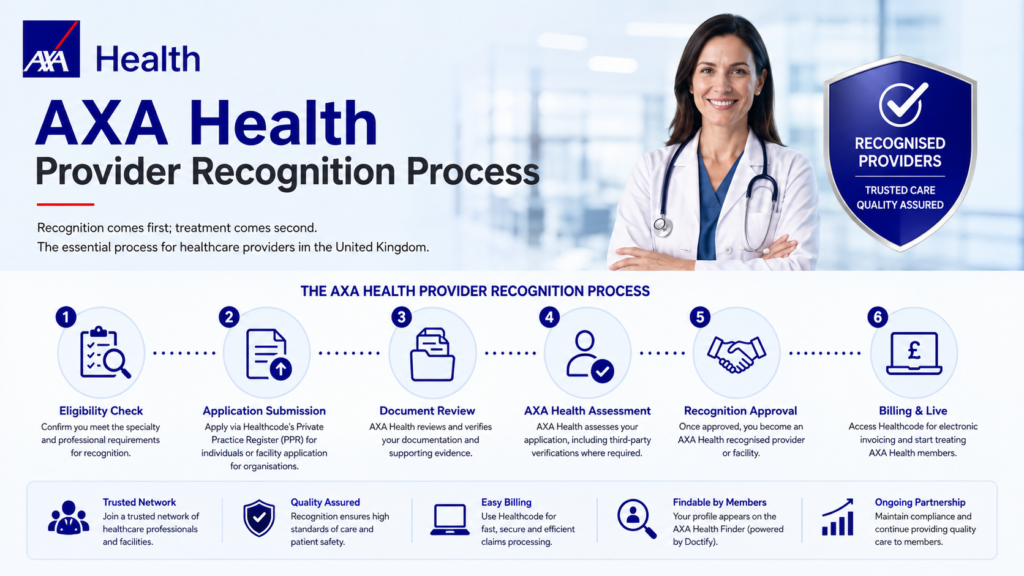
- Confirm the specialty or facility type is currently open for applications. AXA Health doesn’t accept applications year-round for every specialty – check the recognition listings before assembling any paperwork, since submitting a full application for a currently closed specialty wastes time on both sides.
- Read the exact criteria for that route. A surgeon’s eligibility conditions look nothing like a psychotherapist’s, and a hospital’s minimum requirements look nothing like either. Read the specific version, not a general summary, and pay particular attention to which of the eligibility routes actually applies before assuming the most common one (a current NHS post) is the only option.
- Assemble the required evidence. Individuals collect regulator confirmation, post evidence, indemnity insurance, and privileges confirmation. Facilities collect regulatory registration, ISCAS subscription proof, Cyber Essentials certification, and indemnity documentation. This stage is where most delays actually happen in practice, since gathering evidence from third parties (a former NHS employer confirming a previously-held post, for example) can take longer than the applicant expects.
- Submit the application. Individuals apply through AXA Health’s Private Practice Register, formally accepting the Terms of Recognition and Billing Principles – this step officially opens AXA Health provider registration. Facilities that meet the minimum requirements move into the facility-specific application route.
- Wait through AXA Health’s internal review. Applications are checked against the eligibility criteria tied to the specific specialty or facility type submitted, and any gaps identified during review typically generate a follow-up request rather than an outright rejection, provided the underlying eligibility is genuinely there.
- Recognition is confirmed. Once approved, the practitioner or facility is added to AXA Health’s network, gains Healthcode billing access, and, where applicable, may become eligible for a profile on the AXA Health Finder, which is powered by Doctify.
How Long Does Provider Recognition Take?
AXA Health has not published a fixed processing time for recognition because the checks involved vary by applicant, and several depend on third-party organisations rather than AXA Health itself.
A consultant with a current, uncomplicated NHS post and full regulator registration will typically move through the process faster than someone applying via a previously held NHS post or an academic route that requires additional references, as fewer external checks are needed.
Facility applications generally take longer because AXA Health must verify regulatory registration, ISCAS subscription, Cyber Essentials certification, and indemnity insurance before finalising a facility agreement. Each of these checks involves a different external body.
Providers must wait for formal recognition before treating AXA Health members. AXA Health never backdates provider recognition.
AXA Health Recognition and Fee Structure
Recognition and fee agreements are separate processes. As part of recognition, providers must accept AXA Health’s Billing Principles and submit claims through Healthcode.
Fee schedules are managed independently of the recognition process and may be reviewed or updated over time without affecting a provider’s recognised status. Recognition determines eligibility to join the AXA Health network, while fee agreements govern reimbursement for the services provided.
Where MantraComply Comes In
The AXA Health provider registration process asks for a lot of moving pieces at once – regulator confirmations, post evidence, indemnity certificates, and, for facilities, ISCAS and Cyber Essentials documentation, often each coming from a different source and moving at a different pace. MantraComply supports applicants through each of these steps:
- Verifying regulator registration against the exact criteria for the applicant’s specialty, so the right evidence is gathered for the right eligibility route the first time
- Assembling evidence for NHS, Armed Forces, or academic post history, including chasing third-party confirmations that tend to be the slowest part of any individual application
- Compiling facility documentation, including ISCAS subscription and Cyber Essentials certification, so nothing is missing when the facility application actually goes in
- Tracking the AXA provider application from submission to final confirmation, flagging any follow-up requests as soon as they arrive rather than after they’ve sat unanswered
The aim is to get every AXA Health provider requirement met the first time correctly, so the application isn’t delayed by avoidable back-and-forth.
Conclusion
Becoming an AXA Health provider in the United Kingdom involves more than completing an application. Individual practitioners must meet specialty-specific eligibility requirements, maintain appropriate professional registrations and indemnity insurance, and complete registration through Healthcode’s Private Practice Register. Hospitals and clinics must satisfy additional operational, regulatory, and security requirements before they can be recognised.
Recognition is only granted once AXA Health has verified that all applicable standards have been met. Providers who prepare their documentation carefully and address every requirement before applying are typically able to progress through the recognition process more efficiently, with fewer requests for additional information.
Frequently Asked Questions
Yes. AXA Health may suspend or withdraw recognition at its discretion. Ongoing audits can trigger reviews, and any change in recognition status is confirmed in writing to the provider.
Treatment provided before recognition is confirmed may not be reimbursed. AXA Health does not backdate recognition, so providers should wait for formal approval before treating members.
Not really, and not immediately. AXA Health sets fee schedules as part of its recognition arrangements. While consultation fees may be reviewed after a period of recognition, procedure fees are generally not negotiated on an individual basis. Consultation fees can be reviewed, but only after a consultant has held recognition for three years – so fee terms are something a practitioner grows into revisiting, not something settled at the application stage.
No – they’re the same legal entity. AXA Health is simply the trading name AXA PPP Healthcare Limited now operates under, so recognition granted under either name refers to the same underlying agreement and the same provider network.
AXA Health doesn’t publish a formal appeals process, but recognition decisions aren’t necessarily permanent – if the underlying reason for rejection is resolved (a missing document, a lapsed certification, a regulatory restriction that’s since been lifted), a fresh application reflecting that change can go back in. What AXA Health won’t do is backdate recognition to cover the gap in between.