There’s a strict order to how Aviva works with private practitioners: recognition first, patients second. Nothing gets reversed. A specialist who sees an Aviva-insured patient before their recognition is confirmed has no claim to payment for that treatment, and Aviva Health Provider doesn’t retroactively fix that once the paperwork catches up. Understanding how that recognition actually gets granted – and how it differs from what other insurers do – is the whole point of this guide.
What makes Aviva worth looking at separately is its approach to the application itself. Rather than running its own standalone sign-up form the way some competitors do, Aviva plugs into Healthcode’s Private Practice Register (PPR), an industry-shared system several UK insurers use to hold practitioner data. So becoming an Aviva health provider in the United Kingdom starts somewhere slightly unexpected if you’re used to other insurers: not on Aviva’s own site, but inside a shared registration platform.
This guide covers what that route actually involves and why it’s structured this way, who’s eligible and under what evidence, what obligations come with recognition once it’s granted, how CCSD coding and billing actually work day to day, how the Aviva health provider login setup works in practice, and how MantraComply helps practitioners get through it cleanly.
How Aviva Health Provider Recognition Work?
Recognition is Aviva’s stamp of approval – confirmation that a practitioner satisfies its eligibility bar and has agreed to its terms before Aviva will pay out on treatment given to one of its members. Skip that step, and the claim simply isn’t honoured, no matter how routine the treatment was. This isn’t an Aviva-specific quirk; every major UK private medical insurer works this way, because the insurer is committing to pay on the patient’s behalf, not simply reimbursing a bill the patient submits after the fact. Verifying standards before money moves is the only way that commitment can be made responsibly.
Being recognised puts a practitioner on Aviva’s radar for referrals – Aviva’s Claims Team draws from its recognised network when advising patients on where to go. It also locks in a fee arrangement: recognised practitioners commit to Aviva’s published fee schedule, earning “Fee Assured” status, which is Aviva’s way of protecting patients from unexpected shortfalls. One detail that catches people off guard: Aviva has stopped letting practitioners step back out of Fee Assured status once they’ve signed up to it. It’s a one-way commitment, not something revisited later, and it’s worth weighing before agreeing to it at the point of recognition rather than after.
Who Can Apply for Aviva Health Provider Recognition?
Wanting to treat Aviva members isn’t enough on its own – becoming an Aviva health provider in the United Kingdom means clearing a specific bar, and Aviva is upfront that it doesn’t recognise every specialist who applies, regardless of how well-established their private practice is.
For consultants, one of three conditions has to be true:
| Provider Type | Eligibility Requirements | Notes |
|---|---|---|
| Consultants | Must meet at least one recognised route: substantive NHS consultant appointment, Certificate of Higher Specialist Training, or inclusion on the GMC Specialist Register. | Meeting another insurer’s requirements does not automatically satisfy Aviva’s eligibility criteria. |
| Allied Healthcare Professionals | Must hold the appropriate professional registration and satisfy Aviva’s profession-specific recognition requirements. | Referral opportunities may also come through partner clinical networks such as Onebright, Vita Health Group, IPRS Health, and HCML. |
| Hospitals & Facilities | Must meet Aviva’s facility requirements for providing equipment, consumables, drugs, and regulated healthcare services. | Only recognised facilities can supply equipment, consumables, and drugs to Aviva members. |
Aviva sets its own eligibility criteria, so meeting another insurer’s requirements doesn’t automatically qualify a provider for recognition. Allied healthcare professionals follow separate registration pathways based on their profession and regulatory body. Aviva also works with referral partners such as Onebright Mental Health, Vita Health Group, IPRS Health, and HCML to support mental health and musculoskeletal services. These networks help eligible practitioners receive referrals after recognition.
Hospitals and healthcare facilities follow a separate recognition process. Only recognised facilities can supply equipment, consumables, and drugs to Aviva members. Individual practitioners cannot provide these directly or indirectly. This approach helps maintain regulatory compliance and clear accountability for patient care.
Step-by-Step Aviva Health Provider Registration Process
Aviva uses Healthcode’s Private Practice Register (PPR) to manage provider registration instead of a dedicated application portal. Understanding each step helps practitioners prepare the right documentation, complete registration efficiently, and avoid unnecessary delays.
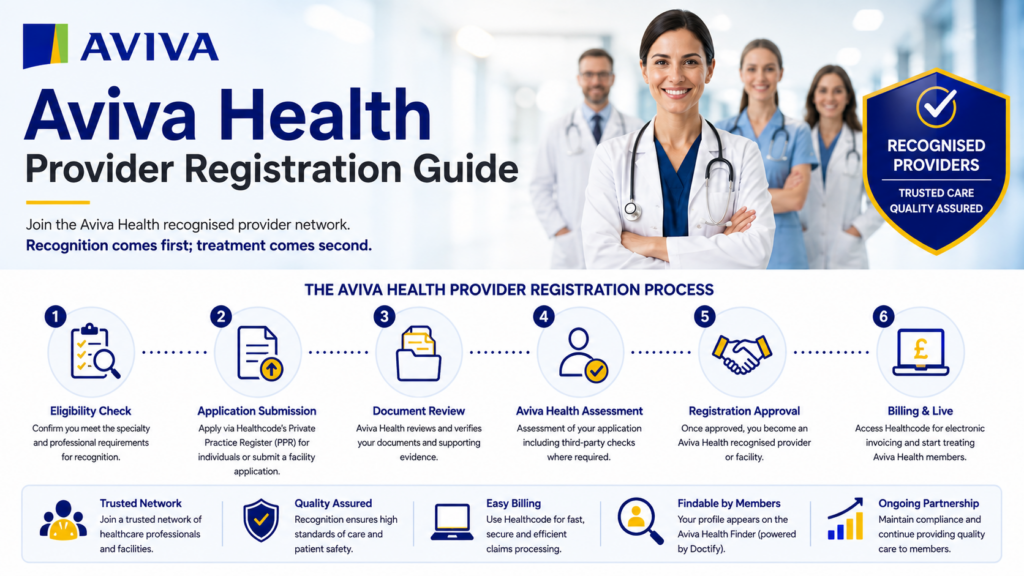
Step 1 – Confirm Your Eligibility
Before creating a Healthcode profile, ensure you meet Aviva’s eligibility requirements for your profession. Consultants should qualify through one of Aviva’s recognised eligibility routes, while allied healthcare professionals must hold the appropriate professional registration and meet their specialty-specific requirements. Reviewing these criteria before applying helps determine the correct registration pathway and prevents avoidable delays.
Step 2 – Create Your Healthcode Private Practice Register (PPR) Profile
Register with the Healthcode Private Practice Register (PPR) and complete your professional profile. Enter accurate information about your qualifications, specialty, professional registration, practising details, and contact information. Since Aviva uses the PPR as its provider registration platform, maintaining a complete and accurate profile forms the foundation of your application.
Step 3 – Select Aviva for Recognition
Once your PPR profile is complete, choose Aviva from the list of participating insurers and submit your provider recognition request. This officially begins Aviva’s review process. Ensure all supporting information is complete before submission, as missing or inaccurate details may delay the assessment.
Step 4 – Complete Your Billing Setup
Configure your preferred electronic billing method before treating Aviva members. Providers can submit claims through Healthcode or the Aviva Online Billing Platform, and should also set up BACS payment details to receive reimbursements. Aviva no longer accepts paper invoices, making electronic billing a mandatory part of provider registration.
Step 5 – Wait for Recognition Approval
Aviva reviews your application, verifies your professional credentials, and confirms that you meet its recognition requirements. During this stage, Aviva may request additional information if documentation is incomplete or requires clarification. Providers should wait until formal recognition is confirmed before treating Aviva members, as recognition is not applied retrospectively.
Step 6 – Maintain Your Provider Profile
After recognition, continue updating your Healthcode PPR profile whenever your professional details change. Keep your contact information, specialty, practising locations, and BACS payment details current, and continue using approved electronic billing methods. Maintaining an accurate profile supports ongoing recognition and helps ensure timely claims processing and reimbursement.
How Long Does Aviva Health Provider Recognition Take?
Aviva doesn’t publish a fixed turnaround time for provider recognition, as processing depends on the completeness of the application, the supporting evidence provided, and any additional verification required. Providers who submit accurate information and complete documentation through Healthcode’s Private Practice Register (PPR) typically experience a smoother review process.
| Timeline Stage | Expected Timeframe |
|---|---|
| Eligibility Review | Before starting your Healthcode PPR registration. |
| Healthcode PPR Setup | Depends on how quickly you complete your profile and upload supporting information. |
| Recognition Review | No fixed timeframe. Processing varies based on application completeness and verification requirements. |
| Recognition Confirmation | Providers may begin treating Aviva members only after receiving formal recognition. |
| Invoice Processing | Aviva aims to process invoices within 7–10 working days. The contractual payment term is 30 days. |
| Ongoing Recognition | Continuous, provided providers maintain Fee Assured status, accurate CCSD coding, electronic billing, and compliance requirements. |
Recognition is only effective once Aviva formally confirms approval. Providers should wait for that confirmation before treating Aviva members, as Aviva does not backdate recognition. After approval, practitioners can begin submitting electronic claims through Healthcode or the Aviva Online Billing Platform in line with Aviva’s billing requirements.
Obligations That Come With Recognition
Getting recognised isn’t a one-time event that then fades into the background for an Aviva health provider in the United Kingdom – it comes bundled with a set of ongoing commitments that shape how a practitioner actually operates with Aviva.
- Fee Assured pricing – charging within Aviva’s published fee schedule, which factors in patient complexity, procedure type, operation time, skill level, specialism, and broader market conditions, and which Aviva reviews monthly through its Clinical and Commercial team.
- Electronic-only billing – every invoice submitted via Healthcode or the Aviva Online Billing Platform, tied to Aviva’s stated commitment to net zero operations by 2030 and full net zero as a company by 2040.
- A six-month invoicing window – invoices submitted more than six months after treatment are declined outright, and practitioners agree not to chase the patient for that payment afterward.
- Checking for pre-authorisation – patients are expected to have contacted Aviva and received an authorisation number before their first appointment, and it falls on the practitioner to confirm this rather than assume it.
- No stacking same-day consultation charges onto a scheduled procedure, and no passing that cost to the patient.
- Accurate CCSD coding – using the correct, clinically appropriate code for every procedure submitted.
Accurate CCSD coding is essential because it supports every claim Aviva processes. CCSD (Clinical Coding and Schedule Development) provides the standard procedure codes used by Aviva, Bupa, AXA Health, and other major UK private medical insurers. Each procedure or diagnostic test has its own alphanumeric code, allowing providers to submit standardised claims instead of writing full procedure descriptions.
The CCSD Group defines the codes and their clinical descriptions but does not set reimbursement rates. Each insurer decides how much it pays for a specific code. This is why CCSD coding and Fee Assured status serve different purposes. Incorrect or outdated codes can delay, query, or reject a claim.
Aviva may also withdraw provider recognition if it identifies excessive or clinically unjustified shortfalls. Providers must continue meeting Fee Assured requirements after recognition. Aviva monitors compliance through ongoing audits to ensure providers continue following its billing and reimbursement standards.
How Are Aviva Health Fees Determined?
Aviva’s stated goal is processing and paying invoices within 7 to 10 working days of receipt for every Aviva health provider in the United Kingdom. Its formal contractual term, though, is the standard 30 days – the 7-to-10-day figure is an aspiration, not a guarantee, and it’s worth budgeting around the contractual figure rather than the faster one when planning cash flow. BACS is Aviva’s recommended payment method, pitched as faster and more secure than the alternatives, and it’s set up through the Healthcode Register rather than anywhere on Aviva’s own site – one more example of how the PPR functions as the practical hub for a practitioner’s ongoing relationship with Aviva, well beyond the initial application itself.
Where MantraComply Fits
Registering as an Aviva health provider in the United Kingdom means navigating a system that works a little differently from most other insurers, since everything starts inside Healthcode’s Private Practice Register rather than a dedicated Aviva form. MantraComply takes that off a practitioner’s plate:
- Building out a complete, accurate Healthcode PPR profile with Aviva selected as a recognised insurer
- Working out which of Aviva’s three eligibility routes actually applies and pulling together the right supporting evidence for it
- Setting up BACS payment details and clarifying exactly where the Aviva health provider login process sits, whether that’s Healthcode or the Aviva Online Billing Platform
- Reviewing CCSD coding practices against Aviva’s requirements and keeping track of Fee Assured commitments before they turn into invoicing headaches down the line
The goal is simple – get every practitioner through the process correctly on the first attempt, without the Healthcode-based structure causing unnecessary confusion along the way.
Conclusion
Becoming a recognised Aviva health provider in the United Kingdom differs from the registration process used by many other private medical insurers. Instead of applying through a standalone Aviva portal, practitioners register through Healthcode’s Private Practice Register (PPR). Consultants must also qualify through one of Aviva’s recognised eligibility routes, including a substantive NHS consultant appointment, a Certificate of Higher Specialist Training, or inclusion on the GMC Specialist Register under the relevant qualifications order.
Recognition also comes with ongoing responsibilities beyond the initial application. Providers must follow Fee Assured pricing, use electronic billing, submit accurate CCSD codes, and comply with Aviva’s six-month invoicing window. Keeping your Healthcode PPR profile up to date and understanding how Aviva’s registration and billing systems work can help ensure a smoother recognition process and ongoing compliance.
Frequently Asked Questions
There isn’t a dedicated, standalone Aviva login for new registrations. Everything starts through the Healthcode Private Practice Register, which also handles updates to personal details and BACS payment setup once recognition is confirmed. For day-to-day invoicing specifically, practitioners also have the option of the Aviva Online Billing Platform.
Yes, but the process differs after the initial registration. Consultants and allied healthcare professionals both start by registering through the Healthcode Private Practice Register (PPR). However, Aviva also works with specialist referral partners for mental health and musculoskeletal services. These partnerships don’t replace PPR registration but may increase referral opportunities for recognised providers.
No – Aviva is explicit that recognition isn’t automatic. It depends on meeting one of three defined criteria: a substantive NHS consultant appointment (held now or previously), a Certificate of Higher Specialist Training from the relevant Royal College or Faculty, or GMC Specialist Register inclusion under the European Specialist Medical Qualifications Order 1995.
No. Aviva has confirmed it no longer permits practitioners to move away from Fee Assured status after accepting it as part of recognition. It functions as a permanent condition of ongoing recognition rather than a choice that can be revisited later.
Anything submitted more than six months after the date of treatment gets declined by Aviva, and the practitioner isn’t permitted to pursue the patient for that payment instead. An incorrect or misapplied CCSD code typically results in the claim being queried or rejected rather than automatically declined outright, since the CCSD Group defines the code but Aviva separately controls whether and how much it reimburses against it – so a query usually means resubmitting with the correct code rather than losing the claim entirely.