
Psychiatrist insurance credentialing requires accurate provider information, complete documentation, and careful coordination with each payer to establish network participation.
Psychiatrists who want to accept commercial insurance, Medicare, Medicaid, or other health plans must navigate more than a single credentialing application. The process can involve NPI setup, CAQH, primary-source verification, payer applications, contracting, group affiliation, enrollment, and effective-date confirmation.
For psychiatric practices, keeping these requirements organized is especially important. A structured psychiatrist credentialing process can help reduce administrative delays, maintain consistent provider records, and support smoother participation across multiple mental health payer panels.
What Is Psychiatrist Insurance Credentialing?
Psychiatrist insurance credentialing is the process health plans use to verify a psychiatrist’s qualifications before establishing network participation. This may include medical licensure, education, residency, board certification, work history, liability coverage, NPI, specialty, and practice information.
Credentialing is separate from contracting and payer enrollment. A psychiatrist may be credentialed but still need to complete contracting, group affiliation, enrollment, or effective-date requirements before becoming active with a payer.
Why Is Psychiatrist Credentialing Important?
Insurance participation can influence how patients access psychiatric services. Patients often use their health plan’s provider directory when looking for an in-network psychiatrist, while practices may rely on payer participation to reach a broader insured population.
A completed credentialing process helps establish the relationship between the psychiatrist and the health plan. It can also support accurate provider directories, appropriate billing arrangements, and the administrative requirements associated with payer participation.
For psychiatric practices, credentialing is not simply an onboarding task. Provider information can change after approval. A psychiatrist may move to another office, join a different group, obtain another state license, renew liability coverage, or add new insurance relationships.
These changes need to be reflected in the appropriate payer and provider systems. Treating credentialing as an ongoing administrative process can make it easier to maintain accurate payer records.
How to Get a Psychiatrist Credentialed With Insurance Payers
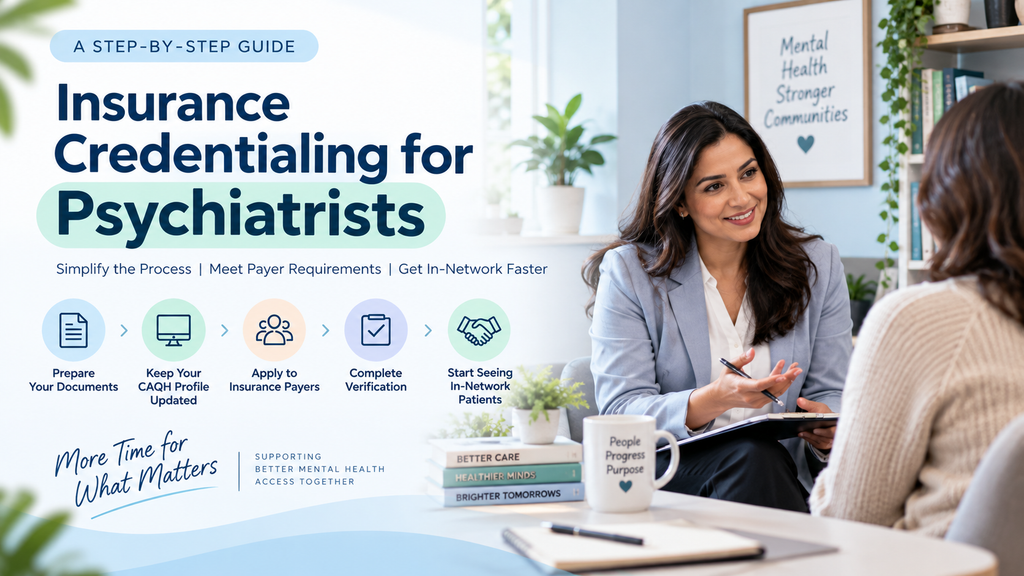
Psychiatrist credentialing works best when the process is handled in a defined sequence. The practice should establish its payer strategy, prepare the provider’s information, complete the applicable credentialing and enrollment requirements, and then track each payer through approval and effective participation.
Step 1: Identify the Right Mental Health Payer Panels
Before submitting applications, determine which insurance panels are relevant to the psychiatrist and the practice.
Payer selection should be based on the patients the practice intends to serve rather than simply applying to every available insurance company. Consider the local payer landscape, patient demand, psychiatric specialty, geographic coverage, reimbursement considerations, Medicare or Medicaid participation, and telehealth requirements.
Joining every available payer network is not always necessary. A more targeted approach can help the practice prioritize plans that align with its patient population and growth objectives.
Once the target payer list is established, review each plan’s credentialing, contracting, and enrollment requirements. Different insurers can have different forms, submission methods, documentation requirements, and review processes.
A centralized payer enrollment process can help organize these payer-specific requirements.
Step 2: Verify Licensure and Professional Credentials
The psychiatrist’s professional credentials should be reviewed before the payer application is submitted.
An active medical license is fundamental to physician credentialing. The practice should confirm the license status and expiration date for every state in which the psychiatrist will practice.
Board certification, professional liability insurance, DEA registration where applicable, and other relevant credentials should also be checked before finalizing the provider file.
The American Psychiatric Association notes that ABPN certification requires an active, full, unrestricted medical license and completion of approved specialty training requirements.
This verification step is important because payers may independently verify submitted information. If the application conflicts with licensing or professional records, the payer may request clarification and extend the review process.
Step 3: Obtain and Verify the Individual NPI
The psychiatrist should have the appropriate individual NPI for provider identification. An NPI is a unique identifier used in covered healthcare transactions.
Taxonomy information should also accurately represent the psychiatrist’s provider classification and specialization. CMS explains that taxonomy codes identify provider classification and specialization and are used as part of the NPI process.
The NPI and taxonomy information should remain consistent across payer applications, CAQH, enrollment records, and other provider information.
For psychiatrists working within a group practice, the individual NPI and organizational NPI serve different purposes. The relationship between the individual psychiatrist, group, tax ID, and practice locations should therefore be documented accurately.
Step 4: Complete and Maintain CAQH
CAQH is an important part of many commercial payer credentialing workflows. The CAQH Provider Data Portal allows providers to enter, update, and validate professional information and share completed credentialing information with participating plans. CAQH also incorporates primary-source verification into its credentialing process.
Before authorizing a payer to access the profile, review the information carefully. The psychiatrist’s CAQH profile should align with the CV, payer application, NPI record, licensing information, and supporting documents.
Pay particular attention to work history and practice locations. Incorrect dates, missing professional history, or an outdated address can create discrepancies when a payer compares CAQH data with the submitted application.
CAQH should not be treated as a one-time task. When provider information changes, the profile should be reviewed and updated so payer records remain consistent.
For practices that need a structured approach to provider data, a complete CAQH profile workflow can help keep information organized for payer review.
Step 5: Build a Complete Psychiatrist Credentialing File
A centralized provider file gives the credentialing team one reliable source of information instead of requiring staff to collect documents from different systems whenever a new payer application is started.
The file should contain the current version of the psychiatrist’s professional information and supporting documentation.
Important records can include:
- Medical license and applicable state licenses
- Current CV and complete work history
- Education and residency information
- Board certification, when applicable
- Individual NPI
- CAQH information
- Professional liability insurance
- DEA registration, when applicable
- Practice locations
- Professional disclosures
- Group and payer affiliations
Work history deserves particular attention. Payer applications can require detailed professional history, and unexplained gaps may lead to additional questions.
The same dates, addresses, credentials, and professional information should appear consistently across the psychiatrist’s CV, CAQH profile, payer applications, and supporting records.
Step 6: Submit the Payer Credentialing Application
Once the provider file is complete, submit the application according to the payer’s specific process.
A commercial insurance application may require credentialing forms, CAQH authorization, license information, professional history, liability coverage, NPI information, tax information, practice details, and contracting documentation.
Submission is not the end of the process. Save the application confirmation and record the payer’s reference number, submission date, outstanding requirements, and follow-up status.
Different payers may use different application systems and review procedures. Information from one completed application should not automatically be assumed to satisfy another payer’s requirements.
Step 7: Complete Contracting and Group Affiliation
Credentialing and contracting are related but separate components of payer participation.
A psychiatrist can be individually credentialed but still need to be connected to the correct group, tax entity, location, or payer contract before the relationship is fully established.
This becomes particularly important when a psychiatrist joins an established behavioral health practice. Previous participation under another organization should not automatically be assumed to transfer to the new group.
Review the individual NPI, group NPI, tax ID, legal entity, practice location, billing information, provider roster, contract status, and payer affiliation.
For organizations managing multiple clinicians, provider group credentialing can help maintain accurate relationships between individual psychiatrists and group payer records.
Step 8: Complete Medicare and Medicaid Enrollment
Medicare should be managed separately from commercial credentialing. Enrollment is generally handled through PECOS, with requirements depending on whether the psychiatrist enrolls individually or through a group. Certain provider or practice changes may also require updates to Medicare records.
Medicaid requirements vary by state, so psychiatrists practicing across multiple states may need separate state enrollment and managed-care participation. Medicare, Medicaid, and commercial payer applications should therefore be tracked separately.
For Medicare-related workflows, Medicare provider credentialing and enrollment can help practices distinguish Medicare enrollment from commercial payer credentialing.
Track Every Psychiatrist Credentialing Application
Once applications have been submitted, maintaining a centralized tracker makes it easier to identify what has been completed, what remains pending, and which payer requires follow-up.
The tracker should remain active until the payer confirms the psychiatrist’s participation and effective date. This prevents an application marked “approved” from being mistaken for one that is fully active for billing.
How Long Does Psychiatrist Credentialing Take?
There is no single credentialing timeline that applies to every psychiatrist or payer. Processing time can depend on the health plan, application completeness, verification requirements, contracting process, provider arrangement, and whether additional documentation is requested.
Applications can take longer when provider information does not match across systems, CAQH has not been updated, employment history contains gaps, documents expire during review, or payer requests are not answered promptly.
Starting the process early is particularly important when a psychiatrist is joining a new practice or expanding into several insurance networks at once. Maintaining an application tracker also makes it easier to identify which payer is causing a delay and what action is needed.
Common Psychiatrist Credentialing Mistakes
Avoiding common credentialing mistakes can help psychiatric practices reduce delays and keep payer records accurate.
1. Inconsistent Provider Information – Differences in names, addresses, NPI details, or specialties across CAQH and payer applications can trigger additional verification.
2. Incomplete Work History – Missing employment dates or unexplained gaps may lead to payer follow-up.
3. Outdated CAQH – Incorrect licenses, practice locations, liability coverage, or other outdated information can delay credentialing.
4. Expired Credentials – Expired medical licenses, board certification, or liability insurance can hold up an application.
5. Incorrect Group Affiliation – A psychiatrist may be credentialed individually but not properly linked to the intended group or tax ID.
6. Confusing Credentialing With Enrollment – Credentialing approval does not always mean contracting, enrollment, or billing setup is complete.
7. Missing Payer Follow-Up – Overlooking requests for additional documents or information can leave applications pending.
8. Not Confirming the Effective Date – Payer approval should not automatically be treated as the date network participation begins.
9. Treating Credentialing as One-Time – Licenses, CAQH, liability coverage, payer records, and recredentialing requirements need ongoing maintenance.
How Credentialing Services Can Help Psychiatric Practices
Managing psychiatrist credentialing internally can require coordination between physicians, practice administrators, insurance companies, credentialing platforms, and enrollment systems.
A structured credentialing service can help organize provider documentation, maintain application records, manage payer follow-ups, coordinate enrollment requirements, and keep credentialing information current.
MantraComply helps healthcare practices manage credentialing and payer enrollment workflows across providers and insurance relationships.
For individual psychiatrists and smaller practices, individual practitioner credentialing can provide support with provider documentation, payer applications, and ongoing participation requirements.
The objective is not simply to submit an application. A strong credentialing workflow should continue through payer approval, contracting, effective-date confirmation, directory verification, and future recredentialing.
Key Takeaway
Psychiatrist insurance credentialing connects a psychiatrist’s professional qualifications with insurance payer participation. The process can involve NPI verification, CAQH, documentation, payer applications, contracting, group affiliation, Medicare or Medicaid enrollment, and effective-date confirmation.
Starting with an accurate provider file and a clear payer strategy can help reduce avoidable delays. Each payer should be tracked separately because credentialing, contracting, enrollment, and participation dates may occur at different stages.
Credentialing also continues after approval. Keeping licenses, CAQH, liability coverage, practice information, payer affiliations, and recredentialing requirements current helps psychiatric practices maintain accurate payer relationships and support continued insurance participation.
Frequently Asked Questions
Psychiatrist insurance credentialing is the process health plans use to verify a psychiatrist’s professional qualifications before establishing network participation. It can involve reviewing medical licensure, education, residency, board certification, work history, NPI information, liability coverage, practice information, and other provider data.
No. CAQH provides a centralized provider-data platform that participating health plans can use for credentialing and related activities. Completing or updating CAQH does not automatically establish participation with every insurance payer. The psychiatrist may still need to complete payer-specific credentialing, contracting, enrollment, group affiliation, and effective-date requirements.
Yes. A psychiatrist can participate with multiple insurance companies when the provider meets each payer’s requirements and completes the applicable credentialing, contracting, and enrollment processes. Each payer relationship should be tracked separately because approval with one health plan does not automatically establish participation with another.