
Do you manage a large practice, hospital, or clinic network? Then you already know credentialing is slow and repetitive. Every new provider means new forms, new documents, and weeks sometimes months of waiting for payer approval.
Now imagine skipping that wait. Imagine having the authority to credential your own providers directly. No more waiting on each insurance company one by one.
That’s what delegated credentialing does.
In this blog,
- we’ll explain delegated credentialing and what it means.
- We’ll also compare it to traditional credentialing.
- You’ll learn the key requirements you must meet.
- We’ll show how it can speed up onboarding and payer approval timelines.
So, let’s dive in!
What Is Delegated Credentialing?
It is a process where a healthcare organization—such as a hospital, group practice, or large clinic—is authorized by an insurance company (payer) to credential its own providers on the payer’s behalf.
Here’s how it works normally, without delegation: your team sends each provider’s application to every insurance plan. Then you wait for approval — one payer at a time.
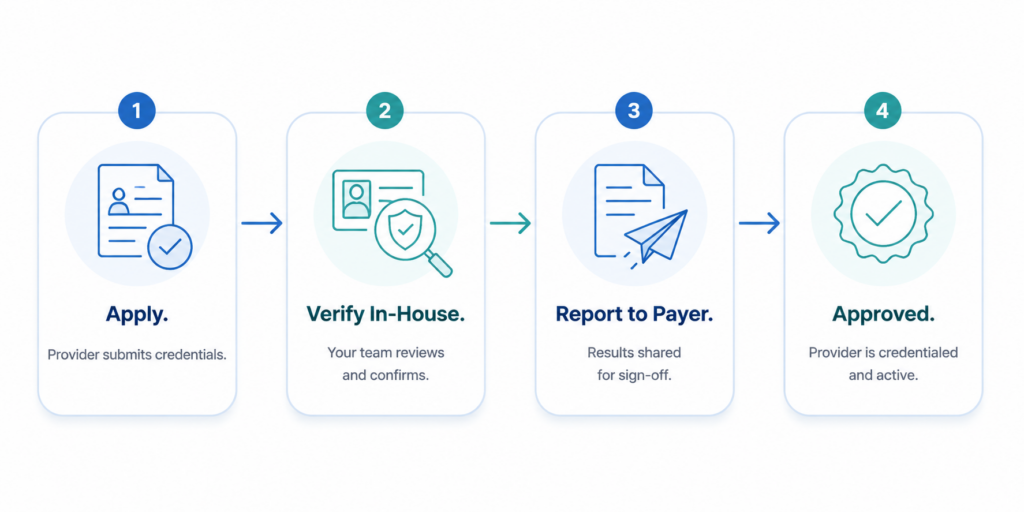
With delegated credentialing, that changes. Your organization takes over this work under a formal agreement with the payer. Your team handles:
- Verification
- Primary source checks
- File reviews
You follow the payer’s rules and NCQA standards. Once done, you simply send your results to the payer for final sign-off.”
What this means for you:
- Faster onboarding
- Less back-and-forth with insurers
- More control over your own timeline
Example: A clinic adds 5 new therapists. With delegated credentialing, the clinic reviews and adds them in-house — no 60-90 day wait per provider.g workflow in-house, but with payer approval and oversight to ensure accuracy and compliance.
Delegated Credentialing VS Traditional Credentialing
The difference between delegated credentialing and traditional credentialing lies mainly in who controls the process.
In traditional credentialing, the payer does the work. They check every license, degree, and insurance policy. Your team sends data to each payer separately — then waits.
In delegated credentialing, you do the work. Your team handles verification in-house. You just report results to the payer on a set schedule.
Here’s a quick comparison for clarity:
| Aspect | Traditional Credentialing | Delegated Credentialing |
|---|---|---|
| Who Performs Verification | The insurance payer | The healthcare organization |
| Average Turnaround Time | 60–120 days | 15–30 days |
| Administrative Workload | High – repetitive submissions | Lower – done internally once |
| Compliance Oversight | Payer-driven | Organization-driven under NCQA |
| Flexibility | Limited | High – full control over timelines |
| Best For | Solo practices, small clinics | Hospitals, large provider networks |
In short, delegated credentialing shifts the process from being payer-controlled to provider-controlled, helping large organizations speed up approvals while maintaining compliance.
Benefits of Delegated Credentialing
Delegated credentialing isn’t just about speed — it’s about control, consistency, and confidence in how your organization manages provider onboarding. Here are some key advantages:
- Faster Onboarding — Providers start seeing patients weeks sooner.
- Less Admin Work — Submit data once, not to five different payers.
- Better Accuracy — Fewer mismatches between your records and payer systems.
- Stronger Compliance — NCQA-aligned processes build payer trust.
- More Control — You set your own credentialing schedule.
- Better Provider Experience — Less waiting, more time with patients.
- Built to Scale — Works whether you have 10 providers or 1,000.
Requirements for Delegated Credentialing (What You Need to Qualify)

Not every healthcare organization can immediately start delegated credentialing — payers usually grant this privilege only to groups that have proven, standardized processes and meet regulatory standards.
Here’s what you typically need to qualify:
- An NCQA-compliant program — Written policies and trained staff for verification.
- A credentialing committee — Led by medical directors who review and approve files.
- Documented procedures — Every step written down, from data collection to re-credentialing.
- Audit-ready reporting — Reports and audit trails the payer can request anytime.
- A secure data system — HIPAA-compliant, with access controls and logs.
- A track record — Payers want to see you’ve already run internal credentialing well.
- A signed agreement — Covers scope, audit frequency, reporting, and termination terms.
Once all these requirements are met, the payer grants delegation authority — allowing your organization to control its own credentialing process while staying compliant with NCQA and payer standards.
How MantraComply Simplifies Credentialing
Delegated credentialing sounds complex. Policy manuals. NCQA audits. Compliance tracking. It doesn’t have to be.
MantraComply puts it all in one platform:
- Centralized credentialing dashboard
- AI-powered automation
- Built-in NCQA compliance tools
- Secure data management
- Real-time monitoring and alerts
- Expert support team
By combining AI technology, compliance expertise, and hands-on support, MantraComply empowers healthcare organizations to manage delegated credentialing with confidence, accuracy, and speed.
Conclusion
Tired of paperwork, long approval cycles, and audit checklists?
MantraComply puts you in control. Onboard providers faster. Stay compliant. All in one place.”
Click on the button below and get your free consultation today — let’s discuss how we can accelerate your credentialing process and help your organization grow faster.