Benenden Health does not operate a traditional provider network in the way most private medical insurers do. There is no published online application, no self-service portal, and no standard document checklist for consultants seeking recognition. This reflects the organisation’s discretionary, mutual structure rather than any gap in standards. Becoming a Benenden Health e-provider therefore starts with understanding how Benenden’s model works, not with locating a form to fill in.
Benenden Health is the trading name of The Benenden Healthcare Society Limited, an incorporated Friendly Society registered under the Friendly Societies Act 1992, registered number 480F. The organisation traces its roots to 1905, when it was founded as The Post Office and Civil Service Sanatorium Society. It has no shareholders and reinvests surplus into member services rather than paying dividends.
The Society’s contractual business, which covers tuberculosis benefits specifically, is authorised by the Prudential Regulation Authority and regulated by both the Financial Conduct Authority and the Prudential Regulation Authority, under Firm Reference Number 205351. The remainder of Benenden’s services are provided on a discretionary basis, meaning the Board decides what is offered and what isn’t, and that provision can change over time. Benenden Health serves more than 870,000 members and owns its own hospital, Benenden Hospital in Kent, which holds a CQC rating of Outstanding.
This guide explains what it means to become a Benenden Health e-provider, who needs to engage with Benenden directly, what documentation practitioners should hold, how long recognition-related steps typically take, how fees and billing work, and where MantraComply can help.
What Does It Mean to Become a Benenden Health e-Provider?
Benenden does not describe itself as a private medical insurer. It operates on a discretionary basis, with the exception of tuberculosis treatment, which is provided on an insured basis. This distinction matters. Because most services aren’t insured in the conventional sense, Benenden doesn’t run the kind of formal, published provider recognition scheme that insurers like Bupa or AXA maintain.
For consultants, access to Benenden members runs through two separate routes. The first is Benenden’s own hospital in Kent, where consultants hold practising privileges directly with the hospital and can be found through its searchable consultant directory. The second is Benenden’s wider treatment network, used for members who request Surgical Treatment or Medical Diagnostics when NHS waiting times exceed set thresholds. Becoming a Benenden Health e-provider under this second route depends on being reachable within that treatment network, rather than completing a standalone application.
Members requesting Surgical Treatment must have an NHS referral wait of five weeks or more, a CCSD code for the procedure, and a consultant’s report confirming diagnosis. CCSD stands for Clinical Coding and Schedule Development Group, a standard coding system used across UK private medical practice. Benenden maintains an approved procedure list covering more than 250 selected surgeries, correct as of 31 October 2025. Notably, Benenden states it cannot discuss the composition of this list with members, GPs, consultants, or any other medical professional, which underlines how tightly the Board controls service scope.
Members living within a two-hour drive time of Benenden Hospital are generally required to attend Benenden Hospital itself for treatment. This geographic rule effectively channels a large proportion of surgical demand toward Benenden’s own facility rather than the wider treatment network, which shapes where a Benenden Health e-provider is actually needed most.
Who Needs to Register as a Benenden Health e-Provider
Not every specialist needs the same relationship with Benenden. Eligibility depends on where a consultant practises and which service a member is accessing.
Consultants practising at Benenden Hospital in Kent hold practising privileges directly with the hospital. These consultants appear in the hospital’s own searchable directory, filterable by treatment, location, language, and private medical insurance provider. This is the most direct route to becoming a Benenden Health e-provider, since it runs through the hospital’s existing credentialing rather than a separate insurer-style application.
Consultants outside Benenden Hospital become relevant when a member is referred for Surgical Treatment or Medical Diagnostics through Benenden’s wider treatment network, following an NHS wait beyond the stated threshold. Because Benenden does not publish a formal provider list for this route, recognition here is less about a discrete registration step and more about GMC registration, an appropriate CCSD code, and a consultant’s report that satisfies Benenden’s review process.
Diagnostics operate slightly differently again. Members with an NHS GP referral and a wait exceeding three weeks can access Benenden’s national diagnostic network, with diagnostic tests covered up to £1,800 in value. Consultants and diagnostic providers within this network are engaged through Benenden’s existing arrangements rather than an open call for applications.
| Provider Type | Recognition Requirement | Access Route |
|---|---|---|
| Consultants at Benenden Hospital | Current GMC registration and successful hospital credentialing with practising privileges. | Benenden Hospital |
| Consultants in the Wider Treatment Network | Current GMC registration, appropriate CCSD coding, and consultant reports supporting eligible treatment requests. | Benenden’s Surgical Treatment and Medical Diagnostics network |
| Diagnostic Providers | Appropriate professional registration and participation within Benenden’s approved diagnostic network. | Medical Diagnostics service |
| Benenden Hospital | Hospital governance, credentialing, and consultant practising privileges. | Benenden-owned hospital |
Documents and Requirements for Benenden Health e-Provider Recognition
Benenden does not publish a formal application checklist for consultants outside its own hospital. Even so, several requirements consistently determine whether a specialist’s treatment of a member will be recognised.
GMC registration – all private consultants in the UK must be registered with the General Medical Council and hold a unique GMC number. This is the baseline credential referenced across private healthcare generally, and it underpins any recognition a specialist receives when treating Benenden members, whether at Benenden Hospital or elsewhere.
Professional association membership (where applicable) – many consultants also register with a relevant body, such as the Royal College of Surgeons, the British Association of Dermatologists, or the British Association of Aesthetic Plastic Surgeons. These aren’t mandated by Benenden specifically, but they support the credibility a consultant presents when being considered as a Benenden Health e-provider.
Practising privileges at Benenden Hospital – consultants wishing to appear in Benenden Hospital’s own consultant directory should hold practising privileges directly with the hospital. This is the clearest and most structured pathway available, since it sits within the hospital’s own governance rather than a separate insurer process.
CCSD coding accuracy – for treatment through Benenden’s wider network, the consultant’s report should carry the correct CCSD code for the procedure being requested. Without it, a member’s request for Surgical Treatment cannot proceed, regardless of the consultant’s own standing.
Adherence to Benenden’s Rules – Benenden’s services are governed by a formal rulebook, published at benenden.co.uk/rulebook. This document sets out the Society’s discretionary basis and the Board’s authority over what’s provided. Consultants engaging with Benenden members should understand that services can change, and that Benenden’s Board retains discretion over the approved procedure list at any time.
Preparing these elements in advance helps a specialist meet Benenden’s expectations, even without a formal registration form to complete.
Step-by-Step Process to Become a Benenden Health e-Provider
Benenden’s structure means recognition unfolds through existing credentials and practising arrangements, rather than a single application journey.
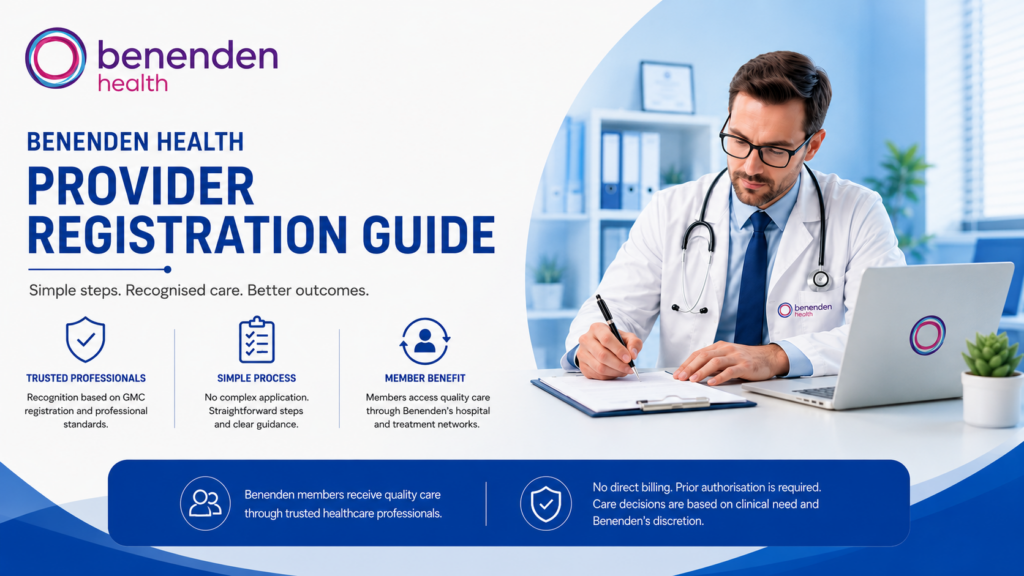
Step 1 – Confirm GMC Registration
Begin by ensuring your General Medical Council (GMC) registration is current and reflects your correct specialty. GMC registration forms the foundation of consultant recognition across all Benenden pathways and demonstrates that you meet the professional standards required for private practice in the United Kingdom. Before engaging with Benenden members, review your registration details to ensure they remain accurate and up to date. Maintaining valid GMC registration helps support treatment authorisation and demonstrates your ongoing eligibility to provide specialist care.
Step 2 – Identify the Relevant Route
Benenden supports providers through different pathways depending on where treatment will take place. Determine which route applies to your practice before proceeding, as each has its own operational requirements and credentialing arrangements.
The main routes include:
- Benenden Hospital for consultants seeking practising privileges and directory listing.
- Benenden’s wider treatment network for Surgical Treatment and Medical Diagnostics services.
Understanding the correct pathway helps you prepare the appropriate documentation and avoid unnecessary delays during the engagement process.
Step 3 – Establish Practising Privileges, If Applicable
Consultants who wish to practise at Benenden Hospital should apply directly for practising privileges through the hospital’s own credentialing process. Unlike many private medical insurers, Benenden does not operate a separate consultant recognition application for this pathway. Instead, the hospital assesses professional qualifications, clinical experience, and governance requirements before granting practising privileges. Completing the hospital’s credentialing process enables eligible consultants to appear in Benenden Hospital’s consultant directory and provide care within the hospital.
Step 4 – Understand Benenden’s Treatment Eligibility Requirements
Before treating Benenden members, familiarise yourself with the Society’s treatment eligibility requirements. Benenden reviews requests against its published criteria and approved procedure list rather than automatically authorising every treatment request. Understanding these requirements helps consultants prepare accurate documentation and manage patient expectations throughout the authorisation process.
Pay particular attention to:
- Eligible Surgical Treatment and Medical Diagnostics services.
- NHS waiting time requirements where applicable.
- Benenden’s approved procedure list and discretionary rules.
Step 5 – Ensure Accurate CCSD Coding
When providing treatment through Benenden’s wider treatment network, include the correct CCSD code in your consultant report. Benenden relies on accurate CCSD coding to assess treatment requests and determine whether the proposed procedure falls within its approved services. Incorrect or incomplete coding can delay authorisation or require additional clarification before treatment progresses. Reviewing procedure codes carefully before submitting documentation helps streamline case reviews and supports a smoother authorisation process for both providers and members.
Step 6 – Maintain Ongoing Compliance
Recognition is an ongoing responsibility rather than a one-time milestone. Continue maintaining valid GMC registration, practising privileges where applicable, relevant professional memberships, and accurate clinical documentation throughout your relationship with Benenden. Keeping your credentials current supports continued participation across Benenden’s treatment pathways and helps ensure future treatment requests progress without unnecessary administrative issues. Regularly reviewing professional records and remaining familiar with Benenden’s evolving eligibility requirements can help practices remain prepared to support eligible members effectively.
How Long Does Benenden Health e-Provider Registration Take?
Benenden doesn’t publish a standard timeframe for provider recognition, largely because there isn’t a single formal process to time. For consultants at Benenden Hospital, timing depends on the hospital’s own credentialing process for practising privileges, which sits outside Benenden Health’s central operations.
| Stage | Typical Timeframe |
|---|---|
| Practising Privileges at Benenden Hospital | Depends on the hospital’s credentialing process. |
| Medical Documents Submitted | Typically processed within five working days. |
| Surgical Treatment Review | Following receipt of the required documentation. |
| Diagnostic Request Review | Following receipt of the required documentation. |
| Ongoing Eligibility | Continuous while professional credentials remain valid. |
For the wider treatment network, there’s no separate “registration” event at all. Recognition instead depends on whether a specific request meets Benenden’s criteria, including NHS wait time, CCSD code accuracy, and the consultant’s report. Benenden states that medical documents are typically processed within five working days once submitted, which gives a practical sense of how quickly individual case reviews move, even though this isn’t the same as a provider becoming a Benenden Health e-provider in a formal sense.
How Benenden Consultant Fees are Determined
Benenden’s discretionary model shapes billing as much as it shapes recognition. Because most services aren’t provided on an insured basis, Benenden reviews each request for Surgical Treatment or Medical Diagnostics individually, checking NHS wait time, CCSD code, and diagnosis details before authorising costs.
Where treatment is approved, Benenden states it will cover costs directly with the authorised consultant and hospital, including associated fees for staff and accommodation. This mirrors the direct-settlement approach many members expect from private cover, even though Benenden itself is careful to state it isn’t a private medical insurer.
Diagnostic tests are covered up to £1,800 in value under Benenden’s Medical Diagnostics service, with members responsible for any costs above that threshold. This cap is a useful reference point for a Benenden Health e-provider assessing likely reimbursement on a diagnostic case, since it sits outside the standard percentage-based fee negotiation used by larger insurers.
Billing Rules and Payment Requirements
Billing under Benenden’s model depends on prior authorisation. Benenden states it cannot pay for services obtained before authorisation is given, with limited exceptions such as the 24/7 GP and Mental Health helplines. This makes the authorisation step, rather than a provider registration step, the real gatekeeper for payment.
Consultants and hospitals treating Benenden members should ensure the CCSD code, consultant’s report, and NHS wait confirmation are submitted accurately, since incomplete information can delay both authorisation and payment. Providers should also maintain accurate clinical records and ensure invoices reflect the treatment and fees authorised by Benenden for the specific case.
How MantraComply Can Help
Understanding that Benenden operates on a discretionary basis, rather than as a conventional insurer with a published provider portal, is the starting point for any specialist exploring this space. MantraComply supports practitioners through the practical steps involved:
- Confirming GMC registration status and specialty match are current and correctly recorded
- Clarifying whether Benenden Hospital practising privileges or the wider treatment network is the relevant route for a given practitioner
- Reviewing CCSD coding accuracy on consultant reports submitted for Surgical Treatment requests
- Helping practitioners understand Benenden’s discretionary rulebook and how it affects service availability over time
The aim is to help a specialist understand exactly which elements of becoming a Benenden Health e-provider are governed by existing GMC and hospital credentialing, and which require direct engagement with Benenden itself.
Conclusion
Becoming a Benenden Health e-provider in the United Kingdom differs from joining a traditional private medical insurer. Instead of completing a formal provider application, consultants engage with Benenden through existing professional credentials, practising privileges at Benenden Hospital, or participation in the wider treatment network. Prior authorisation, accurate CCSD coding, and compliance with Benenden’s eligibility requirements determine whether treatment can proceed and be reimbursed.
Understanding Benenden’s discretionary model helps healthcare providers navigate the process with greater confidence. By maintaining the right credentials, following Benenden’s treatment requirements, and preparing the necessary documentation, consultants can minimise administrative delays and support a smoother experience for both their practice and eligible Benenden members.
Frequently Asked Questions
No. Benenden Health does not publish a self-service provider application or recognition portal for consultants. Instead, consultants work with Benenden either by obtaining practising privileges at Benenden Hospital or by treating members through Benenden’s wider treatment network. Eligibility depends on existing professional credentials, hospital arrangements, and the requirements of individual treatment requests rather than a separate provider application.
Benenden Health operates as a discretionary mutual society rather than a conventional private medical insurer. Instead of maintaining a formal provider recognition programme, it delivers services through Benenden Hospital and an established treatment network. Treatment requests are assessed against Benenden’s eligibility criteria, approved procedure list, and supporting clinical documentation before authorisation is granted.
To access Surgical Treatment, members generally need an NHS referral wait of at least five weeks, an eligible procedure supported by the correct CCSD code, and a consultant’s report confirming the diagnosis. Benenden reviews this information before deciding whether to authorise treatment under its discretionary healthcare model.
Benenden does not publish a direct application process for consultants wishing to join its wider treatment network. Instead, participation depends on professional credentials, appropriate clinical documentation, accurate CCSD coding, and Benenden’s internal treatment arrangements. Consultants should ensure they meet these requirements before treating Benenden members.
Consultants who wish to practise at Benenden Hospital should apply directly for practising privileges through the hospital’s own credentialing process. Once approved, eligible consultants may be included in Benenden Hospital’s searchable consultant directory, allowing members to locate specialists by treatment, specialty, or location.