Simplyhealth doesn’t work the way most private medical insurers do. There’s no formal application, no fee schedule to sign, and no Healthcode profile required to become a Simplyhealth healthcare provider in the United Kingdom. Understanding why matters just as much as knowing the process itself, because assuming Simplyhealth mirrors Bupa or AXA leads a practitioner straight to the wrong paperwork, chasing forms and portals that simply don’t exist within this model.
Simply health is a health cash plan provider, not a traditional private medical insurer, and that structural difference is what shapes everything that follows. Members pay monthly premiums, then pay their dentist, optician, physiotherapist, or other practitioner directly at the point of treatment, before claiming a portion of that cost back afterward. This reimbursement model changes what “recognition” actually means for a Simplyhealth healthcare provider in the United Kingdom, and it’s the reason this guide looks different from a typical insurer recognition walkthrough.
What follows covers how Simplyhealth verifies who a member can see, which regulators matter for which treatment type, what documentation actually gets used, how Denplan’s separate dentist membership route works, how claims get paid, and where MantraComply fits in.
What Is Simply health Provider Recognition?
The starting point for understanding Simplyhealth is accepting that “recognition” here doesn’t mean what it means elsewhere. There is no central Simplyhealth provider panel that a practitioner applies to join for most benefit categories. Instead, Simplyhealth’s cover terms specify which professional register a practitioner has to appear on for a member’s claim to be valid. A member choosing a chiropodist or podiatrist, for example, only gets reimbursed if that practitioner is registered with the Health and Care Professions Council. Foot health professionals who haven’t completed HCPC registration, even if listed on the separate Professional Register for Foot Health Care, don’t qualify – Simplyhealth is explicit that this isn’t a judgement on quality, but a condition of cover.
That same pattern repeats consistently across benefit categories, which is worth noticing because it tells you what to expect before checking any specific treatment type. Optical claims require a qualified optical professional. Dental claims require treatment from a qualified dental professional in a dental surgery. Acupuncture guidance points members toward a regulated healthcare professional, referencing the British Acupuncture Council’s Accredited Register specifically. In every case, the checkpoint sits with an external, statutory or accredited regulator, not with an internal Simplyhealth recognition team a practitioner has to apply through.
Carrying that logic forward, for a Simplyhealth healthcare provider in the United Kingdom, the real prerequisite is professional registration itself, not a Simplyhealth-specific credential. A dentist keeps their General Dental Council registration current. A chiropodist keeps their HCPC registration current. There’s no separate Simplyhealth-specific credentialing step layered on top for a member’s claim to be accepted – which naturally raises the next question: given that there’s no application to join, who exactly does this apply to, and does it apply the same way to everyone?
Who Needs to Become a Simply health Healthcare Provider in the United Kingdom?
Becoming a Simplyhealth healthcare provider in the United Kingdom differs from joining a traditional private medical insurer in a way that’s worth restating plainly: for most treatment categories, there is no separate provider application or recognition process to complete at all. Instead, Simplyhealth relies entirely on the practitioner’s professional registration with the appropriate statutory or accredited body to determine whether a member’s treatment is eligible for reimbursement.
| Provider Type | Recognition Requirement |
|---|---|
| Dentists | Maintain current General Dental Council (GDC) registration. Denplan dentists must complete a separate Denplan membership application. |
| Opticians and Optical Professionals | Hold the appropriate professional qualifications and registration required for optical practice. |
| Physiotherapists, Podiatrists, Osteopaths, Chiropractors, and Other Eligible Practitioners | Maintain registration with the relevant statutory or accredited professional body required for the treatment provided (such as HCPC where applicable). |
| Denplan Member Dental Practices | Complete Denplan’s separate membership application and onboarding process. |
In practical terms, this covers a broad range of professions. Dentists, opticians, physiotherapists, podiatrists, osteopaths, chiropractors, and other eligible healthcare professionals can all treat Simplyhealth members, provided they hold the professional registration required for their specific treatment category. Members pay for treatment directly and then submit a claim to Simplyhealth using their receipt, which means the practitioner’s obligations sit almost entirely on the clinical and regulatory side, rather than on any commercial relationship with Simplyhealth itself.
There is one meaningful exception to all of this, and it’s worth flagging early since it changes the entire process for one specific group. Dental practices wishing to join Denplan must complete a separate membership application, because Denplan operates as a capitation-based dental payment plan rather than a cash plan reimbursement scheme. That distinction is significant enough that it gets its own dedicated section further down, since the process genuinely doesn’t resemble anything described above.
Documents Required for Simply health Provider Recognition
Because Simplyhealth does not operate a traditional provider recognition application for most healthcare professionals, the documentation required focuses on maintaining professional registration and issuing compliant patient records rather than completing insurer-specific paperwork. Practitioners should ensure their professional registration and practice information remain accurate and up to date before treating Simplyhealth members. Maintaining complete documentation helps members submit successful claims and allows Simplyhealth to verify practitioner eligibility where required.
- Professional registration – practitioners should maintain current registration with the appropriate statutory or accredited professional body applicable to their treatment category, since this is the single most important piece of documentation in the entire relationship
- Practice details – accurate practice information, including the practice name, address, and contact details, should be maintained to support patient records and claim verification
- Patient receipts – receipts should clearly show the patient’s name, treatment date, practitioner details, treatment provided, and the amount paid, since members use these receipts when submitting claims and any missing detail can hold up reimbursement
- Treatment records – providers should maintain accurate clinical records in accordance with their professional and regulatory obligations, since supporting information may be required if a claim is reviewed
- Denplan membership information – dental practices applying to Denplan should complete the online membership application and provide the information required during onboarding, which sits apart from everything above
With that documentation picture in mind, it’s worth walking through how these pieces actually come together in practice, since the absence of a formal application doesn’t mean there’s no process at all – just a different one.
Step-by-Step Process to Become a Simply health Healthcare Provider in the United Kingdom
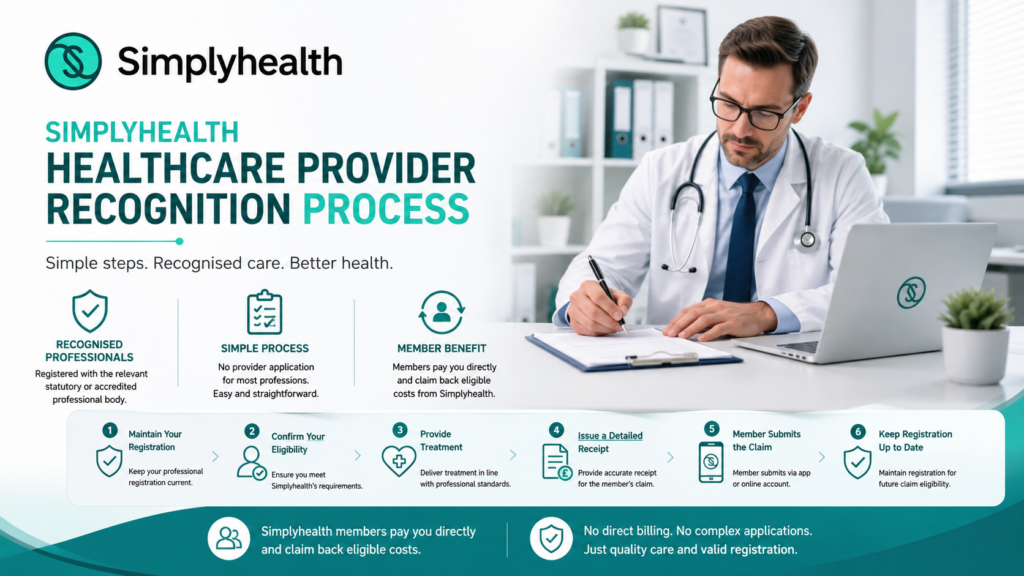
Unlike traditional private medical insurers, Simplyhealth does not require most practitioners to complete a formal recognition application. The process instead centres on maintaining the appropriate professional registration and providing members with the documentation needed to claim reimbursement, which turns what would normally be a multi-week approval process into something closer to an ongoing compliance habit.
Step 1 – Maintain your professional registration
Before treating Simplyhealth members, ensure your registration with the appropriate statutory or accredited professional body is current and in good standing. Simplyhealth relies on recognised professional registrations rather than a separate provider application, making your registration the primary requirement for member reimbursement eligibility.
Step 2 – Confirm your eligibility
Verify that your profession, qualifications, and regulatory registration meet Simplyhealth’s reimbursement requirements for the specific treatment you provide. Different benefit categories recognise different professional bodies, so confirming your eligibility in advance helps ensure members can successfully claim reimbursement for eligible services.
Step 3 – Provide treatment
Deliver treatment in accordance with your professional standards, regulatory obligations, and established clinical practices. Since Simplyhealth members pay for treatment directly before claiming reimbursement, your responsibilities remain focused on providing high-quality care and maintaining accurate clinical records rather than insurer-specific administrative procedures.
Step 4 – Issue a detailed patient receipt
Provide a clear, itemised receipt that includes the patient’s name, treatment date, practitioner details, services provided, and the amount paid. Members rely on this documentation when submitting reimbursement claims, so accurate and complete receipts help minimise delays and reduce the likelihood of claim queries.
Step 5 – Member submits the claim
After treatment, the member submits their receipt through the Simplyhealth app or online account. Simplyhealth reviews the claim against the relevant benefit rules and confirms that the treatment was provided by an appropriately registered healthcare professional before reimbursing eligible costs under the member’s plan.
Step 6 – Keep your registration up to date
Continue maintaining your professional registration, practice information, and supporting documentation throughout your career. Because Simplyhealth verifies practitioner eligibility through recognised professional bodies rather than one-time provider approval, ongoing compliance is essential to ensure members remain eligible to claim reimbursement for future treatments.
That absence of a discrete approval stage naturally leads to a question most practitioners coming from other insurers ask immediately: how long does recognition actually take?
How Long Does Simply health Recognition Take?
For most healthcare professionals, there is no formal recognition timeline because Simplyhealth does not operate a traditional provider approval process.
| Process | Simplyhealth Approach |
|---|---|
| Provider Application | Not required for most healthcare professions. |
| Professional Registration | Required with the appropriate statutory or accredited professional body. |
| Member Payment | Members pay healthcare providers directly at the time of treatment. |
| Claim Submission | Members submit their receipt through the Simplyhealth app or online account. |
| Practitioner Billing | No direct invoicing or billing to Simplyhealth. |
| Recognition Timeline | No formal provider approval or recognition stage for most practitioners. |
| Denplan | Separate membership application and onboarding process for dental practices. |
As long as the practitioner holds the appropriate professional registration required for the treatment provided, members can generally claim eligible treatment immediately after paying for it. There’s no waiting period built in, because there’s no recognition step sitting between treatment and reimbursement eligibility. The only notable exception, again, is Denplan, where dental practices complete a separate membership application before joining the network – and because that process is genuinely different, it deserves a closer look on its own terms.
Denplan Membership Process
Although Simplyhealth does not operate a traditional provider recognition process for most healthcare professionals, one important exception exists within the Simplyhealth Group. Denplan, Simplyhealth’s dental payment plan brand, operates under a different model and requires dental practices to complete a formal membership application before joining its network. Because Denplan is based on a capitation payment model rather than cash-plan reimbursement, its membership process differs significantly from Simplyhealth’s standard approach.
Becoming a Denplan member dentist starts with an online membership application form. Once that application is complete, Denplan connects the practice with a dedicated Business Development Consultant, who works through fee setting, patient communication, and practice income planning – a level of ongoing support that has no equivalent anywhere else in the Simplyhealth Group. Denplan’s network is substantial: over 6,700 member dentists across the UK, caring for more than 1.5 million patients. Some member dentists go further still and join Denplan Excel, a tier requiring an ongoing, demonstrated focus on quality improvement.
Once live, member dentists gain access to an online dashboard for patient applications, fee amendments, practice administration, monthly reporting, and Denplan’s training academy and CPD-eligible events. The platform supports Denplan’s practice membership model and is designed around ongoing capitation arrangements rather than the reimbursement claims process used by Simplyhealth’s cash plans.
How MantraComply Can Help
Knowing which Simplyhealth process applies to your practice helps avoid unnecessary administration and ensures members can claim eligible treatment without avoidable delays. MantraComply supports practices by:
- Confirming which professional register applies to a given treatment category, and that registration is current before treating any Simplyhealth member
- Setting up receipt and documentation practices that meet what Simplyhealth needs to process a member’s claim smoothly, so reimbursement isn’t delayed by a missing detail
- Guiding dental practices through the separate Denplan membership application, including the online form and the Business Development Consultant handover
- Clarifying, category by category, where a formal provider relationship exists and where it doesn’t, so practices aren’t chasing paperwork that Simplyhealth’s cash plan model doesn’t actually require
The goal throughout is making sure a practice understands exactly which Simplyhealth-related process applies to them, rather than defaulting to assumptions carried over from other insurers – a mistake that, left unchecked, tends to waste far more time than the actual requirements ever would.
Conclusion
Becoming a Simplyhealth healthcare provider in the United Kingdom is different from joining a traditional private medical insurer, and that difference runs through every section of this guide. For most healthcare professionals, there is no formal provider recognition process, no fee schedule to sign, and no direct billing relationship with Simplyhealth. The key requirement is maintaining the appropriate professional registration so members can claim eligible treatment under their cash plan. Rather than completing a one-off recognition process, providers must continue meeting the professional standards that support ongoing reimbursement.
Denplan remains the exception within the Simplyhealth Group, and it’s worth remembering exactly why: its capitation model requires an actual practice-level agreement in a way that simple reimbursement claims never do. Dental practices wishing to join the Denplan network must complete a separate membership process and work directly with Denplan before offering its payment plans. Understanding which model applies to your practice – cash plan reimbursement on one side, Denplan capitation on the other – helps avoid unnecessary paperwork and ensures Simplyhealth members can claim reimbursement without avoidable delays.
Frequently Asked Questions
No. Simplyhealth’s cover requires the practitioner to be registered with the Health and Care Professions Council, which members and practitioners can check on the HCPC’s own public register. There’s no separate Simplyhealth application involved.
They don’t invoice Simplyhealth directly. The member pays for treatment themselves, then submits a claim through the Simplyhealth app or online account, and Simplyhealth reimburses the member, typically within five working days for approved claims.
Through an online membership application form. Once submitted, Denplan connects the practice with a dedicated Business Development Consultant to work through fee setting and patient transition.
Through an online membership application form. Once submitted, Denplan connects the practice with a dedicated Business Development Consultant to work through fee setting and patient transition.
No. Simplyhealth is explicit that treatment must come from a practitioner registered with the relevant statutory or accredited body for that treatment type – an HCPC-registered chiropodist, for instance, not simply a foot health professional without that registration – for a member’s claim to be valid.