Starting a CAQH profile is easier when you have the right information ready. Without preparation, you may need to stop midway to find an old license, confirm an employment date, or locate an insurance document.
A clear CAQH profile checklist can help you prepare before you log in. It gives you a practical way to organize your professional information and identify documents that may be needed during the application.
The same applies to CAQH documents required for your profile. The exact documents can vary based on your provider type, circumstances, and the requirements shown in your CAQH account. CAQH’s Provider Data Portal allows providers to maintain professional and practice information and upload supporting documentation.
This guide explains what to gather before starting your profile. It also covers employment history, licenses, education, practice information, insurance, supporting documents, common mistakes, and final checks.
2026 note: CAQH requirements can change. Always use the requirements displayed in your current CAQH Provider Data Portal and follow any additional instructions from the payer or organization requesting your credentialing information.
Why Should You Prepare Before Starting CAQH?
A CAQH profile contains more than basic contact information.
Depending on your provider type and circumstances, you may need information about your NPI, licenses, certifications, education, training, employment, practice locations, hospital affiliations, and professional liability insurance.
That is why preparation matters.
A CAQH profile checklist gives you a starting point before you begin entering information. It can also help you compare your current records with the information already in your professional files.
The process can be especially time-consuming when you have a long employment history or multiple practice locations.
Preparing your records first can reduce interruptions. It can also help prevent simple inconsistencies between your profile and supporting documents.
For example, CAQH guidance indicates that professional liability insurance information should match the supporting document. If the information does not match, the document may be rejected.
The goal is simple: gather your information, verify it, then complete your profile.
CAQH Profile Checklist: What to Have Ready
Before you start, gather the information that applies to your professional situation.
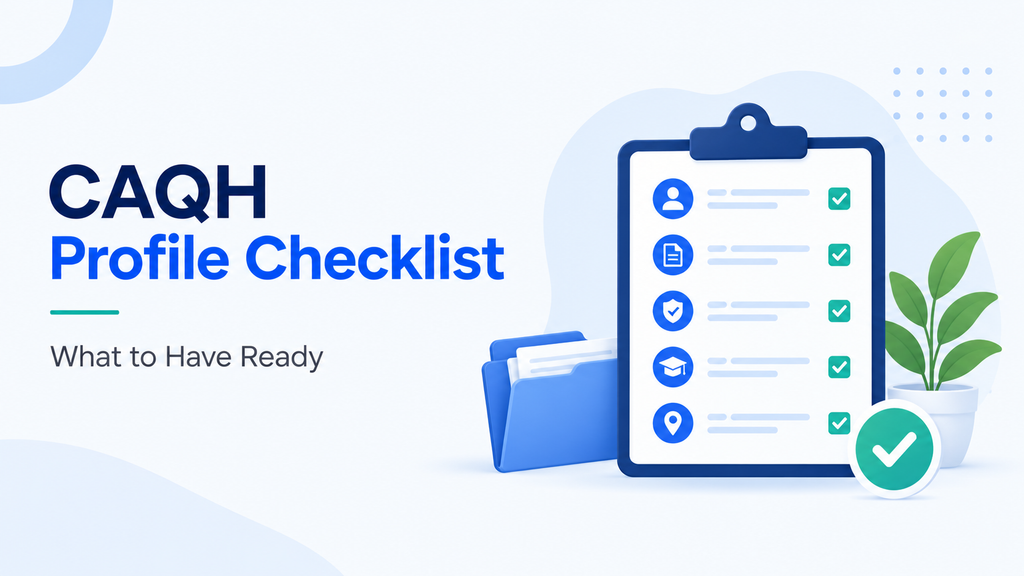
Your CAQH profile checklist should generally include:
- Personal and contact information
- Individual or Type 1 NPI
- Current professional licenses
- Certifications and board certifications, where applicable
- Education and training information
- Employment history
- Practice location details
- Hospital affiliations, where applicable
- Professional liability insurance information
- DEA registration, where applicable
- Other applicable credentials
- Required supporting documents
- Authorization and release requirements
- Information requested by the payer or credentialing organization
Not every provider will need every item.
The CAQH documents required for your profile are determined by your specific circumstances and the requirements displayed in the portal. CAQH’s provider guidance explains that supporting documents are managed through the Documents section of the Provider Data Portal.
So, use a general checklist for preparation, but use your actual CAQH account to confirm what you must submit.
1. Personal and Contact Information
Start with your basic information.
Make sure your name and contact details are accurate and current. Review any information that may already be populated in your profile.
Pay particular attention to your email address.
Your email address should be one that you check regularly. CAQH uses account communications to notify providers about profile activity and re-attestation requirements.
Before starting, check:
- Legal name
- Email address
- Phone number
- Mailing information
- Other personal details requested by the portal
Do not assume that pre-populated information is automatically correct.
Review it carefully.
Your contact information should also be consistent with your other professional records.
2. Individual or Type 1 NPI
Your individual or Type 1 NPI is another important item to have ready.
Keep your NPI information available before you begin your profile.
Check that your professional information is consistent across your NPI records, CAQH profile, and other credentialing applications.
Your NPI does not replace the other information required for credentialing.
It is simply one of the core identifiers used during provider enrollment and credentialing workflows.
Adding your NPI to your CAQH profile checklist before you start can help you avoid searching for it during the application.
3. Professional Licenses
Current professional licenses are among the most important credentials to review.
For each applicable license, gather the information shown on the official record.
Check the:
- License number
- Issuing state
- License type
- Effective date
- Expiration date
Make sure the license is current.
If you recently renewed a license, use the updated information.
You should also keep the supporting license document available if it is required in your profile.
Expired license information can create additional work during attestation. CAQH guidance states that if a state license or professional liability insurance has expired, providers may be required to update the relevant information before completing re-attestation.
This makes license verification an important part of your CAQH profile checklist.
4. Certifications and Board Credentials
If you hold professional certifications or board credentials, gather those records as well.
Check the credential name, issuing organization, certificate number if applicable, and expiration date.
Do not assume that every provider needs the same certifications.
The CAQH documents required will depend on the provider profile and applicable requirements.
If a certification is listed in your profile, make sure the information is accurate.
It is also useful to compare your certifications with your current CV. This can help identify credentials that may have been renewed or changed since your last credentialing application.
5. Education and Training Information
Your education and training history should be prepared before you begin.
Depending on your profession, this may include professional school, residency, fellowship, postgraduate training, or other applicable programs.
Use official records when checking dates and institution names.
Avoid guessing.
Small differences in dates can create questions when information is later verified.
Your education history should also align with your CV and other credentialing applications.
When reviewing CAQH documents required, check whether your individual profile or the organization requesting credentialing requires supporting education or training documents.
Do not assume that every provider needs to upload every education record.
Use your specific portal requirements.
6. Employment History
Employment history can take the most time to prepare.
CAQH’s current provider guidance identifies relevant employment history for the previous 10 years. It also notes that some organizations may require a longer history, including a full work history beginning with the professional degree, and may require information about gaps.
Review your CV and previous employment records before entering this information.
Check employer names, job titles, start dates, end dates, and other requested details.
Pay special attention to gaps.
Do not change dates to make your history appear continuous.
If a payer or credentialing organization requires an explanation for a gap, provide an accurate explanation based on your records.
Your employment history is an important part of any CAQH profile checklist because reconstructing it while completing the application can slow you down.
7. Practice Location Information
Prepare information for each current practice location.
This may include the practice name, address, phone number, and other information requested by the portal.
If you work at multiple locations, gather information for each one.
Review the information carefully if you recently changed practices.
An outdated address should not remain listed as a current location when it no longer applies.
Practice information can also be relevant to payer enrollment.
A health plan may have additional requirements for a specific practice location, even when the provider’s CAQH profile is complete.
Therefore, your CAQH profile checklist should include every current location rather than only your primary office.
8. Hospital Affiliations and Privileges
If you have hospital affiliations or privileges, prepare those details before starting.
You may need the hospital name, affiliation information, privilege status, and other details depending on your provider type.
Review each affiliation carefully.
If you no longer have an active affiliation, make sure the information in your profile reflects your current status.
The CAQH documents required for hospital affiliations can vary. Your specific portal requirements and payer instructions should determine what you need to provide.
Keeping this information ready can make the profile completion process smoother.
9. Professional Liability Insurance
Professional liability insurance is another important part of your preparation.
Have your current insurance certificate available before entering the information.
Check the:
- Insurance carrier
- Policy number
- Effective date
- Expiration date
- Coverage information
The information entered in CAQH should match the supporting insurance documentation.
CAQH guidance specifically addresses matching professional liability insurance information with the supporting document.
Do not copy information from an old policy.
Use the current document.
Also check the expiration date before uploading it.
If your policy has been renewed, make sure the profile and supporting documentation reflect the current policy.
10. DEA Registration, When Applicable
Some healthcare professionals may need DEA registration information.
This depends on the provider’s profession and circumstances.
If DEA registration applies to you, have your current registration information available.
Check the registration number and expiration date.
Also check whether your payer or credentialing organization has additional DEA documentation requirements.
Do not assume that every provider needs DEA information.
Instead, follow the requirements that apply to your profession and profile.
This is an important distinction when reviewing CAQH documents required because there is no single document list that applies to every provider.
11. Curriculum Vitae and Professional Records
Keep your current CV or resume nearby.
A CV can help you verify your education, training, employment history, practice locations, and professional roles.
It can also help you identify gaps before you begin.
However, your CV is not automatically a substitute for a specific supporting document.
If CAQH or a payer asks for a particular credential or document, provide the requested document according to the applicable instructions.
Use your CV as a reference tool.
It can help you maintain consistency across CAQH and other credentialing applications.
12. Authorization, Attestation, and Release Requirements
Authorization and attestation are important parts of the CAQH process.
CAQH’s provider guidance explains that providers must review their profile and complete the applicable attestation process. The portal also includes an Authorize section for managing access to provider information.
The current CAQH guidance also states that a signed release form is required when a provider initially completes the profile and attestation. State-specific requirements can affect which form is displayed.
Do not leave these requirements until the last minute.
Check your account to determine which authorization and release documents apply.
Include them in your CAQH profile checklist so you can confirm that they have been completed before considering your profile finished.
13. Review the Documents Section
The Documents section is one of the most important areas to check.
CAQH identifies supporting documents needed for your profile through the Provider Data Portal.
The documents required can vary based on your provider type and circumstances.
This means there is no universal list of CAQH documents required for every provider.
Instead, review your own Documents section.
Look for:
- Missing documents
- Expired documents
- Documents requiring updates
- Rejected documents
- Documents that do not match profile information
If a document is rejected, review the reason provided by the portal and correct the issue.
For a first attestation, CAQH guidance states that required documents must be submitted before participating organizations can receive the provider’s information.
This makes document review an essential part of your CAQH profile checklist.
How to Organize Your CAQH Documents
Organization matters.
Create a secure location for your current credentialing documents.
Keep current and expired documents separate.
Use clear file names so you can quickly identify the correct document.
For example, you can include the provider name, credential type, and expiration date in the file name.
Review your files before uploading them.
Make sure you are using the latest version.
The CAQH documents required can change when a license, insurance policy, certification, or other credential expires.
A well-organized document system makes updates easier.
It can also help when you complete recredentialing or apply to another payer.
Common Mistakes to Avoid
Even with good preparation, providers can make simple mistakes.
Using Expired Documents
Check every expiration date before uploading a credential.
An expired license or insurance document may need to be replaced before you can complete the applicable CAQH process.
Entering Information From Memory
Use official records whenever possible.
Dates, policy numbers, license numbers, and employment information are easy to enter incorrectly.
Uploading Mismatched Documents
Your profile information and supporting documents should be consistent.
This is especially important for professional liability insurance.
Forgetting Employment Gaps
Review your full employment history.
Some organizations may require additional information about gaps.
Assuming Every Provider Needs the Same Documents
The CAQH documents required vary.
Do not rely only on a generic checklist.
Review the requirements in your individual CAQH account.
Forgetting to Re-Attest
Completing your profile does not mean you can forget about it.
CAQH requires re-attestation every 120 days for most providers. Illinois providers have a 180-day re-attestation period.
CAQH Profile Checklist: Final Review
Before you consider your profile ready, review each area carefully.
Your final CAQH profile checklist should include:
- Personal and contact information
- Individual or Type 1 NPI
- Current professional licenses
- Certifications, where applicable
- Education and training
- Employment history
- Practice locations
- Hospital affiliations, where applicable
- Professional liability insurance
- DEA registration, where applicable
- Current CV or professional records
- Required supporting documents
- Authorization and release requirements
- Profile review
- Attestation
- Payer-specific requirements
- Next re-attestation date
Take a final look at dates and expiration information.
Make sure your documents match the information in your profile.
Then complete the applicable attestation steps.
How MantraComply Can Help With CAQH Management
Preparing your CAQH information is only one part of provider credentialing.
For organizations managing multiple providers, keeping profiles, documents, applications, and deadlines up to date can become an ongoing administrative task.
MantraComply provides credentialing and enrollment services, including CAQH profile management, application management, document preparation, submission tracking, and recredentialing support. Its platform also includes CAQH management and recredentialing tracking.
MantraComply can help organizations centralize provider information and documentation while giving teams visibility into credentialing tasks and deadlines.
Its platform also supports real-time status updates, expiration tracking, provider portals, and CAQH integration.
This can be useful for practices and organizations managing multiple providers.
Instead of treating your CAQH profile checklist as a one-time task, a centralized workflow can help your team manage CAQH alongside broader credentialing and payer enrollment activities.
Final Thoughts
A successful CAQH application starts with preparation.
Gather your professional information before you begin. Review your licenses, certifications, education, training, employment history, practice locations, affiliations, and insurance information.
Then review the CAQH documents required for your specific profile.
The most effective approach is to prepare first and complete the profile second.
Use a CAQH profile checklist to keep track of your information. Check every expiration date. Make sure your supporting documents match the information you enter.
Most importantly, remember that CAQH is an ongoing responsibility. Most providers must re-attest every 120 days, and profile information should be updated when relevant professional details change.
For organizations managing several providers, this maintenance can become difficult to handle manually. MantraComply can help centralize CAQH management, documentation, credentialing tasks, and payer enrollment workflows.
The goal is not simply to complete a profile.
It is to maintain accurate, current, and verifiable provider information throughout the credentialing lifecycle.
Use this CAQH profile checklist before you begin, and always confirm the CAQH documents required through your current CAQH account and the organization requesting credentialing.
Frequently Asked Questions
The CAQH documents required vary by provider profile and applicable requirements, so providers should review the Documents section of their CAQH account rather than rely only on a generic list.
No. Requirements can vary based on provider type, state, and other circumstances.
Most providers must re-attest every 120 days, while Illinois providers have a 180-day re-attestation period under CAQH guidance.
No. CAQH is part of the credentialing process, but individual health plans and organizations can have additional credentialing and enrollment requirements.
Yes. MantraComply offers CAQH management as part of its credentialing and enrollment services and provides tools for recredentialing tracking and ongoing provider management.