Healthcare providers and practice administrators often use the terms CAQH, insurance credentialing, and provider enrollment interchangeably. While these processes are closely connected, they serve different purposes.
A CAQH profile helps centralize and maintain provider information. Credentialing involves reviewing and verifying a provider’s qualifications. Provider enrollment involves completing the payer- or program-specific administrative requirements needed to establish a provider with an insurance payer or healthcare program.
Understanding CAQH vs credentialing is important because completing one process does not automatically complete the others. A provider may have an accurate CAQH profile while credentialing is still under review or while payer enrollment requirements remain incomplete.
This guide explains how CAQH, credentialing, and provider enrollment differ, where they overlap, and how healthcare practices can manage them as connected but separate workflows.
Understanding CAQH, Credentialing, and Provider Enrollment
The easiest way to understand CAQH vs credentialing is to assign each process a clear role.
CAQH primarily helps maintain centralized provider information. Credentialing focuses on reviewing and verifying professional qualifications. Provider enrollment focuses on completing the payer- or program-specific administrative requirements associated with establishing a provider’s enrollment and, where applicable, billing relationship.
Although these workflows often use similar information, including licenses, education, training, certifications, practice locations, and supporting documents, they should not be treated as identical processes.
The CAQH Provider Data Portal provides a centralized platform for maintaining provider information and sharing it with authorized organizations for uses including credentialing and other provider-data workflows. However, maintaining a CAQH profile does not itself represent a final credentialing decision or payer enrollment approval.
The simplest distinction is this: CAQH organizes provider information, credentialing verifies qualifications, and provider enrollment addresses payer- or program-specific administrative requirements.
What Is CAQH?
CAQH provides a centralized system for maintaining professional and practice-related provider information.
Depending on the provider’s circumstances, the profile may include:
- Professional identification details
- State licenses
- Education and training history
- Employment history
- Practice locations
- Board certifications
- Professional liability information
- Supporting documentation
The primary advantage of CAQH is that providers can maintain important information centrally rather than repeatedly entering the same professional details during multiple administrative workflows.
However, CAQH does not replace credentialing or provider enrollment.
A payer or credentialing organization may still need to review and verify the provider’s qualifications according to its own requirements. Likewise, a payer may require separate applications, agreements, or administrative information before enrollment requirements are complete.
What Is Insurance Credentialing?
Insurance credentialing is the process through which a healthcare organization or payer reviews and verifies a provider’s qualifications.
Requirements can vary depending on the payer, provider type, specialty, and applicable policies. The process commonly involves reviewing information related to professional qualifications, licenses, education, training, certifications, and other professional records.
The purpose is to determine whether the provider meets the applicable requirements for participation.
A CAQH profile may provide organized information that supports this process, but credentialing remains a separate review activity.
For example, a provider may have an updated CAQH profile containing current licenses and employment information. A payer may still need to conduct its own verification and review before making a credentialing decision.
This is the most important point in the CAQH vs credentialing comparison: an updated provider profile can support credentialing, but it does not replace the credentialing review itself.
What Is Provider Enrollment?
Provider enrollment is a separate but closely related process.
While credentialing focuses on reviewing a provider’s qualifications, provider enrollment generally focuses on completing the administrative requirements needed to establish the provider with an insurance payer or healthcare program.
The exact process varies by payer and program.
Depending on the situation, provider enrollment may involve submitting payer-specific information, identifying practice locations, establishing billing relationships where applicable, completing participation requirements, and providing additional supporting documentation.
For Medicare, provider enrollment is a distinct CMS-administered process. CMS states that providers and suppliers can use PECOS to submit and manage enrollment information, update records, upload supporting documentation, and complete other enrollment-related activities.
This distinction matters because a provider may complete qualification-related credentialing requirements while still having additional payer- or program-specific enrollment activities pending.
CAQH vs Credentialing vs Provider Enrollment
| Process | CAQH | Insurance Credentialing | Provider Enrollment |
|---|---|---|---|
| Primary purpose | Centralizes and maintains provider information | Reviews and verifies provider qualifications | Completes payer- or program-specific administrative requirements |
| Main focus | Provider data and documentation | Professional qualifications and verification | Administrative, payer, and participation requirements |
| Information involved | Licenses, education, employment locations, and documents | Qualifications, licenses, training, and professional records | Payer-specific details, billing, and participation information |
| Does it mean the provider is approved by a payer? | No | Not necessarily | Subject to the payer or program’s requirements and approval |
| Is it a one-time task? | No, information requires maintenance | Often includes ongoing credentialing or recredentialing requirements | Updates or revalidation may be required when provider or practice information changes |
| Relationship to other processes | Supports provider information management | Evaluates provider qualifications | Addresses payer- or program-specific administrative requirements |
The table highlights the core difference without treating the three processes as interchangeable.
Why CAQH and Credentialing Are Often Confused
The confusion around CAQH vs credentialing exists because many of the same documents and professional details appear in both workflows.
Providers may enter license information, education history, employment details, and practice locations into their CAQH profile. Credentialing organizations may then need to review many of these same details during their verification process.
Because the information overlaps, some providers assume that completing a CAQH profile completes credentialing.
It does not.
CAQH helps organize provider information, while credentialing involves the review and verification of that information according to the requirements of the relevant organization.
The same principle applies to provider enrollment. A payer may rely on existing provider information while still requiring payer-specific applications and administrative steps.
Instead of using one general “completed” status, practices should track CAQH, credentialing, and enrollment milestones separately.
Where CAQH Fits Into the Credentialing Process
CAQH is best understood as a centralized source of provider information that can support credentialing workflows.
A typical process may involve:
- The provider updates professional and practice information.
- Current documents are maintained.
- Relevant organizations receive authorized access to provider information.
- A payer or credentialing organization reviews the provider’s qualifications.
- Additional information or clarification may be requested.
- Credentialing requirements are addressed.
- Separate provider enrollment requirements are completed where applicable.
The exact sequence may vary by payer and organization. In some cases, credentialing and enrollment activities may overlap.
The official CAQH Provider Data Portal User Guide explains that providers use the portal to enter and maintain profile information, authorize participating organizations, attest to their data, and maintain the profile through re-attestation.
This is why CAQH should be treated as part of a broader provider-administration workflow rather than a standalone completion milestone.
Where Provider Enrollment Fits In
Provider enrollment becomes important when a healthcare provider needs to establish enrollment with a specific insurance payer or healthcare program.
Unlike CAQH, which centralizes provider information, enrollment requirements are generally payer- or program-specific.
A practice working with several insurance companies may therefore need to manage separate enrollment activities for multiple payers.
Common challenges include:
- Different payer requirements
- Practice-information consistency
- Expiring documents
- Application follow-ups
- Provider or practice changes
- Different enrollment timelines
A provider may therefore have several different statuses simultaneously:
- CAQH profile updated
- Credentialing under review
- Provider enrollment pending
Separating these milestones makes it easier for practices to identify exactly where delays or outstanding requirements exist.
For organizations managing multiple payer applications, Credentialing & Enrollment offers a dedicated workflow for collecting provider information and managing credentialing and enrollment requirements.
A Practical Example: How the Three Processes Work Together
Consider a physician joining a new medical practice.
The physician first needs to ensure that professional information is current. This may include licenses, employment details, practice locations, professional liability information, and supporting records.
The CAQH profile may then need to be updated to reflect the physician’s current circumstances.
The practice may begin credentialing activities with relevant insurance payers. During this stage, the payer or credentialing organization reviews and verifies the provider’s qualifications according to applicable requirements.
Separate provider enrollment activities may also be required to establish the physician appropriately with the payer or program.
If the physician later changes locations or employment arrangements, the practice may need to update information across multiple workflows.
This example demonstrates why CAQH, credentialing, and enrollment should be coordinated together but never treated as the same administrative step.
What Information Overlaps Across These Processes?
Several types of provider information may appear across CAQH, credentialing, and provider enrollment workflows.
Common examples include:
- Provider identification details
- NPI information
- Professional licenses
- Education and training
- Board certifications
- Employment history
- Practice locations
- Professional liability coverage
- Supporting documentation
The overlap makes consistency extremely important.
For example, differences between employment information in a CAQH profile and a payer application may require clarification. Similarly, outdated practice information or expired documentation can create additional follow-up.
Maintaining organized and current provider records reduces the risk of inconsistencies appearing across multiple administrative workflows.
How Practices Can Manage These Workflows More Efficiently
Managing CAQH, credentialing, and provider enrollment manually can become increasingly complex as a healthcare practice grows.
A multi-provider organization may need to monitor licenses, documents, payer applications, credentialing deadlines, enrollment statuses, and renewal requirements simultaneously.
A structured workflow should clearly identify:
- Whether provider information is current
- Whether the CAQH profile requires updates
- Which credentialing applications are under review
- Which payer applications are pending
- Whether provider enrollment has been completed
- Which documents are approaching expiration
- When renewal activity is required
This visibility is particularly important because credentialing work often competes with other administrative responsibilities.
Healthcare teams may also be managing appointment scheduling, patient calls, reminders, follow-ups, and routine front-office communication. Reducing repetitive work in these areas can help staff focus on complex responsibilities that require greater attention.
For example, healthcare automation trends and workflow strategies explore how AI and automation can reduce repetitive administrative work across healthcare operations.
The objective is not to combine every healthcare task into one system. It is to reduce unnecessary manual work while maintaining clear ownership of provider-related deadlines and requirements.
When Do You Need CAQH, Credentialing, or Provider Enrollment?
The answer depends on what the provider or practice is trying to accomplish.
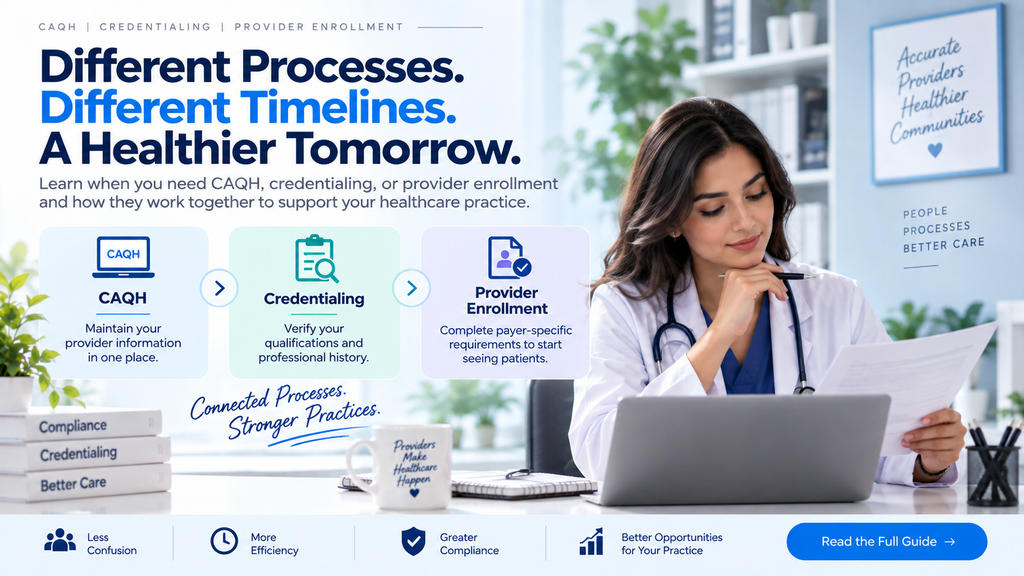
You may need CAQH when:
You need to maintain centralized professional and practice information and keep provider records current.
You may need credentialing when:
A healthcare organization or payer requires the provider’s qualifications and professional history to be reviewed and verified.
You may need provider enrollment when:
A provider needs to establish participation with a specific insurance payer or healthcare program.
You may need all three when:
A provider is joining a new practice, expanding into additional payer networks, or completing an insurance participation process requiring current provider information, qualification review, and payer-specific administrative setup.
For organizations managing these workflows together, MantraComply’s credentialing and insurance enrollment solutions combine provider information management, credentialing support, application workflows, and payer enrollment services.
CAQH vs Credentialing: The Key Takeaway
Understanding CAQH vs credentialing is important because each process represents a different stage of provider administration. CAQH helps maintain centralized provider information, credentialing involves reviewing and verifying professional qualifications, and provider enrollment focuses on completing the payer-specific requirements needed to establish a provider with an insurance payer or healthcare program.
For healthcare practices, the most important step is to avoid treating these processes as a single completion milestone. An updated CAQH profile does not necessarily mean credentialing is complete, and completed credentialing does not always mean provider enrollment requirements have been finalized.
Instead, practices should track each workflow separately while keeping provider information consistent across all three. Monitoring profile updates, credentialing progress, payer applications, supporting documents, and enrollment status can make it easier to identify outstanding requirements before they create avoidable delays.
In simple terms: maintain the information in CAQH, track the credentialing review, and monitor payer-specific enrollment requirements separately. When practices clearly distinguish these three workflows, provider administration becomes easier to manage, and progress is easier to track.
Frequently Asked Questions
No. CAQH is primarily used to maintain centralized provider information, while credentialing involves reviewing and verifying a provider’s qualifications. An updated CAQH profile can support credentialing but does not replace the credentialing process.
No. Completing or updating a CAQH profile does not automatically mean that a healthcare payer or organization has completed its credentialing review.
Requirements vary by payer and provider situation. A current CAQH profile may support certain workflows, but providers should always confirm the specific requirements of the payer or organization involved.