
Obstetricians Credentialing is the process of verifying an OB/GYN’s professional qualifications and establishing participation with health insurance plans.
For obstetricians joining a medical group, opening a private practice, or expanding into new insurance networks, payer enrollment involves more than submitting a single application. The process can include NPI verification, CAQH, medical license verification, credentialing, contracting, group affiliation, Medicare or Medicaid enrollment, and confirmation of the effective date.
A structured OB/GYN credentialing process helps practices keep provider information consistent, manage payer requirements, and reduce avoidable delays that can affect network participation and billing.
What Is OB/GYN Credentialing?
OB/GYN credentialing is the process through which a health plan evaluates and verifies an obstetrician’s professional qualifications before establishing network participation.
Depending on the payer, the review may include medical licensure, education, residency training, board certification, work history, malpractice insurance, NPI information, practice locations, specialty, and professional disclosures.
Credentialing should not be confused with contracting or payer enrollment. A physician may complete credentialing but still need to finalize a contract, establish group affiliation, complete enrollment, or receive a confirmed effective date before the payer relationship is fully active.
For practices managing several physicians, provider credentialing services can help organize these requirements across multiple providers and payers.
Why Is Obstetrician Credentialing Important?
Insurance participation can directly affect patient access to OB/GYN services. Patients often use health plan directories to identify in-network physicians, while practices depend on payer relationships to serve insured populations.
Credentialing also creates a verified connection between the physician and the payer. Accurate credentialing records can support appropriate provider directories, billing arrangements, group affiliations, and payer enrollment.
For obstetricians, keeping information current is particularly important because practice locations, hospital affiliations, licenses, malpractice coverage, and employment arrangements may change over time.
Credentialing should therefore be treated as an ongoing process rather than a one-time application.
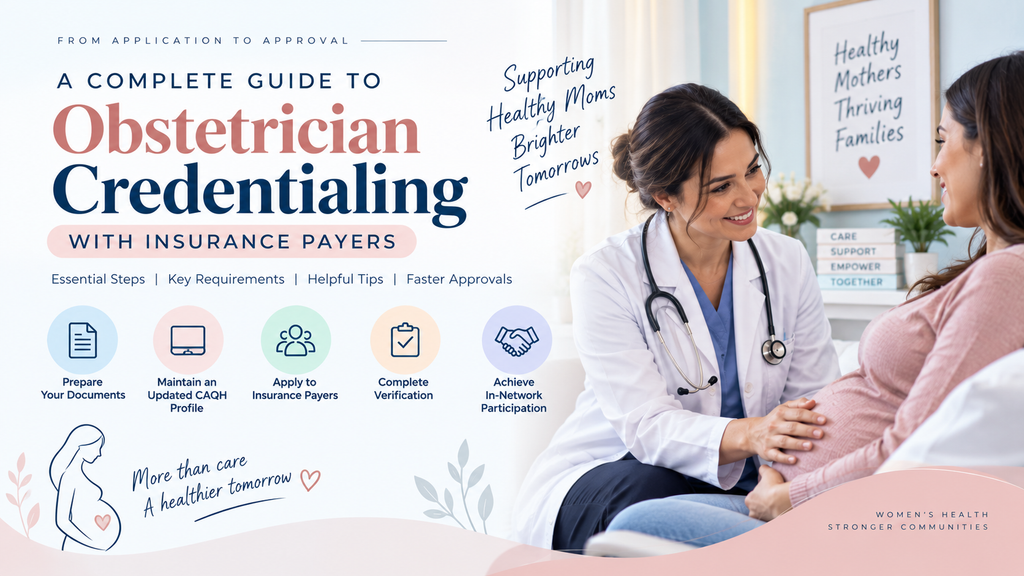
How to Get an Obstetrician Credentialed With Insurance Payers
The most effective approach is to prepare the provider’s information first, identify the appropriate payer requirements, and then track each application through credentialing, contracting, enrollment, and approval.
Step 1: Identify Target Insurance Payers
Before starting applications, determine which health plans are relevant to the OB/GYN practice.
Consider the practice’s patient population, local insurance market, commercial payer participation, Medicare and Medicaid requirements, geographic coverage, reimbursement considerations, and whether the physician is joining an existing group.
Not every practice needs to join every available network. Prioritizing the most relevant payers can make the credentialing process more manageable.
A structured payer enrollment workflow can help practices organize payer-specific requirements before applications are submitted.
Step 2: Verify the Obstetrician’s Credentials
The provider file should be reviewed before submitting payer applications. The physician’s medical license, specialty, education, residency, board certification, malpractice coverage, and other applicable credentials should be current.
The American Board of Obstetrics and Gynecology (ABOG) provides certification pathways for physicians in obstetrics and gynecology, making board certification information an important part of the physician’s professional record. (abog.org)
The same professional information should appear consistently across the physician’s CV, CAQH profile, payer applications, NPI records, and supporting documentation.
Step 3: Verify NPI and Provider Information
An individual OB/GYN should have the appropriate Type 1 NPI. The NPI should be consistent across payer applications and enrollment records.
Taxonomy information should also accurately reflect the physician’s provider classification and specialty. CMS identifies taxonomy as part of the information used in the NPI process.
If the obstetrician works within a group practice, the individual provider and organization may have separate NPIs and tax identification information. The relationship between the physician, group, locations, and billing entity should therefore be documented correctly.
Step 4: Complete and Maintain CAQH
CAQH is an important component of many commercial payer credentialing workflows. The CAQH Provider Data Portal allows physicians to maintain professional and practice information and share it with participating health plans for credentialing, directory updates, enrollment, and related activities.
Before authorizing payer access, review the OB/GYN’s CAQH profile carefully. Information such as licenses, education, training, work history, practice locations, liability insurance, specialty, and supporting documents should be current.
CAQH should also be updated when information changes. An outdated practice address or expired document can create discrepancies when a payer compares the CAQH profile with a credentialing application.
Practices can use a complete CAQH profile process to keep provider information organized before submitting applications.
Step 5: Prepare the OB/GYN Credentialing File
A centralized provider file gives the credentialing team one reliable source of information.
For an obstetrician, the file should generally contain:
- Current CV and work history
- Medical license
- Education and residency information
- Board certification, when applicable
- Individual NPI
- CAQH information
- Professional liability insurance
- Practice addresses
- Hospital affiliations, when required
- Professional disclosures
- Group and payer affiliations
Work history should receive particular attention. Missing dates or unexplained gaps may lead to payer questions and additional documentation requests.
The goal is to ensure that the information submitted to each payer is accurate and consistent rather than rebuilding the physician’s credentialing file for every application.
Step 6: Submit Payer Applications
Once the provider file is complete, submit the application according to the payer’s requirements.
Commercial health plans may require credentialing applications, CAQH authorization, license information, liability coverage, NPI information, tax details, practice information, and contracting documents.
Each payer should be treated separately. Completing an application for one health plan does not automatically satisfy another payer’s requirements.
After submission, record the application date, confirmation number, outstanding documentation, payer contact information, and current status.
Step 7: Complete Contracting and Group Affiliation
Credentialing approval does not always mean the physician is fully active with the intended group.
An obstetrician joining an established practice may need to be linked to the group’s NPI, tax ID, legal entity, practice locations, and payer contract.
If the physician was previously credentialed under another organization, the previous payer relationship should not automatically be assumed to transfer.
For practices managing multiple physicians, provider group credentialing can help maintain accurate group and provider relationships.
Step 8: Complete Medicare and Medicaid Enrollment
Medicare should be handled as a separate enrollment workflow rather than treated as an automatic result of commercial credentialing.
CMS directs physicians through Medicare enrollment using PECOS and identifies the CMS-855I as the enrollment application for physicians and non-physician practitioners. Medicare enrollment information must also be kept current.
Medicaid requirements vary by state. An OB/GYN practicing across multiple states may therefore need separate state Medicaid enrollment and managed-care participation.
Medicare, Medicaid, and commercial payer applications should be tracked separately because each may have different enrollment requirements and effective dates.
For practices managing Medicare requirements, Medicare provider credentialing and enrollment can help distinguish Medicare enrollment from commercial payer credentialing.
Track Every OB/GYN Credentialing Application
A centralized tracker helps the practice identify which applications are pending, what documentation remains outstanding, and when follow-up is required.
| Track | What to Record |
|---|---|
| Provider | Obstetrician name and specialty |
| Payer | Insurance company or specific plan |
| Application Type | Credentialing, enrollment, contracting, or recredentialing |
| Submission Date | Date the application was submitted |
| Reference Number | Payer confirmation or tracking number |
| Documents | Submitted and outstanding documents |
| Status | Submitted, pending, returned, approved, or denied |
| Follow-Up | Last contact and next follow-up date |
| Contract | Contract status and signature date |
| Effective Date | Confirmed network participation date |
The application should remain on the tracker until the practice confirms the physician’s participation status and effective date.
OB/GYN Credentialing Checklist
Payer requirements vary, so this checklist represents the core information an OB/GYN practice should have prepared.
| Checklist Item | Why It Matters |
|---|---|
| Active Medical License | Confirms the obstetrician is authorized to practice. |
| Individual NPI | Identifies the physician in healthcare and payer transactions. |
| Board Certification | Supports verification of professional qualifications when applicable. |
| CAQH Profile | Provides standardized provider information to participating health plans. |
| Current CV/Work History | Supports verification of education, training, and professional experience. |
| Professional Liability Insurance | Provides evidence of current malpractice coverage. |
| Hospital Affiliations | Supports credential verification when required by the payer. |
| W-9 and Tax ID Information | Connects the physician with the appropriate billing entity. |
| Practice & Group Information | Establishes the correct organization and practice locations. |
| Payer Application | Starts the credentialing or enrollment process with the selected plan. |
| Effective Date Confirmation | Establishes when payer participation becomes active. |
How Long Does OB/GYN Credentialing Take?
The time required for obstetrician credentialing varies by payer, application completeness, verification requirements, contracting, and enrollment arrangements.
Delays can occur when provider information is inconsistent, CAQH is outdated, documents expire, work history is incomplete, or the payer requests additional information.
Starting the process early and tracking every application can help practices identify outstanding requirements before they become major delays.
Common OB/GYN Credentialing Mistakes
Avoiding common mistakes can help practices reduce payer follow-up and keep provider records accurate.
1. Inconsistent Provider Information – Different names, addresses, NPI information, or specialty details can trigger additional verification.
2. Incomplete Work History – Missing employment dates or unexplained gaps may result in payer questions.
3. Outdated CAQH – Old practice locations, licenses, liability coverage, or other provider information can create discrepancies.
4. Expired Credentials – Expired medical licenses, board certification, or malpractice coverage can delay an application.
5. Incorrect Group Affiliation – An OB/GYN may be credentialed individually but not correctly connected to the intended group or tax ID.
6. Confusing Credentialing With Enrollment – Credentialing approval does not necessarily mean contracting, enrollment, or billing setup is complete.
7. Missing Payer Follow-Up – Overlooking requests for additional information can leave an application pending.
8. Not Confirming the Effective Date – Payer approval should not automatically be treated as the date network participation begins.
What Happens After OB/GYN Credentialing Approval?
Once the payer approves the obstetrician, the practice should verify the network status, contract, group affiliation, effective date, practice location, and billing setup.
Provider directory information should also be reviewed. The physician’s name, specialty, location, telephone number, and group affiliation should appear accurately wherever the payer publishes provider information.
CAQH identifies directory updates as one of the uses of its Provider Data Portal, making accurate provider information important beyond the initial credentialing process.
The effective date should be documented carefully. If the payer has not clearly communicated when participation becomes active, the practice should confirm the date directly.
OB/GYN Recredentialing and Ongoing Maintenance
Credentialing does not end after the first payer approval. Physicians may need periodic recredentialing, while licenses, malpractice coverage, CAQH information, practice locations, and payer records need ongoing maintenance.
Practices should establish a process for monitoring these changes and responding to payer requests.
Recredentialing requirements can be incorporated into the practice’s ongoing credential management process so that renewals and updates are not left until the last minute.
How Credentialing Services Can Help OB/GYN Practices
Managing OB/GYN credentialing internally requires coordination between physicians, practice administrators, health plans, credentialing systems, and enrollment platforms.
A structured credentialing service can help practices organize provider files, prepare payer applications, monitor application status, manage follow-ups, and maintain payer-related records.
MantraComply helps healthcare practices manage credentialing and payer enrollment workflows across providers and insurance relationships.
For individual obstetricians and smaller practices, individual practitioner credentialing can provide support with documentation, payer applications, and ongoing participation requirements.
The goal is to create a repeatable process that continues beyond the initial application and supports accurate payer relationships as the practice grows.
Key Takeaway
OB/GYN credentialing connects an obstetrician’s professional qualifications with insurance payer participation. The process can involve NPI verification, CAQH, documentation, payer applications, contracting, group affiliation, Medicare or Medicaid enrollment, and effective-date confirmation.
Starting with a complete provider file and a focused payer strategy can help reduce avoidable delays. Each payer should be tracked separately because credentialing, contracting, enrollment, and participation dates may occur at different stages.
Credentialing also continues after approval. Keeping licenses, CAQH, liability coverage, practice information, payer affiliations, and recredentialing requirements current helps OB/GYN practices maintain accurate payer relationships.
Frequently Asked Questions
OB/GYN credentialing is the process health plans use to verify an obstetrician’s professional qualifications before establishing network participation. It can include medical licensure, education, residency, board certification, work history, NPI information, liability coverage, practice information, and other documentation.
No. CAQH provides a centralized provider-data platform that participating health plans can use for credentialing, directory updates, enrollment, and related activities. A physician may still need to complete payer-specific credentialing, contracting, enrollment, group affiliation, and effective-date requirements.
Yes. An obstetrician can participate with multiple insurance plans when the physician meets each payer’s requirements and completes the applicable credentialing and enrollment process. Each payer relationship should be tracked separately because approval with one health plan does not automatically establish participation with another.