Orthopedic surgeon credentialing is an essential step for surgeons who want to join insurance networks and build an in-network orthopedic practice. The process involves verifying professional qualifications, submitting payer applications, maintaining provider information, and meeting commercial and government health plan requirements.
For orthopedic surgeons, the process can involve more than a medical license and NPI. Payers may also review education, residency and fellowship training, board certification, hospital affiliations, malpractice coverage, CAQH information, and practice details.
Understanding how insurance credentialing works can help orthopedic practices prepare complete applications, avoid preventable discrepancies, and keep payer enrollment moving from initial submission through network participation.
What Is Orthopedic Surgeon Credentialing?
Orthopedic surgeon credentialing is the process insurance companies use to verify a surgeon’s professional qualifications before approving the provider to participate in their network.
Payers may review information such as:
- Medical license
- Education and orthopedic residency
- Fellowship training, when applicable
- Board certification
- Employment history
- NPI and taxonomy
- Professional liability insurance
- Hospital affiliations
- Surgical privileges
- Practice locations
- CAQH profile
- Other professional and regulatory information
Credentialing is different from payer enrollment.
Credentialing focuses on verifying the surgeon’s qualifications and determining whether the provider meets the payer’s participation requirements. Enrollment establishes the provider’s information with the payer for participation and billing.
The two processes are often connected, but completing credentialing does not necessarily mean every enrollment, contracting, or group-affiliation step is finished.
Why Is Insurance Credentialing Important for Orthopedic Surgeons?
Insurance participation can make orthopedic services more accessible to patients who depend on their health plans for covered care.
For orthopedic practices, joining relevant networks can also support referrals, patient acquisition, and participation across commercial and government payer programs.
A completed credentialing process can help an orthopedic surgeon:
- Join commercial insurance networks
- Serve patients with in-network benefits
- Establish payer participation
- Support insurance claims
- Enroll with applicable Medicare or Medicaid programs
- Participate with Medicare Advantage plans
- Maintain network participation through re-credentialing
However, approval with one payer does not automatically make the surgeon in-network with another.
Each insurance company may have different credentialing requirements, contracting procedures, enrollment rules, and provider-directory processes.
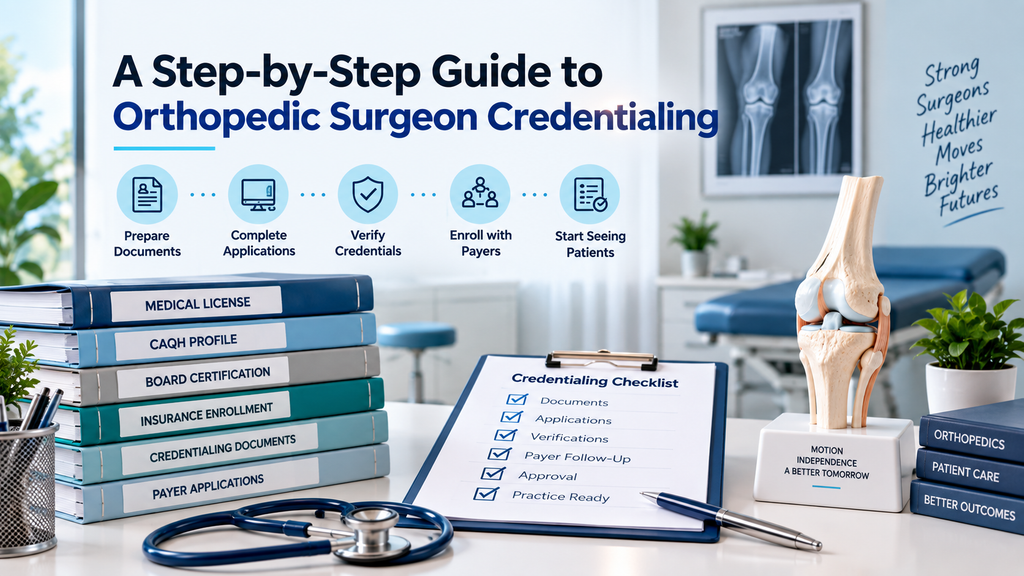
How to Get Credentialed as an Orthopedic Surgeon
For orthopedic surgeons, successful insurance credentialing starts with accurate professional information, complete documentation, and a focused payer strategy.
1. Verify Your Medical License, NPI, and Provider Information
Start by making sure the surgeon’s basic professional information is accurate.
The medical license should be active in every state where the surgeon practices, subject to applicable state requirements.
The surgeon should also have an individual NPI and verify that the associated information is correct.
CMS’s Medicare enrollment guidance starts with obtaining an NPI before completing Medicare enrollment through PECOS. CMS identifies PECOS as its online Medicare enrollment system and lists CMS-855I as the Medicare enrollment application for physicians and non-physician practitioners.
Before beginning orthopedic surgeon credentialing, check:
- Legal name
- NPI
- Medical license
- Taxonomy
- Specialty
- Practice address
- Mailing address
- Contact information
- Group affiliation
These details should remain consistent across NPPES, CAQH, payer applications, W-9 documents, Medicare enrollment records, and other credentialing materials.
CMS also notes that NPPES updates do not automatically update PECOS, so Medicare records should be reviewed separately when information changes.
2. Verify Board Certification and Orthopedic Credentials
Board certification can be an important part of an orthopedic surgeon’s professional record.
The American Board of Orthopaedic Surgery (ABOS) maintains a certification-verification system that provides primary-source verification of ABOS certification status.
ABOS explains that board certification is distinct from state medical licensure. A surgeon can hold a medical license without being board certified, while board certification demonstrates that the surgeon has met the board’s certification standards.
Depending on the surgeon, the credentialing file may also need to reflect relevant subspecialty information, such as:
- Sports medicine
- Hand surgery
- Joint replacement
- Spine
- Foot and ankle
- Pediatric orthopedics
- Orthopedic trauma
Keep certification information current and consistent with the professional record submitted to payers.
3. Create or Update Your CAQH Profile
CAQH is a major part of credentialing for many healthcare providers. CAQH’s provider data tools allow practitioners to maintain professional and practice information and share it with participating health plans for purposes such as credentialing, enrollment, directory updates, and related activities. CAQH currently directs providers to its CAQH Unity experience as its portal environment evolves.
An orthopedic surgeon’s profile may contain:
- Medical licenses
- Education and training
- Residency
- Fellowship information
- Employment history
- Practice locations
- Hospital affiliations
- Malpractice insurance
- Certifications
- Provider identifiers
- Supporting documentation
CAQH emphasizes regularly reviewing and confirming provider information so participating plans can access current data.
If a surgeon changes practice locations, renews liability coverage, changes affiliations, or updates professional information, review the CAQH profile accordingly.
4. Prepare Your Orthopedic Credentialing Documents
Before applying to insurance networks, create a complete provider file.
The exact requirements vary by payer and state, but an orthopedic surgeon may need:
- Active medical license
- NPI information
- CAQH profile
- Professional liability insurance
- Current CV
- Medical education records
- Residency information
- Fellowship documentation
- Board certification
- Employment history
- Hospital affiliations
- Surgical privileges, when required
- Practice location information
- Group practice information
- W-9 and tax information
- Medicare information, if applicable
- Medicaid information, if applicable
- Payer-specific forms
Your CV and professional history deserve particular attention.
Make sure education, residency, fellowship, employment, and practice dates are consistent across the CV, CAQH profile, and payer applications.
ABOS certification processes also involve detailed information about orthopedic practice, hospital privileges, and surgical case experience, making accurate professional records particularly relevant for orthopedic surgeons.
5. Decide Which Insurance Networks to Join
Credentialing with every available payer is not always the best approach.
Instead, determine which insurance plans are most relevant to your orthopedic practice.
Consider:
- Which plans are common among patients in your area?
- Which payers serve your target patient population?
- Does the plan operate in your state?
- Does the payer cover your orthopedic services?
- Are there network or location restrictions?
- Does the payer use CAQH?
- Does the plan require separate group enrollment?
- Does the payer offer Medicare Advantage products relevant to your practice?
Your target networks may include commercial health plans, Medicare, Medicaid, Medicare Advantage, or other managed-care organizations.
A focused payer strategy allows you to prioritize applications that are most relevant to your practice rather than submitting applications without a clear network objective.
6. Submit Your Payer Credentialing Applications
Once you have identified your priority insurance networks, begin each payer’s application process.
Some health plans may access information through CAQH, while others may require additional forms or supporting documents.
Review every application carefully before submitting it.
Check:
- Provider name
- Specialty
- NPI
- Taxonomy
- Tax ID
- Practice location
- Group affiliation
- Medical license
- Board certification
- Liability coverage
- Hospital affiliations
- Supporting documentation
Do not assume that completing one payer application means you are credentialed with other insurance companies.
Each payer maintains its own process.
After submission, keep a record of the application date, confirmation number, payer contact, outstanding documents, follow-up dates, status, and effective date.
Track Your Credentialing Application
| Credentialing Detail | What to Track |
|---|---|
| Payer | Insurance company or network |
| Submission Date | Date the application was submitted |
| Method | Portal, electronic form, email, or other method |
| Confirmation | Reference or confirmation number |
| Documents | Documents and materials submitted |
| Outstanding Items | Missing or requested information |
| Follow-Up | Next payer contact or follow-up date |
| Status | Pending, approved, returned, or denied |
| Effective Date | Date payer participation begins |
7. Complete Medicare Enrollment If You Plan to Bill Medicare
Medicare enrollment is a separate consideration for orthopedic surgeons.
CMS identifies the CMS-855I as the Medicare enrollment application for physicians and non-physician practitioners. Eligible providers can use PECOS to submit and manage Medicare enrollment information online.
For an orthopedic surgeon, Medicare enrollment can involve information about:
- Individual NPI
- Practice location
- Ownership information, when applicable
- Reassignment of benefits
- Group relationships
- Billing information
- Supporting documentation
CMS explains that PECOS allows providers to submit enrollment information online, upload documents, electronically sign applications, and review information currently on file.
Having an NPI is therefore not the same as being enrolled in Medicare.
If Medicare is part of the practice’s payer strategy, monitor the enrollment process through the appropriate Medicare Administrative Contractor.
8. Review Medicaid and Medicare Advantage Requirements
Medicaid enrollment is administered at the state level, so orthopedic surgeons should review the requirements for each state in which they plan to provide covered services.
Medicare Advantage plans can also have their own network participation and credentialing requirements.
As a result, an orthopedic surgeon may have several payer statuses at the same time.
For example, a surgeon could have active Medicare enrollment, a commercial payer application under review, and a Medicare Advantage network application awaiting additional documentation.
Keep these statuses separate so the practice knows which relationships are active and which still require action.
9. Complete Contracting and Billing Setup
Credentialing approval is not necessarily the final step. Depending on the payer, you may still need to complete contracting, enrollment, effective-date confirmation, or billing setup.
This may include:
- EFT enrollment
- ERA enrollment
- Payer portal registration
- Provider roster updates
- Group affiliation
- Practice location confirmation
- Billing information
The effective date is especially important. Before billing a payer as an in-network orthopedic surgeon, confirm that participation is active for the correct provider, group, location, and date. This helps prevent billing problems caused by assuming that credentialing approval automatically activates every part of the payer relationship.
How Long Does Orthopedic Surgeon Credentialing Take?
There is no universal timeline for orthopedic surgeon credentialing.
Processing time can vary depending on the payer, application completeness, primary-source verification, contracting requirements, provider history, and whether additional information is requested.
An incomplete application can take longer because the payer may need to pause its review while waiting for missing information.
The same can happen when CAQH information is outdated, liability coverage has expired, practice addresses do not match, or professional history contains discrepancies.
Starting early and tracking every payer application can make the process easier to manage.
Common Orthopedic Surgeon Credentialing Mistakes
Even small errors can slow down an insurance application. These are some common mistakes orthopedic practices should avoid.
- Providing inconsistent information – The surgeon’s NPI, CAQH profile, payer applications, W-9, and practice records should reflect the same current information.
- Letting CAQH become outdated – CAQH should be reviewed when licenses, practice locations, hospital affiliations, liability coverage, or other professional information changes.
- Overlooking hospital affiliations – Orthopedic surgeons may practice across hospitals or surgical facilities, so applicable affiliation and privilege information should be kept current.
- Submitting an incomplete work history – The CV and professional history should provide a consistent timeline for education, residency, fellowship, and employment.
- Confusing licensure with board certification – A medical license and orthopedic board certification are separate credentials. ABOS specifically distinguishes certification from state licensure.
- Assuming Medicare enrollment covers commercial plans – Medicare enrollment does not automatically establish participation with commercial insurance companies or Medicare Advantage plans.
- Failing to follow up – Submitting an application does not mean the payer has completed its review. Monitor requests for additional information and respond promptly.
- Forgetting re-credentialing – Credentialing is an ongoing responsibility. Licenses, malpractice coverage, affiliations, and payer records require continued maintenance.
Maintaining a clear schedule for provider re-credentialing requirements can help prevent missed deadlines and keep payer information current.
Orthopedic Surgeon Credentialing Checklist
Before submitting your insurance applications, make sure these key requirements are ready.
| Credentialing Checklist | Why It Matters |
|---|---|
| Active Medical License | Confirms the surgeon meets applicable state licensure requirements. |
| Individual NPI and Taxonomy | Helps identify the provider and maintain accurate specialty and enrollment information. |
| CAQH Profile | Allows participating health plans to access current professional and practice information, when applicable. |
| Current CV | Supports verification of education, training, employment history, and professional experience. |
| Board Certification | Provides relevant certification information for payer review, when required or applicable. |
| Professional Liability Insurance | Helps verify that applicable malpractice coverage requirements are met. |
| Hospital Affiliations and Surgical Privileges | Provides relevant information about hospital relationships and applicable practice privileges. |
| Practice Locations and Group Affiliation | Helps maintain accurate provider, location, and group information across payer records. |
| W-9 and Tax Information | Supports accurate tax and billing information for payer enrollment and related processes. |
| Medicare Enrollment Information | Helps confirm applicable Medicare enrollment details when the surgeon plans to bill Medicare. |
| Medicaid Enrollment Information | Supports review of applicable state Medicaid enrollment requirements. |
| Payer-Specific Forms and Supporting Documents | Helps ensure the application meets the requirements of the selected insurance payer. |
| Application Confirmation and Follow-Up Records | Makes it easier to monitor application progress, outstanding requests, and follow-up dates. |
| Confirmed Payer Effective Date | Helps confirm when participation is active for the correct provider, group, location, and date. |
How Credentialing Services Can Help Orthopedic Surgeons
Managing several payer applications while running an orthopedic practice can quickly become an administrative burden.
Licenses, CAQH information, malpractice coverage, hospital affiliations, payer forms, follow-ups, effective dates, and re-credentialing deadlines all require ongoing attention.
MantraComply provides credentialing and enrollment workflows that help organize provider information, documentation, payer applications, and ongoing credentialing requirements.
For practices that want additional administrative support, healthcare credentialing services can help coordinate credential verification, payer enrollment, documentation, application management, and ongoing credentialing workflows.
A centralized process can make it easier to identify pending applications, monitor provider credentials, and stay ahead of renewal or re-credentialing requirements.
Key Takeaway
Orthopedic surgeon credentialing involves much more than completing an insurance form.
It requires coordination between the surgeon’s medical license, NPI, CAQH profile, board certification, professional history, hospital affiliations, liability coverage, payer applications, and applicable Medicare or Medicaid enrollment.
Start by verifying the surgeon’s professional information and organizing the required documents. Then identify the insurance networks that are most relevant to the practice and complete each payer’s requirements separately.
If the surgeon plans to bill Medicare, pay particular attention to the applicable PECOS enrollment process and keep Medicare information separate from commercial payer credentialing. CMS provides PECOS as the online system for Medicare enrollment and enrollment maintenance.
And remember that credentialing does not end with initial approval.
Licenses renew, liability policies expire, surgeons change practice locations, hospital affiliations can change, and payers require providers to periodically update their credentials.
A structured orthopedic surgeon credentialing process can help reduce administrative delays, maintain accurate provider information, and support continued participation with insurance networks.
Frequently Asked Questions
Start by confirming your active medical license and NPI, verifying applicable board certification, completing or updating your CAQH profile, gathering professional and hospital-affiliation documentation, and identifying the insurance networks you want to join. Then complete each payer’s credentialing and enrollment requirements and monitor the application through its effective date.
Many health plans use CAQH as part of their credentialing and provider-data processes, although requirements vary by payer. CAQH allows providers to maintain professional and practice information and share it with participating health plans for credentialing, enrollment, directory updates, and related purposes.
Yes. Eligible physicians can enroll in Medicare through PECOS or the applicable CMS-855I process. CMS identifies CMS-855I as the enrollment application for physicians and non-physician practitioners. An orthopedic surgeon should still verify the applicable enrollment requirements and ensure the Medicare record correctly reflects the individual provider and group information.