
Insurance credentialing is often one of the first major administrative steps for an acupuncturist who wants to move beyond self-pay services. Before an acupuncturist can participate with a payer, the health plan may need to verify professional qualifications, practice details, and other information required for network participation. Understanding acupuncturist credentialing insurance requirements can help practitioners prepare the right information from the beginning.
The process may include selecting appropriate payer networks, reviewing provider credentials, maintaining CAQH and NPI information, organizing documentation, and completing payer-specific enrollment or contracting steps. Since requirements are not identical across insurance plans, having a payer-specific process can help keep applications accurate, organized, and easier to follow up on.
What Is Acupuncture Provider Credentialing?
Acupuncture provider credentialing is the process an insurance payer uses to verify that an acupuncturist meets its professional and participation requirements.
Depending on the payer and state, the information reviewed may include:
- Current state acupuncture license
- Education and training
- Professional certifications, where applicable
- NPI
- Work history
- Professional liability insurance
- Practice and service locations
- CAQH information, when required
- Tax identification information
- Group or organizational affiliation
- Other payer-specific credentials
The exact requirements depend on the provider, state, payer, and practice structure.
It is also important to distinguish credentialing from payer enrollment. Credentialing focuses primarily on verifying professional qualifications and determining whether a provider meets the payer’s participation standards. Enrollment establishes the provider or organization in the payer’s system for participation and billing.
A practice may therefore need to complete several connected steps before an acupuncturist is fully ready to bill a particular insurance plan.
Why Do Acupuncturists Need Insurance Credentialing?
Insurance credentialing allows eligible acupuncturists to participate in payer networks and serve patients whose health plans provide covered acupuncture benefits.
For practices, establishing appropriate payer relationships can also support patient access, referrals, and business growth.
Credentialing may allow an acupuncturist to:
- Participate in commercial insurance networks
- Enroll with applicable Medicaid programs
- Add acupuncturists to an existing group
- Serve patients with eligible in-network benefits
- Establish payer participation
- Support claims and reimbursement
- Maintain network participation through recredentialing
However, credentialing with one insurance company does not automatically establish participation with another. Each payer can have its own provider application, credentialing standards, contracting process, enrollment requirements, and effective-date procedures.
Acupuncturists should also distinguish network participation from benefit coverage. A patient may have an insurance plan that does not cover acupuncture, even when the practitioner participates in that network.
Acupuncturist Credentialing vs. Enrollment: What’s the Difference?
Credentialing, enrollment, and contracting are often used interchangeably, but they describe different parts of the payer process.
- Credentialing verifies the provider’s professional qualifications. This may include licenses, education, work history, certifications, and liability coverage.
- Enrollment establishes the provider or organization in the payer’s system for participation and, where applicable, billing.
- Contracting establishes the terms under which a provider participates in a payer network.
For an acupuncturist, these processes may happen alongside one another, but they should still be tracked separately. Completing credentialing does not necessarily mean every enrollment or contracting requirement has been completed.
How to Get Credentialed as an Acupuncturist
There is no single application that credentials an acupuncturist with every insurance company. Instead, the process should be approached payer by payer.
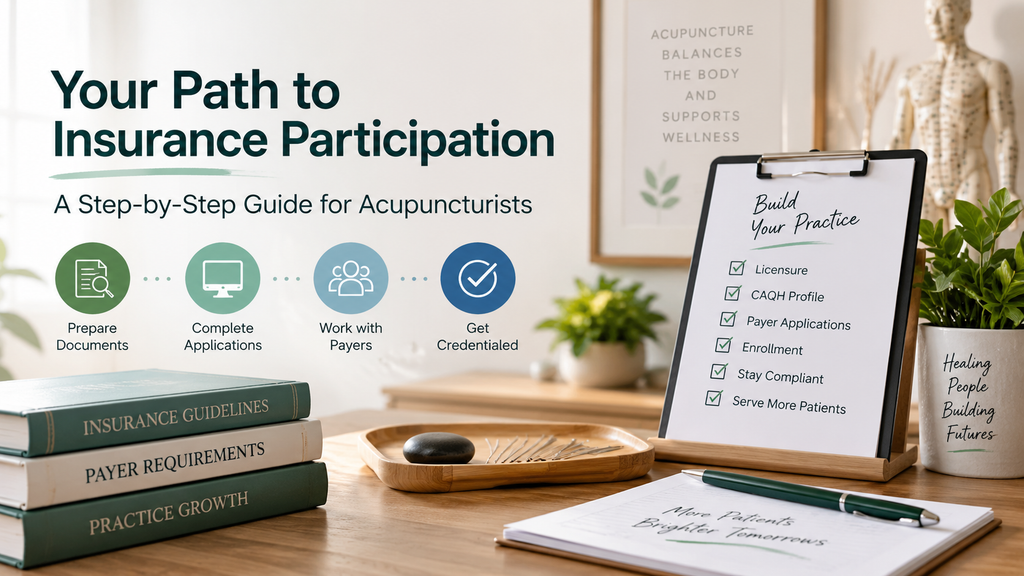
1. Identify Which Acupuncturists Need to Be Credentialed
Start by determining who within your organization needs to be credentialed or enrolled.
This can depend on how the payer recognizes providers and how services are billed.
An acupuncture organization may have:
- Individual acupuncturists
- Supervising practitioners, where applicable
- Other healthcare professionals
- Rendering providers
- An organizational or group provider
Not every provider type necessarily follows the same credentialing pathway.
Before submitting an application, determine whether the payer requires an individual credentialing application, group enrollment, rendering-provider enrollment, or another arrangement.
This is particularly important for growing acupuncturists because adding a practitioner may require more than simply adding the provider to an internal staff list.
2. Verify State Licensure and Professional Credentials
Before beginning acupuncturist credentialing, make sure every practitioner has the credentials required to practice in the relevant state.
Requirements for acupuncturists can differ by state, so practices should verify the applicable licensing and professional requirements before beginning payer credentialing.
Keep track of:
- License status
- License number
- License expiration date
- Professional certification, when applicable
- Certification expiration
- State of practice
- Provider name
- NPI
- Practice location
Credential information should match the information submitted to the payer.
If an acupuncturist works across multiple states, review the requirements for each location rather than assuming that authorization in one state applies everywhere.
3. Make Sure the NPI Information Is Correct
The National Provider Identifier is an important part of a provider’s administrative identity.
An individual acupuncturist generally uses a Type 1 NPI, while an organization may have a Type 2 NPI.
For an acupuncture group practice, the relationship between the individual provider, organization, Tax ID, NPI, and practice location should be clearly documented.
Before submitting applications, verify:
- Individual NPI
- Organizational NPI, if applicable
- Legal business name
- Tax ID
- Taxonomy
- Practice address
- Mailing address
- Group affiliation
Inconsistent information between NPI records, CAQH, payer applications, W-9 forms, and contracts can result in additional payer questions or requests for clarification.
4. Complete and Maintain CAQH
CAQH is used by many health plans as a centralized source of provider information.
The CAQH Provider Data Portal allows healthcare providers to maintain professional and practice information and share it with participating organizations for credentialing and related purposes.
For an acupuncturist, the profile may contain:
- Professional credentials
- Education
- Licensure
- Employment history
- Practice locations
- Liability insurance
- Certifications
- NPI information
- Supporting documentation
Keeping CAQH for acupuncture providers current is important when participating payers rely on the profile during credentialing.
Completing the profile is only part of the process. Providers should review their information for accuracy, authorize appropriate organizations, attest when required, and keep supporting documentation current.
A CAQH profile is not necessarily a substitute for every payer application. Health plans can still require additional forms or documentation.
5. Build a Complete Acupuncture Credentialing File
Gather the provider’s documents before starting payer applications.
Depending on the payer and provider type, the credentialing file may include:
- State acupuncture license
- NPI documentation
- Professional liability insurance
- Current CV
- Education and training information
- Employment history
- CAQH information
- W-9
- Tax information
- Practice locations
- Group affiliation
- Ownership information, when applicable
- Payer-specific forms
- Supporting documentation
- EFT and ERA information
Pay special attention to the provider’s CV.
Dates of employment, education, licenses, and practice history should be consistent across the CV, CAQH profile, and payer application. If information conflicts, the payer may request clarification before completing its review.
6. Research Your Target Insurance Payers
Don’t begin by submitting applications to every payer you can find.
First determine which insurance networks are actually important to your acupuncturist.
Consider:
- Which insurers are common in your service area?
- Which payers cover your target patient population?
- Does the payer cover acupuncture services?
- Is the payer accepting new providers?
- Does it require CAQH?
- Does it require separate Medicaid enrollment?
- Does the payer use a managed care organization?
- Does it have location-specific network requirements?
- Are there provider eligibility restrictions?
For many acupuncturists, the payer mix can include commercial health plans, Medicaid programs, and other health plans.
Your payer strategy should reflect the patients you serve, the services you provide, and the states in which your practice operates.
7. Submit the Payer Application
Once your payer list is established, complete each insurance company’s application according to its instructions.
Some payers may obtain provider information through CAQH. Others may require their own application, supplemental forms, or additional documentation.
Before submitting, compare the application against your master credentialing file.
Check:
- Provider name
- NPI
- Tax ID
- License
- Certification, when applicable
- Provider type or specialty
- CAQH information
- Practice address
- Group affiliation
- Liability insurance
- Ownership information
- Supporting documentation
After submission, record the application date and confirmation information.
Also track requests for additional documents, payer contacts, follow-up dates, credentialing status, contracting status, and final effective date.
Track Your Acupuncture Credentialing Applications
Use a centralized tracker for every payer application so that outstanding requests and follow-ups do not get overlooked.
| Credentialing Detail | What to Track |
|---|---|
| Payer | Insurance company, health plan, or Medicaid program |
| Submission Date | Date the application was submitted |
| Submission Method | Payer portal, email, mail, or other method |
| Confirmation Number | Payer-issued application or reference number |
| Documents Submitted | Credentials and supporting documents included |
| Outstanding Items | Additional documents or information requested |
| Follow-Up Date | Date for the next payer follow-up |
| Application Status | Submitted, under review, pending, approved, or other payer status |
| Contracting Status | Contract pending, sent, signed, or completed |
| Effective Date | Date payer participation becomes active, when applicable |
8. Complete Medicaid Enrollment When Applicable
Medicaid deserves special attention because enrollment requirements are determined at the state level.
A practice may need to complete state Medicaid enrollment before participating with certain Medicaid managed care plans. The exact pathway can vary by provider type, state, and program.
Before pursuing Medicaid enrollment for acupuncturists, determine:
- Which state Medicaid program applies
- Whether acupuncture is a covered service
- Whether acupuncturists are eligible provider types
- Whether individual providers must enroll
- Whether the organization must enroll
- Whether rendering providers must be linked
- Whether managed care contracting is required
- Which documents must be submitted
- Whether prior authorization applies
- Whether additional provider qualifications apply
An acupuncturist should not assume that Medicaid requirements in one state apply to another.
For multi-state practices, this can mean maintaining different enrollment workflows for different states.
9. Complete Contracting and Provider Setup
Credentialing approval does not necessarily mean the provider is ready to bill.
Depending on the payer, additional steps may include:
- Contract execution
- Payer enrollment
- Provider roster submission
- Group-provider linking
- EFT registration
- ERA registration
- Payer portal setup
- Practice-location confirmation
- Billing configuration
The effective date should be confirmed before treating the provider as an active in-network participant.
For group practices, verify that the correct individual acupuncturist is connected to the correct organization, Tax ID, location, and payer contract.
How Long Does Acupuncture Credentialing Take?
There is no universal turnaround time for acupuncture provider credentialing.
Processing can depend on the payer, state, provider type, application completeness, credential verification, contracting requirements, and whether additional information is requested.
An application can take longer when:
- Credentials are expired
- CAQH information is incomplete
- Employment history needs clarification
- Documents are missing
- Practice information does not match
- The payer requests additional verification
- Contracting is handled separately from credentialing
For this reason, practices should begin credentialing before they need a provider to start billing.
Application tracking is equally important. Knowing exactly where each payer application stands makes it easier to respond to outstanding requests and avoid unnecessary delays.
Common Acupuncturist Credentialing Mistakes
From outdated credentials to incomplete applications, several common mistakes can complicate the credentialing process.
1. Applying without confirming payer eligibility — A payer may have specific provider or network requirements that should be reviewed before submitting an application.
2. Using inconsistent NPI and Tax ID information — Differences between provider, organization, and payer records can lead to additional verification.
3. Allowing CAQH information to become outdated — A completed CAQH profile still requires ongoing maintenance when used by participating payers.
4. Ignoring state-specific Medicaid requirements — Medicaid enrollment requirements can vary by state and program.
5. Assuming credentialing equals contracting — A provider may still need a signed agreement, enrollment, or effective-date confirmation.
6. Failing to track group relationships — For group acupuncturists, make sure individual practitioners are correctly connected to the organization and payer.
7. Waiting until a provider is ready to see patients — Starting credentialing too late can create gaps between hiring a practitioner and establishing payer participation.
8. Forgetting recredentialing — Credentialing continues after initial approval. Licenses, liability insurance, practice information, and payer records require ongoing attention.
Practices should maintain a schedule for provider re-credentialing requirements so important renewal dates are not overlooked.
Acupuncturist Credentialing Verification Checklist
Before submitting payer applications, verify that the following information is complete, current, and consistent.
| Credentialing Item | Why It Matters |
|---|---|
| Current State Acupuncture License | Confirms authorization to practice in the state |
| Individual NPI | Identifies the acupuncturist in healthcare administrative systems |
| Organizational NPI, If Applicable | Supports group practice and organizational billing arrangements |
| Correct Taxonomy | Helps payers identify the provider’s specialty and services |
| CAQH Profile, When Required | Provides provider information used by participating payers |
| Current CAQH Attestation, When Required | Confirms provider information has been reviewed and attested |
| Updated CV | Provides a current record of professional history |
| Complete Employment History | Helps support professional history verification |
| Education and Training Records | Supports verification of professional qualifications |
| Professional Liability Insurance | Demonstrates current professional liability coverage |
| Practice Location Information | Helps payers confirm where services are provided |
| Group Practice Information, If Applicable | Links the provider to the correct organization and billing entity |
| W-9 and Tax Information | Supports payer enrollment and payment setup |
| Medicaid Enrollment Information, If Applicable | Supports participation in applicable state Medicaid programs |
| EFT and ERA Information | Supports electronic payments and remittance processing |
| Payer-Specific Forms | Payers may require additional forms or information |
| Supporting Documentation | May support verification of credentials and practice information |
| Application Confirmation Number | Helps track the application and payer follow-ups |
| Follow-Up Date | Helps ensure pending items are addressed on time |
| Payer Approval and Effective Date | Confirms when payer participation becomes active |
How Credentialing Services Can Help Acupuncturists
Managing insurance credentialing can become time-consuming when an acupuncturist works with multiple payers, providers, or locations. Acupuncture credentialing services can help streamline the process by organizing applications, documentation, payer requirements, and follow-ups.
Credentialing professionals can help maintain provider information across CAQH, NPI records, payer applications, and supporting documents, while also tracking application status and responding to outstanding payer requests. This can help reduce delays caused by missing or inconsistent information.
For growing practices, credentialing support can also help coordinate commercial payer credentialing, Medicaid enrollment, group affiliations, and multiple practice locations. A structured process makes it easier to manage different payer requirements without losing track of individual applications.
Ongoing credentialing support can extend beyond initial enrollment by helping practices monitor license renewals, liability insurance, CAQH updates, recredentialing deadlines, and provider changes. This allows acupuncturists to spend less time on administrative tasks and more time managing their practice.
Key Takeaway
Acupuncture credentialing insurance requirements can vary considerably between health plans and states. The strongest approach is to begin with payer research, prepare an accurate provider profile, organize documentation, maintain CAQH where required, and understand the distinction between credentialing, contracting, and enrollment.
Acupuncturists should also look beyond the initial application. Confirming effective dates, maintaining provider records, monitoring payer communications, and preparing for recredentialing are all part of maintaining network participation.
With a structured approach to acupuncturist credentialing, practices can spend less time reacting to missing information and more time managing their payer relationships effectively.
Frequently Asked Questions
Can acupuncturists credential with multiple insurance payers?
Yes. Acupuncturists may apply to multiple payer networks when they meet the eligibility and participation requirements of each plan. Each payer may have its own credentialing and enrollment process.
What documents are commonly required for acupuncturist credentialing?
Common requirements may include an active state license, NPI, CAQH information when applicable, CV, education or training records, professional liability insurance, practice details, W-9, and payer-specific forms. Requirements vary by payer and state.
Does insurance credentialing guarantee that acupuncture services will be covered?
No. Being credentialed or participating in a payer network does not guarantee coverage for every acupuncture service. Coverage depends on the patient’s specific health plan, benefits, eligibility, and applicable payer policies.