
Starting an optometry practice involves more than obtaining a license and opening your doors. If you plan to accept insurance, you also need to establish your provider credentials, complete payer enrollment, and meet the requirements of the networks you want to join.
Optometrist credentialing may involve your NPI, taxonomy, optometry license, Doctor of Optometry degree, CAQH profile, malpractice coverage, employment history, practice information, and other payer-required documentation.
The process can become more complex when an optometrist works with both vision and medical insurance, joins multiple networks, adds providers, or operates from several locations. Understanding credentialing, payer enrollment, contracting, and recredentialing can help keep the process organized.
What Is Optometrist Credentialing?
Optometrist credentialing is the process of verifying an eye-care provider’s professional qualifications before approving network participation.
Depending on the payer, verification may include:
- Active optometry license
- Doctor of Optometry degree
- Education and training
- Employment history
- Professional liability insurance
- NPI and taxonomy
- Practice locations
- Certifications, when applicable
- Hospital or facility affiliations, when applicable
- Professional and regulatory information
Credentialing is related to provider enrollment, but the two terms do not mean the same thing.
Credentialing focuses on verifying a provider’s qualifications and eligibility. Enrollment establishes the provider within a payer’s administrative and billing systems.
A payer may combine these activities or handle them separately. An optometrist can therefore complete credentialing while enrollment, contracting, or billing setup is still pending.
For practices coordinating these connected processes, credentialing and enrollment services can help organize provider administration.
Why Is Credentialing Important for Optometrists?
Insurance credentialing helps establish an optometrist’s participation with the networks patients use for covered eye-care services.
Optometry is somewhat different from many other specialties because providers may work with both vision plans and medical insurance.
Vision plans commonly address routine eye care and related benefits, while medical insurance may apply when eye care is connected to a medical condition, disease, injury, or medically necessary service.
A practice may therefore need separate payer relationships depending on the services it provides.
A well-managed credentialing process can help an optometry practice:
- Apply to relevant vision networks
- Participate with medical insurance plans
- Establish payer participation
- Support accurate claims submission
- Maintain current provider information
- Add optometrists to an existing group
- Prepare for recredentialing
The American Optometric Association (AOA) provides professional resources for optometrists and practices dealing with insurance, coding, and practice-management issues.
Credentialing can also affect when a practice can begin billing a particular payer under network terms. Starting early gives the practice time to address missing documents, verification questions, and payer-specific requirements.
How to Get Credentialed as an Optometrist
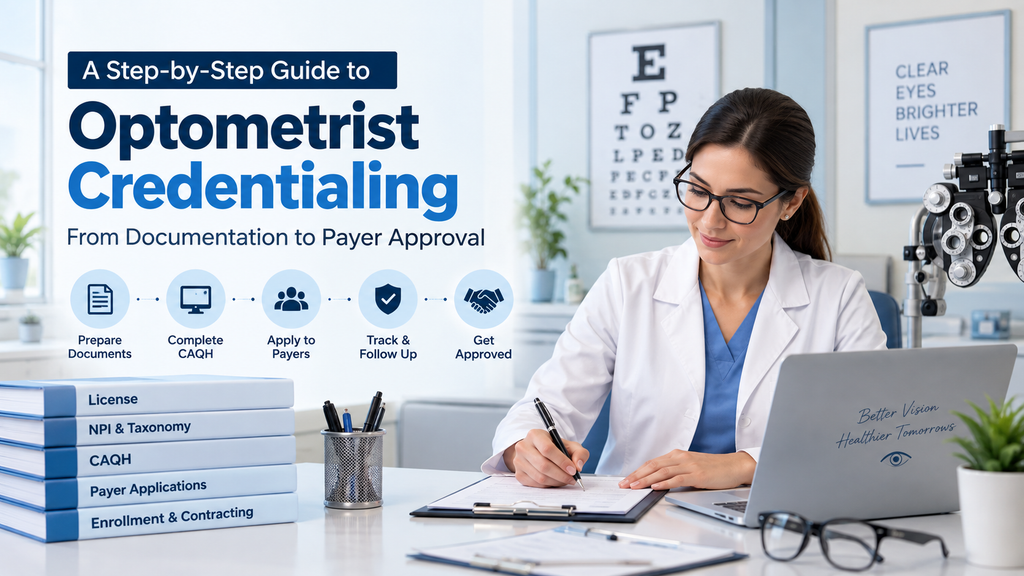
Although requirements vary by payer and state, most optometrists can organize credentialing into several practical steps.
1. Obtain and Verify Your NPI
Your NPI is a core provider identifier that should be accurate before beginning payer enrollment.
An individual optometrist generally uses a Type 1 NPI, while an optometry practice organized as a separate entity may have a Type 2 NPI.
Before submitting payer applications, review the information associated with the provider’s NPI.
Check:
- Legal name
- Practice address
- Mailing address
- Taxonomy
- Contact information
- Individual NPI
- Organizational NPI, when applicable
- Group affiliation
The taxonomy should accurately reflect the provider’s professional classification.
An incorrect NPI or inconsistent provider information can create additional questions when a payer compares records.
For practices managing individual providers, individual practitioner credentialing resources can help organize provider-level information.
Choose the Correct Optometry Taxonomy
An accurate taxonomy helps identify the provider’s professional classification and specialization.
Optometrists should review their taxonomy information before submitting insurance applications.
The taxonomy should be consistent with the provider’s professional credentials and the information being submitted to the payer.
If the practice has multiple providers, avoid assuming that every provider record can use identical information. Individual provider data should be reviewed separately.
2. Complete and Maintain Your CAQH Profile
CAQH provides a centralized way for optometrists to maintain provider information for participating health plans.
The CAQH Provider Data Portal allows providers to maintain professional and practice information, upload supporting documentation, and authorize participating health plans to access their information for credentialing and related activities.
An optometrist’s CAQH profile may include:
- Personal information
- Professional license
- Education
- Training
- Employment history
- Practice locations
- Malpractice coverage
- Certifications
- Disclosure information
- Professional references, when required
- Supporting documentation
Completing the profile is only the beginning.
Providers should review their information, maintain current documents, authorize appropriate organizations, and complete required attestations.
For practices that need a structured approach to profile management, CAQH credentialing support can help organize this part of the enrollment workflow.
CAQH does not mean every payer has identical requirements. A health plan may still request its own application, contract, forms, or additional documents.
3. Build Your Credentialing Document File
Preparing your documentation before applying can reduce avoidable delays and repeated requests.
A typical optometrist credentialing file may include:
- Active optometry license
- NPI information
- CAQH information
- Doctor of Optometry degree information
- Malpractice insurance certificate
- Current CV
- Education and training records
- Complete employment history
- Certifications, when applicable
- Hospital or facility affiliation information, when applicable
- DEA registration, when applicable
- State controlled-substance registration, when applicable
- Government-issued identification
- W-9
- Tax identification information
- Practice ownership information
- Medicare information, when applicable
- Medicaid information, when applicable
- EFT and ERA information
Payers may request additional documentation depending on the provider and network.
Why Document Consistency Matters
Complete documents are important, but consistent information across every record is equally important.
The optometrist’s legal name, address, NPI, Tax ID, practice locations, employment dates, and group information should match wherever the same information is requested.
For example, an address on a payer application that differs from the CAQH profile may trigger a verification request.
Creating a master provider profile before beginning applications gives the practice one reliable source of information.
4. Identify the Insurance Plans You Want to Join
Choosing the right networks before applying can prevent time being spent on payers that do not fit the practice.
An optometrist does not necessarily need to apply to every insurance network in the market.
Instead, identify networks that align with:
- Patient population
- Geographic market
- Referral sources
- Services offered
- Expected payer mix
- Practice goals
- Existing provider relationships
Depending on the practice, the payer list may include:
- Commercial medical plans
- Vision plans
- Medicare
- Medicare Advantage plans
- Medicaid
- Managed Medicaid plans
- Regional insurance networks
Vision networks can have their own participation processes. For example, EyeMed provides information for eye-care professionals interested in joining its network, while VSP also provides network information for eye-care professionals.
The exact requirements should always be confirmed directly with the payer.
For practices planning multiple payer applications, payer enrollment services can help organize enrollment activities and payer relationships.
5. Submit Payer Credentialing Applications
Once the provider file is ready, submit each payer application according to that network’s requirements.
A payer may obtain information from CAQH but can also request additional forms or documents.
Before submitting, review:
- Provider type
- Specialty
- NPI
- Tax ID
- Practice locations
- Group affiliation
- License information
- Malpractice coverage
- Effective dates
- Supporting documentation
Do not assume that completing one payer application enrolls the optometrist with another insurance company.
Each health plan may have its own credentialing, contracting, enrollment, and provider-directory processes.
Track Every Application
A simple tracking system helps the practice monitor applications from submission through approval.
| Track | What to Record |
|---|---|
| Payer | Insurance company or vision plan |
| Application Type | Credentialing, enrollment, contracting, or recredentialing |
| Submission Date | Date the application was submitted |
| Reference Number | Payer confirmation or tracking number |
| Documents | Submitted and outstanding documents |
| Status | Submitted, pending, returned, approved, or denied |
| Follow-Up | Last contact and next follow-up date |
| Contract | Contract status and signature date |
| Effective Date | Confirmed network participation date |
Tracking every application separately makes it easier to identify stalled applications and respond to payer requests.
6. Complete Medicare Enrollment Through PECOS
Optometrists who are eligible to participate in Medicare must complete the applicable Medicare enrollment process separately from commercial or vision-plan credentialing.
An NPI does not automatically establish Medicare enrollment.
Medicare enrollment and payer credentialing should therefore be treated as separate administrative processes.
An optometrist should verify whether the services being provided are eligible for Medicare coverage and whether the provider meets the applicable enrollment requirements.
This distinction is particularly important because routine vision services and medically necessary eye-care services may be treated differently under insurance benefits.
Practices should also make sure that the individual optometrist and organization are correctly connected when group billing arrangements apply.
7. Complete Medicaid and Medicare Advantage Requirements
Medicaid and Medicare Advantage participation can involve additional requirements beyond standard payer credentialing.
Medicaid enrollment requirements vary by state and may also involve managed-care organizations.
Before applying, determine:
- Whether optometrists are eligible providers.
- Which services are covered.
- Whether managed Medicaid plans require separate participation.
- Whether a state enrollment application is required.
- Which documents must be submitted.
- Whether additional screening applies.
Medicare Advantage plans may also maintain their own provider networks and participation requirements.
An optometrist can therefore have:
- An active state license
- A completed CAQH profile
- An NPI
- Medicare enrollment
- A commercial payer application under review
- Medicaid enrollment pending
- A vision-network application in progress
These statuses should be monitored individually rather than treated as one credentialing record.
8. Complete Contracting and Billing Setup
Credentialing approval does not necessarily mean every payer and billing requirement has been completed.
Depending on the health plan, you may still need to complete:
- Contracting
- Provider enrollment
- Effective-date confirmation
- EFT registration
- ERA registration
- Provider roster updates
- Group affiliation
- Practice location updates
- Payer portal registration
- Billing configuration
Before submitting claims, confirm that the provider’s payer record is active and that the applicable effective date has been established.
This is especially important for optometry practices that participate in both vision and medical insurance networks.
How Long Does Optometrist Credentialing Take?
There is no universal credentialing timeline because each payer can have different requirements and processing procedures.
The processing period can depend on:
- Payer requirements
- State requirements
- Application completeness
- Primary-source verification
- Provider history
- Contracting requirements
- Additional documentation requests
- Payer workload
Commercial medical plans and vision networks can have different processes.
The safest approach is to begin credentialing well before the planned billing or practice-launch date.
Submitting complete and consistent information from the beginning can also reduce avoidable corrections and follow-up requests.
Common Optometrist Credentialing Mistakes
Even minor administrative errors can slow credentialing and create unnecessary work for the practice.
1. Using Different Provider Information – Different names, addresses, Tax IDs, or NPI details across applications can create verification issues.
Better approach: Maintain a master provider profile and use it as the source for payer applications.
2. Treating CAQH as a One-Time Task – A CAQH profile can become outdated when licenses, malpractice coverage, practice locations, or employment information changes.
Better approach: Review and update the profile regularly and complete required attestations.
3. Submitting an Incomplete Work History – Missing employment information or unexplained gaps can result in additional questions.
Better approach: Keep a complete professional history and ensure the CV, CAQH profile, and payer applications are consistent.
4. Waiting Until the Practice Opens – Starting credentialing after patients are already scheduled can create unnecessary operational pressure.
Better approach: Begin payer research and document preparation early enough to accommodate payer-specific processing.
5. Assuming One Payer Application Covers All Plans – Commercial insurance, vision plans, Medicare, Medicaid, and Medicare Advantage organizations may have different enrollment processes.
Better approach: Track each payer independently.
6. Failing to Track Follow-Ups – An application can remain pending if a payer requests additional information and the request is not addressed promptly.
Better approach: Record every submission, outstanding request, payer contact, and follow-up date.
7. Forgetting Ongoing Maintenance – Credentialing does not end when the initial application is approved. Licenses, malpractice coverage, practice locations, and payer information can change.
Better approach: Build credential maintenance and recredentialing into the practice’s regular administrative workflow.
For ongoing maintenance, practices can review re-credentialing requirements and incorporate recurring payer requirements into their credentialing calendar.
Optometrist Credentialing Checklist
Use this checklist to confirm that your core provider, enrollment, documentation, and payer requirements are ready before submission.
| Credentialing Item | Why It Matters |
|---|---|
| Active optometry license | Confirms authorization to practice |
| Individual NPI | Identifies the optometrist |
| Correct taxonomy | Supports accurate provider classification |
| Completed CAQH profile | Provides information to participating health plans |
| Current CAQH attestation | Keeps provider information current |
| Doctor of Optometry degree | Documents professional education |
| Updated CV | Supports professional background verification |
| Complete employment history | Helps verify work history |
| Malpractice insurance | Confirms professional liability coverage |
| Certification information | Supports applicable credential verification |
| Practice locations | Ensures accurate payer records |
| Group affiliation | Connects the provider to the correct organization |
| Tax identification information | Supports payer enrollment and billing |
| Medicare information | Supports applicable Medicare participation |
| Medicaid information | Addresses applicable state requirements |
| Payer-specific applications | Meets individual network requirements |
| EFT/ERA information | Supports electronic payment workflows |
| Application confirmation numbers | Helps track submissions |
| Follow-up dates | Prevents missed payer requests |
| Approval and effective dates | Confirms network participation |
A complete checklist gives the practice a practical way to identify missing information before an application reaches the payer.
After You Are Credentialed
Payer approval is not always the final administrative step before an optometrist can bill as an in-network provider.
Once an optometrist is accepted, the practice should verify the payer’s records.
Check:
- Effective participation date
- Provider directory listing
- Practice address
- Group affiliation
- Billing entity
- Network status
- Claims configuration
- Electronic payment setup
This is particularly important when an optometry practice participates in both vision and medical networks.
A provider may be active with one payer while another enrollment or contracting process is still pending.
The practice should therefore maintain a payer-by-payer record rather than treating credentialing as a single status.
Recredentialing and Ongoing Maintenance
Credentialing is an ongoing process because provider information and payer requirements can change.
Licenses expire. Providers change locations. Practices add or remove optometrists. Liability coverage renews. Payer information changes.
Recredentialing and provider-data maintenance help keep participation current.
A practice should monitor:
- License expiration dates
- Liability insurance renewals
- CAQH updates and attestations
- Provider-directory accuracy
- Payer recredentialing deadlines
- Group affiliations
- Practice locations
- Enrollment changes
Maintaining these records throughout the year is easier than rebuilding the provider file when a payer requests updated information.
How Credentialing Services Can Help Optometry Practices
Managing multiple vision and medical payer relationships can become increasingly difficult as an optometry practice grows.
Administrative teams may need to coordinate:
- CAQH information
- Payer applications
- Credentialing documents
- License renewals
- Malpractice coverage
- Enrollment records
- Payer follow-ups
- Effective dates
- Recredentialing requirements
A centralized workflow can bring these activities into one process instead of relying on disconnected spreadsheets, emails, and reminders.
MantraComply supports healthcare organizations with provider credentialing, payer enrollment, CAQH management, documentation workflows, and ongoing credentialing processes.
For practices that want additional administrative support, healthcare credentialing services can help organize provider records, payer applications, verification, and ongoing monitoring.
Key Takeaway
Optometrist credentialing involves multiple steps across vision and medical insurance networks.
The process includes verifying NPI and taxonomy information, maintaining CAQH, preparing documents, selecting payers, completing enrollment, and confirming contracting and billing setup.
Keeping provider and payer information accurate and tracking each application separately can help optometry practices reduce avoidable delays and maintain network participation.
Frequently Asked Questions
There is no standard timeframe for every payer. Processing can depend on application completeness, verification requirements, payer workload, contracting, and additional information requests. Vision plans and medical insurance companies may also have different processes.
Yes. An optometrist can seek participation with multiple payers, but each health plan may have its own credentialing, contracting, and enrollment requirements. Maintaining a payer-by-payer tracking system helps prevent applications and follow-ups from being overlooked.
Credentialing approval may be followed by contracting, payer enrollment, effective-date confirmation, billing setup, EFT/ERA registration, provider-directory updates, or other payer-specific requirements. Before billing, confirm that the provider’s participation is active and the applicable effective date has been established.