
Starting a podiatry practice takes more than getting licensed and opening your doors. If you plan to accept insurance, you must also establish your provider credentials, complete payer enrollment, and ensure health plans can verify your qualifications and practice information.
Podiatrist credentialing typically involves your NPI, taxonomy, professional license, malpractice coverage, CAQH profile, education and employment history, and other payer-required information. Medicare, Medicaid, commercial insurers, and Medicare Advantage plans may each have separate enrollment or participation requirements.
What Is Podiatrist Credentialing?
Podiatrist credentialing is the process through which an insurance company, healthcare organization, or provider network verifies a podiatrist’s professional qualifications before approving participation.
Depending on the payer, verification may include:
- Professional license
- Education and training
- Employment history
- Malpractice insurance
- Board certification, when applicable
- Practice locations
- Hospital affiliations, when applicable
- NPI and taxonomy
- Professional and regulatory information
Credentialing is related to provider enrollment, but the terms do not mean the same thing.
Credentialing primarily verifies a provider’s qualifications and eligibility to participate. Enrollment establishes the provider within a payer’s administrative and billing systems.
A payer may combine these activities or handle them separately. Therefore, a podiatrist can have completed credentialing with one payer while still having enrollment, contracting, or billing setup pending.
For practices that want to manage both processes together, MantraComply’s credentialing and enrollment services provide a centralized approach to provider administration.
Why Is Credentialing Important for Podiatrists?
Insurance credentialing helps establish a provider’s participation with health plans. Without completing the applicable payer requirements, a podiatrist may not be able to treat patients as an in-network provider or submit claims under the intended participation arrangement.
A well-managed credentialing process can help a podiatry practice:
- Apply to relevant insurance networks
- Establish payer participation
- Complete required enrollment steps
- Support accurate claims submission
- Maintain current provider information
- Prepare for future re-credentialing
Credentialing can also affect the timing of a practice’s ability to bill a particular payer. Starting the process well before the planned launch or billing date gives the practice more time to address missing documents, verification questions, or payer-specific requirements.
How to Get Podiatrist Credentialing
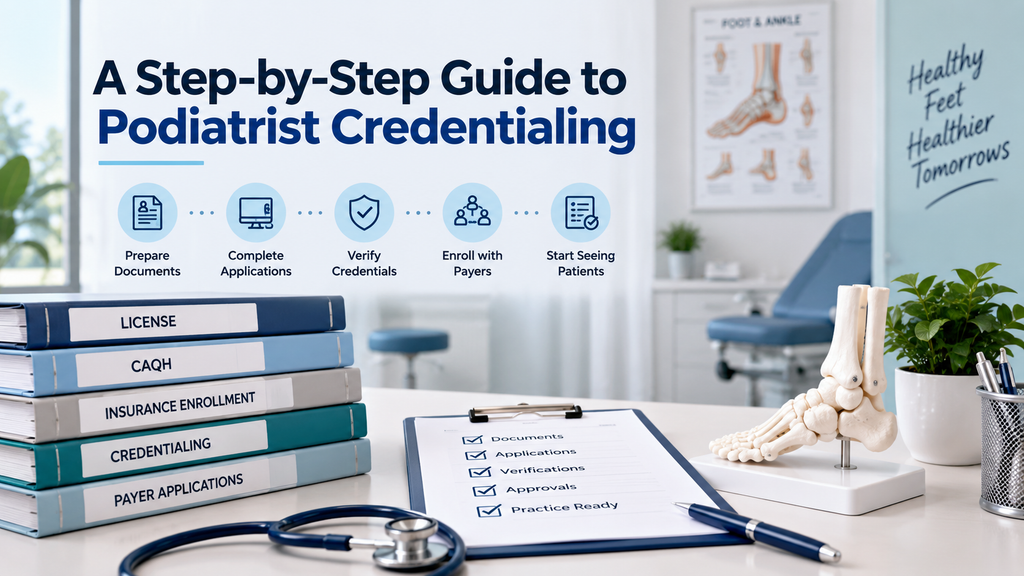
Although requirements vary by payer and location, most podiatrists can organize the process into the following steps.
1. Obtain and Verify Your NPI
A National Provider Identifier (NPI) is a unique 10-digit identifier used in HIPAA-standard healthcare transactions. CMS requires an NPI for Medicare enrollment.
An individual podiatrist generally uses a Type 1 NPI. If the practice operates through a separate organization or group entity, that organization may have a Type 2 NPI.
Before submitting payer applications, verify that your NPI information is accurate and consistent with your other provider records.
Check:
- Legal name
- Practice address
- Mailing address
- Taxonomy
- Contact information
- Individual or organizational NPI
- Group affiliation
Choose the Correct Taxonomy
A taxonomy code identifies a provider’s classification and specialization. CMS notes that taxonomy information is included when applying for an NPI and is relevant to Medicare enrollment.
Use the taxonomy that accurately represents your professional classification. An incorrect or inconsistent taxonomy can create unnecessary questions during enrollment or payer review.
2. Complete and Maintain Your CAQH Profile
The CAQH Provider Data Portal allows providers to maintain professional and practice information and share that information with participating health plans for credentialing and related activities.
A podiatrist’s CAQH profile may include:
- Personal information
- Professional licenses
- Education
- Training
- Employment history
- Practice locations
- Malpractice coverage
- Hospital affiliations
- Board certification
- Professional references, when required
- Supporting documentation
Completing the profile is only the beginning. Providers should review their information, maintain current documentation, authorize appropriate organizations, and complete required attestations.
For practices managing several providers, a structured CAQH credentialing workflow can make profile maintenance easier to manage.
3. Build Your Credentialing Document File
Gather your documents before beginning payer applications. Requirements differ by payer and provider circumstances, but a typical credentialing file may include:
- Active podiatry license
- NPI information
- CAQH information
- Malpractice insurance certificate
- Current CV
- Education and training records
- Complete employment history
- Board certification documentation, when applicable
- Hospital affiliation information, when applicable
- DEA registration, when applicable
- State controlled-substance registration, when applicable
- Government-issued identification
- W-9
- Tax identification information
- Practice ownership information
- Medicare information, when applicable
- Medicaid information, when applicable
- EFT and ERA information
Why Document Consistency Matters
Credentialing delays are not always caused by missing documents. Inconsistent information can also create verification problems.
For example, your legal name, address, tax information, NPI, practice location, or employment dates should be consistent wherever the same information is requested.
Creating a master provider profile before submitting applications gives your team one reliable source of information.
4. Identify the Insurance Plans You Want to Join
You do not necessarily need to apply to every payer operating in your area.
Instead, identify the networks that align with your:
- Patient population
- Geographic market
- Referral sources
- Practice specialties
- Expected payer mix
- Business objectives
Depending on the practice, the payer list may include:
- Commercial health plans
- Medicare
- Medicare Advantage plans
- Medicaid
- Managed Medicaid plans
- Regional or specialty networks
Each payer may have different participation, credentialing, contracting, and enrollment requirements.
Creating a payer matrix before applications begin allows your team to record each payer’s requirements, submission method, application status, follow-up date, and effective date.
5. Submit Payer Credentialing Applications
Once your information and documents are ready, submit the required applications to your selected health plans.
A payer may obtain information from CAQH but can also request additional forms or documents.
Review every application for:
- Provider type
- Specialty
- NPI
- Tax ID
- Practice locations
- Group affiliation
- License information
- Malpractice coverage
- Effective dates
- Supporting documentation
Do not assume that completing one payer application enrolls you with other insurance companies. Each health plan maintains its own processes.
Track Every Application
A simple payer tracking system should record:
| Credentialing Detail | What to Track |
|---|---|
| Payer | Insurance company or network |
| Submission Date | Date the application was submitted |
| Method | Portal, electronic form, email, or other method |
| Confirmation | Reference or confirmation number |
| Documents | Documents and materials submitted |
| Outstanding Items | Missing or requested information |
| Follow-Up | Next payer contact or follow-up date |
| Status | Pending, approved, returned, or denied |
| Effective Date | Date payer participation begins |
This makes it easier to identify stalled applications and respond quickly to payer requests.
6. Complete Medicare Enrollment Through PECOS
If you intend to bill Medicare, you must complete the applicable Medicare enrollment process.
CMS directs providers to obtain an NPI and then complete Medicare enrollment through the Provider Enrollment, Chain, and Ownership System (PECOS).
PECOS allows providers to submit enrollment information electronically, upload supporting documentation, and electronically sign and submit applications. CMS states that PECOS applications generally process faster than paper applications.
For physicians and eligible non-physician practitioners, CMS identifies Form CMS-855I as the applicable paper enrollment application when paper submission is used.
NPI Is Not the Same as Medicare Enrollment
Obtaining an NPI does not automatically enroll a podiatrist in Medicare.
The NPI identifies the provider, while Medicare enrollment establishes the provider’s participation and billing status within Medicare.
Therefore, obtaining an NPI should be treated as an early administrative step rather than the completion of Medicare enrollment.
For practices that need assistance with the process, MantraComply’s Medicare provider credentialing and enrollment services provide additional information about Medicare enrollment workflows.
7. Complete Medicaid and Medicare Advantage Requirements
Medicaid enrollment is administered through state Medicaid programs, so requirements can vary by state. Federal guidance recognizes that states have flexibility in determining provider qualifications and enrollment requirements within applicable federal rules.
If you plan to participate in Medicaid:
- Identify the applicable state Medicaid program.
- Review its provider enrollment requirements.
- Gather the required documentation.
- Submit the provider enrollment application.
- Track the application through approval.
- Maintain required provider information.
Medicare Advantage plans may also have their own participation and provider enrollment requirements.
As a result, a podiatrist may simultaneously have:
- An active state license
- A completed CAQH profile
- An NPI
- Medicare enrollment
- A commercial payer application under review
- Medicaid enrollment pending
These statuses should be monitored individually rather than treated as one credentialing record.
8. Complete Contracting and Billing Setup
Credentialing approval does not necessarily mean the entire payer setup is finished.
Depending on the health plan, you may still need to complete:
- Contracting
- Provider enrollment
- Effective-date confirmation
- EFT registration
- ERA registration
- Provider roster updates
- Group affiliation
- Practice location updates
- Payer portal registration
- Billing configuration
Before submitting claims, confirm that the provider’s payer record is active and that the applicable effective date has been established.
This final verification helps prevent the assumption that an approval notice automatically means every billing function is ready.
How Long Does Podiatrist Credentialing Take?
There is no universal credentialing timeline.
The processing period can depend on:
- Payer requirements
- State requirements
- Application completeness
- Primary-source verification
- Provider history
- Contracting requirements
- Additional documentation requests
- Payer workload
Medicare enrollment through PECOS has its own processing workflow, while commercial payer credentialing timelines vary by health plan.
The safest strategy is to start the process well before your planned billing date rather than relying on an assumed approval timeframe.
Submitting complete, accurate information at the beginning can also reduce avoidable corrections and follow-up requests.
Common Podiatrist Credentialing Mistakes
Even minor errors or oversights can slow down the credentialing process, delay payer approval, and create unnecessary administrative work.
1. Using Different Provider Information – Different names, addresses, tax information, or NPI details across applications can create verification issues.
Better approach: Maintain a master provider profile and use it as the source for payer applications.
2. Treating CAQH as a One-Time Task – A CAQH profile can become outdated when licenses, malpractice coverage, practice locations, or employment information changes.
Better approach: Review and update the profile according to CAQH’s applicable attestation and maintenance requirements.
3. Submitting an Incomplete Work History – Missing employment information or unexplained gaps can result in additional questions.
Better approach: Keep a complete professional history and ensure your CV and applications tell the same story.
4. Waiting Until the Practice Opens – Starting credentialing after patients are already scheduled can create unnecessary operational pressure.
Better approach: Begin payer research and document preparation early enough to accommodate payer-specific processing.
5. Assuming One Payer Application Covers All Plans – Commercial plans, Medicare, Medicaid, and Medicare Advantage organizations may have different enrollment processes.
Better approach: Track each payer independently.
6. Failing to Track Follow-Ups – An application can remain pending if a payer requests additional information and the request is not addressed promptly.
Better approach: Record every submission, outstanding request, contact, and follow-up date.
7. Forgetting Ongoing Maintenance – Credentialing does not end when the initial application is approved. Licenses, malpractice coverage, practice locations, and other provider information can change.
Better approach: Build credential maintenance and re-credentialing into the practice’s regular administrative workflow.
For more information, see MantraComply’s guide to re-credentialing requirements for providers.
Podiatrist Credentialing Checklist
Before submitting applications, verify that you have:
| Credentialing Checklist | Why It Matters |
|---|---|
| Active state podiatry license | Confirms you are authorized to practice in the applicable state. |
| Individual NPI | Provides the identifier used to establish and verify your provider record. |
| Correct taxonomy | Identifies your provider classification and specialization accurately. |
| Completed and current CAQH profile | Gives participating health plans access to current provider information for credentialing. |
| Current CAQH attestation | Confirms that the information in your CAQH profile has been reviewed and attested. |
| Updated CV and complete employment history | Helps payers verify your professional experience and identify gaps that may require clarification. |
| Education and training information | Supports verification of your professional education and training. |
| Malpractice insurance | Provides evidence of required professional liability coverage. |
| Board certification information, when applicable | Allows the payer to verify applicable specialty certification. |
| Hospital affiliation information, when applicable | Helps verify current or relevant hospital affiliations when required. |
| DEA registration, when applicable | Provides applicable prescribing and registration information for payer review. |
| State controlled-substance registration, when applicable | Supports verification of required state-level controlled-substance credentials. |
| W-9 and tax identification information | Helps establish accurate tax and payment information for payer records. |
| Practice ownership information | Identifies the ownership and organizational structure associated with the practice. |
| Medicare enrollment information, when applicable | Confirms applicable Medicare enrollment details when you plan to bill Medicare. |
| Medicaid enrollment information, when applicable | Provides applicable state Medicaid enrollment information. |
| EFT/ERA information | Supports electronic payment and remittance setup with applicable payers. |
| Payer-specific applications | Ensures you meet the individual requirements of each insurance network. |
| Supporting documentation | Allows payers to verify the information submitted in your application. |
| Application confirmation numbers | Provides a reference for tracking submissions and communicating with payers. |
| Follow-up dates | Helps ensure pending applications and payer requests are followed up on time. |
| Payer approval and effective dates | Confirms when payer participation is approved and when it becomes effective. |
A complete checklist gives your team a practical way to identify missing information before an application reaches the payer.
How Podiatrist Credentialing Services Can Help
Managing credentialing internally can become increasingly complex as a practice adds providers, locations, or insurance contracts.
Administrative teams may need to coordinate:
- CAQH information
- Payer applications
- Credentialing documents
- License renewals
- Malpractice coverage
- Enrollment records
- Payer follow-ups
- Effective dates
- Re-credentialing requirements
A centralized workflow can bring these activities into one process instead of relying on disconnected spreadsheets, emails, and reminders.
MantraComply provides healthcare credentialing services designed to help practices manage provider credentialing, payer enrollment, CAQH information, documentation, and ongoing credential maintenance.
For a growing podiatry practice, outsourcing administrative credentialing work can reduce the amount of time staff spends coordinating payer requirements and following up on applications.
Key Takeaway
Podiatrist credentialing is a multi-step process, not a single insurance application.
A successful workflow starts with accurate NPI and taxonomy information, continues through CAQH and payer-specific credentialing, and includes the appropriate Medicare, Medicaid, contracting, and billing requirements.
The most effective approach is to:
- Verify your provider identifiers.
- Complete and maintain your CAQH profile.
- Prepare a complete credentialing document file.
- Prioritize the insurance networks relevant to your practice.
- Submit and track each payer application separately.
- Complete Medicare, Medicaid, or other applicable enrollment.
- Confirm contracting, billing setup, and effective dates.
- Maintain your credentials after approval.
With a structured process, podiatrists can reduce avoidable administrative delays and keep their provider information ready for payer review.
Frequently Asked Questions
There is no standard timeframe for every payer. Processing depends on factors such as application completeness, verification requirements, payer workload, contracting, and additional information requests. Medicare enrollment has its own process through PECOS, while commercial payer timelines vary.
Yes. A podiatrist can seek participation with multiple payers, but each health plan may have its own credentialing, contracting, and enrollment requirements. Maintaining a payer-by-payer tracking system helps prevent applications or follow-ups from being overlooked.
Credentialing approval may be followed by contracting, payer enrollment, effective-date confirmation, billing setup, EFT/ERA registration, or other payer-specific administrative steps. Before billing, confirm that the provider’s participation is active and the applicable effective date has been established.