How does Medicaid provider enrollment work when every state has its own process? Unlike Medicare or commercial health plans, Medicaid follows a federal framework but is administered by individual state Medicaid agencies.
For providers practicing in multiple states, this means there is no single Medicaid enrollment application that covers every state. Each state can have its own portal, documentation requirements, screening procedures, and enrollment timelines.
Understanding the relationship between state Medicaid enrollment and Medicaid MCO credentialing is equally important. This guide explains the Medicaid provider credentialing and enrollment process, including eligibility, requirements, documents, timelines, MCO credentialing, and ongoing enrollment maintenance.
What Is Medicaid Provider Credentialing?
Medicaid provider credentialing and enrollment involve reviewing a healthcare provider’s qualifications and establishing their eligibility to participate in a state’s Medicaid program.
While federal Medicaid regulations establish baseline screening standards, individual states administer their own enrollment systems and determine how providers complete the process.
Depending on the state and provider category, the process may involve verifying:
- Professional licenses and certifications
- NPI and provider information
- Education and training
- Ownership and managing-employee details
- Provider risk category
- Background and exclusion information
- Practice locations
- State-specific enrollment requirements
Providers who participate in Medicaid managed care may also need to complete separate MCO credentialing after establishing their state Medicaid enrollment.
A centralized credentialing and enrollment platform can help healthcare organizations manage provider information, documentation, applications, and payer requirements more efficiently.
Medicaid Provider Credentialing vs. Medicaid Provider Enrollment
Although the terms are often used together, Medicaid enrollment and credentialing are not necessarily the same process.
State Medicaid enrollment establishes a provider’s record with the state Medicaid program. MCO credentialing, on the other hand, may be required by individual managed care organizations before the provider can participate in their networks
| Medicaid Provider Enrollment | Medicaid MCO Credentialing |
|---|---|
| Managed by the state Medicaid agency | Managed by the individual MCO |
| Establishes state Medicaid participation | Supports participation with the MCO |
| Includes required state and federal screening | Follows the MCO’s credentialing requirements |
| Uses the applicable state enrollment system | Uses the MCO’s designated process |
| Requires ongoing enrollment maintenance | May include separate contracting and recredentialing |
A provider can therefore have an active state Medicaid enrollment while still needing to complete credentialing with one or more MCOs.
Understanding this distinction helps providers avoid assuming that enrollment with the state automatically completes every managed care requirement.
Who Is Eligible for Medicaid Provider Credentialing?
Healthcare professionals and organizations that meet their state’s Medicaid participation requirements may need to complete the applicable enrollment process. Requirements depend on the state, provider type, and assigned risk category.
Depending on the state, Medicaid enrollment may apply to:
- Physicians
- Nurse practitioners
- Physician assistants
- Behavioral health professionals
- Therapists
- Specialists
- Laboratories
- Pharmacies
- Home health providers
- Hospitals
- Healthcare facilities
- Other individual and organizational providers
Individual Providers
Individual practitioners generally submit a Medicaid application containing professional, licensing, identification, and screening information required by their state and provider category.
Group and Organizational Providers
Groups, facilities, and institutional providers may have additional enrollment requirements. In some cases, organizational enrollment is required alongside individual practitioner enrollment, with additional ownership disclosures, screening, site visits, or application fees potentially applying.
Providers who want to participate with Medicaid MCOs should also determine which organizations require separate credentialing after state enrollment.
Basic Requirements for Medicaid Provider Enrollment
Before starting a Medicaid provider enrollment application, make sure the information used across your provider records is accurate and up to date.
Common requirements include:
- Active professional license
- National Provider Identifier (NPI)
- Provider taxonomy
- Practice location information
- Ownership disclosures
- Managing-employee information
- Applicable certifications
- Background-screening information
- Tax and billing information
- Provider-specific documentation
The provider’s risk level is another important consideration. Federal Medicaid screening rules categorize providers as limited, moderate, or high risk, which determines the level of screening that may apply.
Your NPI information should also match the information submitted to the state Medicaid agency. NPI information is maintained through NPPES and is an important identifier throughout the enrollment process.
Documents Required for Medicaid Provider Enrollment
Documentation requirements differ by state and provider category, but providers should generally be prepared to supply information that supports their eligibility and screening.
| Documents | Why It Matters |
|---|---|
| NPI Information | Identifies the provider or organization |
| Professional License | Confirms authorization to practice |
| Certifications | Verifies applicable professional qualifications |
| Ownership Information | Identifies required ownership interests |
| Managing Employee Details | Supports required screening |
| W-9 / Tax Information | Provides tax and payment information |
| Practice Location Details | Confirms the service location |
| Background Screening Information | Supports risk-based screening |
| Fingerprinting Documentation | May apply to certain moderate- or high-risk providers |
| Provider-Specific Documents | Meets state-specific requirements |
| Organizational Documents | May be required for groups and facilities |
Certain institutional providers may also have to pay a federal application fee, although specific exemptions may be available.
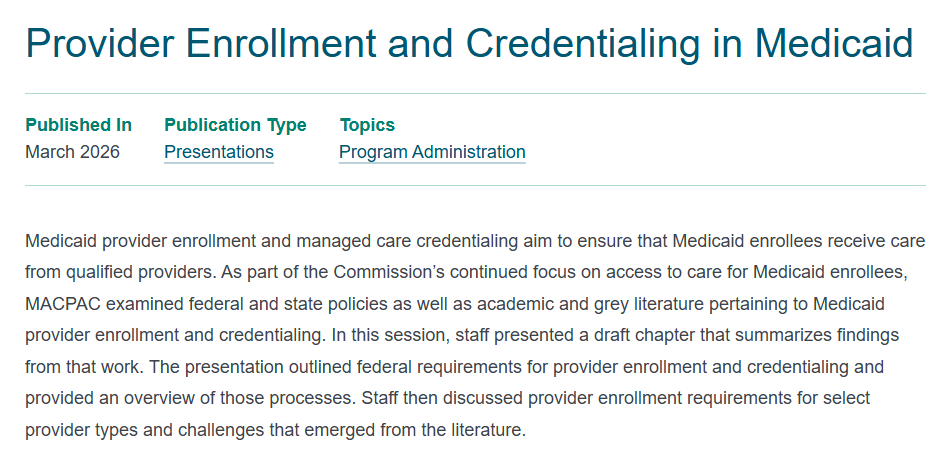
Step-by-Step Medicaid Provider Credentialing & Enrollment Process
Because states administer Medicaid enrollment independently, the exact forms, portals, and procedures can differ. However, the following steps represent the common enrollment workflow.
Step 1: Determine the Provider Category and Risk Level
First, identify the provider type and applicable Medicaid risk category.
Federal rules generally place providers into limited, moderate, or high-risk categories. The category can determine whether additional screening, fingerprinting, or a site visit is required.
Knowing the risk level early helps providers prepare for the appropriate screening requirements.
Step 2: Obtain and Verify the NPI
A valid National Provider Identifier (NPI) is required for Medicaid enrollment.
Before submitting the application, verify that the provider’s NPI information is accurate and consistent with the name, taxonomy, and other identifying information that will appear on the Medicaid application.
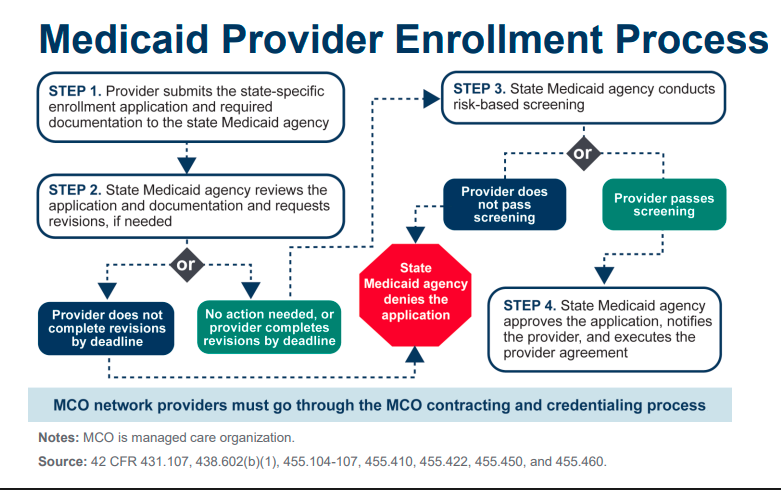
Step 3: Locate the Appropriate State Medicaid Portal
Identify the Medicaid agency and enrollment system for the state where the provider intends to participate.
Because states use different systems and procedures, providers should follow the current instructions provided by the applicable state Medicaid agency rather than relying on another state’s process.
Step 4: Complete the Medicaid Enrollment Application
Enter the required provider and practice information into the state’s Medicaid enrollment application.
Depending on the provider category, this may include:
- Provider demographics
- NPI and taxonomy
- Practice locations
- Ownership information
- Managing employees
- Tax information
- Licensure
- Supporting documentation
Pay particular attention to ownership and managing-employee disclosures because these details can form part of the state’s required screening process.
Step 5: Submit Licensing and Screening Documentation
Upload or submit the documents required for the provider’s category and risk level.
These may include an active license, certifications, background information, and fingerprint-based screening results where applicable.
Review every document before submission to ensure names, dates, addresses, and other identifying information are consistent.
Step 6: Pay the Applicable Enrollment Fee
Some institutional providers are subject to a federal Medicaid application fee.
However, certain providers may qualify for an exemption based on existing Medicare or Medicaid enrollment or other circumstances recognized under federal requirements.
Providers should verify their specific fee or exemption status with the applicable state Medicaid program.
Step 7: Complete Required Database Screening
The state conducts required screening as part of the Medicaid enrollment process.
Screening may involve databases such as:
- NPPES
- Death Master File
- List of Excluded Individuals/Entities
- Other required federal exclusion and integrity databases
These checks support Medicaid program integrity and are also part of ongoing provider oversight after enrollment.
Step 8: Complete a Site Visit, If Required
Certain providers may need to complete an unannounced site visit, particularly when moderate- or high-risk screening requirements apply.
The visit can be used to verify that the provider’s practice location exists and corresponds with the information submitted to Medicaid.
Make sure the location and practice information in the enrollment record are accurate before this stage.
Step 9: Receive the Medicaid Enrollment Decision
Once the required screening and application review are complete, the state Medicaid agency makes an enrollment decision.
Depending on the state and provider type, the provider may also need to complete a provider agreement or other participation requirements.
Keep the approval information and enrollment records available for future updates and revalidation.
Step 10: Complete Medicaid MCO Credentialing
State Medicaid enrollment may be followed by MCO credentialing for providers who want to participate in managed care networks.
Each MCO can have its own credentialing and contracting requirements, so providers may need to submit additional information even after state enrollment becomes active.
Track each MCO relationship separately to avoid confusing state enrollment status with network participation.
Step 11: Verify Active Medicaid Billing Status
Before submitting claims, confirm that the provider’s Medicaid enrollment is active in the state system.
A provider should not rely solely on MCO credentialing or an application submission as proof of active Medicaid billing status.
This check is particularly important when onboarding new providers or updating existing enrollment records.
Step 12: Track the Revalidation Date
Medicaid participation requires ongoing maintenance after initial approval.
Federal rules generally require Medicaid provider revalidation at least every five years, although states may establish more frequent requirements for certain provider categories.
For multi-state organizations, maintain a separate revalidation schedule for each state and provider to prevent missed deadlines.
How Long Does Medicaid Provider Enrollment Take?
There is no standard Medicaid enrollment timeline that applies to every state. Processing can differ based on the state Medicaid agency, provider type, risk level, application completeness, and screening requirements.
Applications requiring additional verification, fingerprinting, site visits, or clarification can take longer than straightforward applications. Missing documents or inconsistent provider information may also result in additional requests.
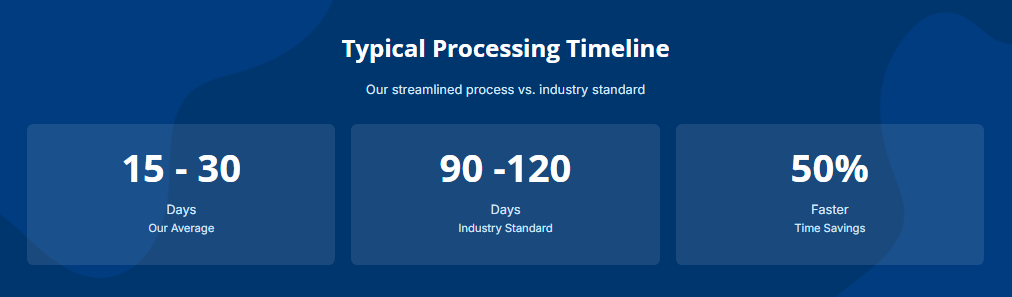
Providers can help minimize delays by submitting complete information, keeping licenses and enrollment records current, and responding promptly to requests from the state Medicaid agency.
For multi-state organizations, each enrollment should be tracked independently because an application moving forward in one state does not affect the enrollment status of another state.
Medicaid Provider Credentialing Services
Managing Medicaid enrollment manually can become difficult when an organization works across several states and MCOs.
A credentialing service can help with:
- State Medicaid applications
- Provider information
- Enrollment documentation
- MCO credentialing
- Application follow-ups
- Revalidation tracking
- Provider data updates
- Enrollment status monitoring
For multi-state practices, MantraComply’s provider group solution can help centralize provider data, credentialing, enrollment, and ongoing payer management.
How MantraComply Can Help With Medicaid Provider Credentialing
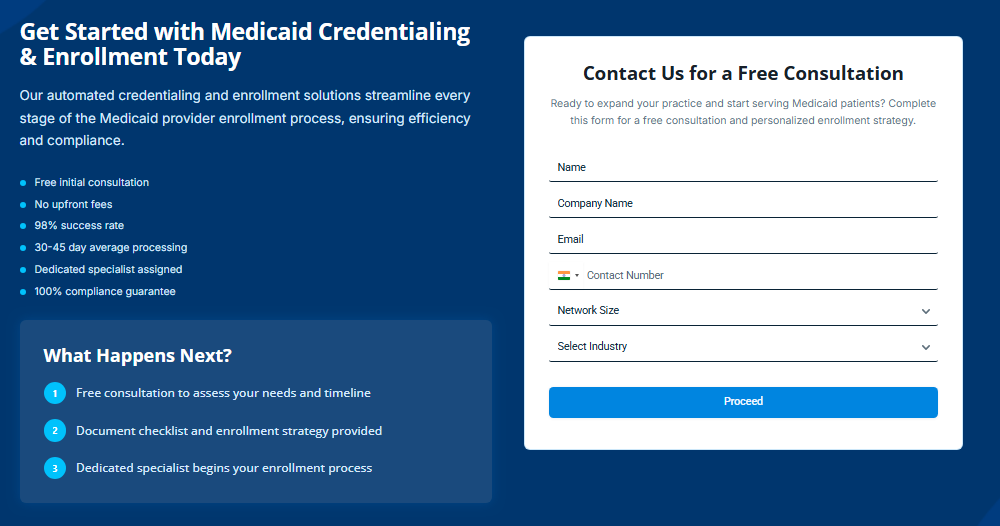
Managing Medicaid Provider Credentialing and Enrollment across multiple states can create significant administrative work. MantraComply brings provider data, credentialing, enrollment, documents, and ongoing monitoring into one centralized workflow.
- Provider Data: Keep provider information organized and current.
- Application Management: Prepare and track state-specific Medicaid applications.
- Document Management: Manage licenses, certifications, disclosures, and supporting documents.
- MCO Credentialing: Coordinate applicable Medicaid managed care credentialing requirements.
- Application Tracking: Monitor payer requests, outstanding items, and follow-ups.
- Ongoing Monitoring: Track revalidation dates and credentialing requirements.
With MantraComply’s credentialing and enrollment platform, organizations can streamline Medicaid enrollment and payer credentialing while reducing repetitive administrative work. It is being updated. Keeping this information consistent across systems as it changes, rather than catching up all at once at revalidation, prevents most of these holds before they happen.
Conclusion
Medicaid provider enrollment combines federal screening requirements with state-specific administration. Each state manages its own enrollment system, documentation, procedures, and timelines, so providers should approach every state enrollment as a separate process.
The process generally involves confirming the provider category and risk level, obtaining an NPI, identifying the state enrollment portal, submitting the application and supporting documents, completing screening, and receiving the enrollment decision.
For providers participating in managed care, state Medicaid enrollment is only the foundation. Separate MCO credentialing and contracting may be necessary for each managed care organization.
For organizations managing multiple states, providers, and payer relationships, healthcare credentialing automation can simplify application tracking, documentation, provider data management, MCO credentialing, and revalidation monitoring.
Frequently Asked Questions
Medicaid provider enrollment timelines vary significantly by state, provider type, risk level, application completeness, and the screening requirements that apply to the provider.
Yes. Medicaid enrollment is state-specific, meaning providers must complete separate enrollment applications for every state where they intend to treat Medicaid beneficiaries.
No. State Medicaid enrollment establishes provider eligibility, while each Medicaid Managed Care Organization (MCO) requires its own separate credentialing and contracting process.
Federal regulations generally require Medicaid providers to complete revalidation at least every five years, although some provider categories have more frequent renewal schedules.
Medicare enrollment can qualify an eligible provider for an exemption from the applicable Medicaid application fee, but providers must still satisfy the Medicaid enrollment and screening requirements that apply in the state.
View Sources
- Centers for Medicare & Medicaid Services. Medicaid Provider Enrollment . Accessed 10/5/2026.
- Centers for Medicare & Medicaid Services. Medicaid Provider Enrollment Compendium . Accessed 10/5/2026.
- Medicaid.gov. Eligibility, Enrollment, and Renewal Tools and Resources . Accessed 10/5/2026.
- MantraComply. Medicaid Provider Credentialing: A Step-by-Step Guide for Healthcare Providers . Accessed 10/5/2026.
- MantraComply. Healthcare Credentialing Services . Accessed 10/5/2026.
- MantraComply. MantraComply . Accessed 10/5/2026.