Enrolling in Medicare is more than filling out an application-it’s the first step toward getting paid for the care you provide to Medicare beneficiaries. From submitting your enrollment through PECOS to receiving your Provider Transaction Access Number (PTAN), every step plays an important role in establishing your practice with Medicare. You’ll also need to understand the role of Medicare Administrative Contractors (MACs), who process enrollment applications and manage provider-related requirements in their jurisdictions.
However, enrollment doesn’t end once your application is approved. Providers must keep their information up to date and complete revalidation when required to maintain their Medicare billing privileges. Whether you’re enrolling for the first time or managing an established practice, understanding these requirements can help you avoid delays, prevent compliance issues, and keep your billing on track.
What Is Medicare Provider Credentialing?
Medicare provider credentialing involves verifying a healthcare provider’s qualifications and eligibility to participate in Medicare. Unlike commercial insurance plans, where credentialing is often handled as a separate process, Medicare incorporates these checks into its provider enrollment procedures. Providers typically apply through the Provider Enrollment, Chain, and Ownership System (PECOS) or submit the applicable CMS-855 paper application. Depending on the provider type, the review may cover professional licenses, National Provider Identifier (NPI) information, practice locations, ownership details, tax information, qualifications, group affiliations, and reassignment relationships.
Once enrollment is approved, the provider receives Medicare billing privileges and must keep enrollment information accurate and up to date. This includes reporting applicable changes within required timeframes and completing revalidation when required to maintain those privileges. For healthcare organizations managing multiple providers, keeping track of applications, supporting documents, affiliations, and deadlines can become challenging. A centralized credentialing and enrollment platform can help streamline these administrative tasks and improve visibility into provider enrollment status.
Medicare Provider Credentialing vs. Medicare Provider Enrollment
Medicare credentialing and Medicare enrollment are closely connected. CMS primarily uses the provider enrollment process to collect and verify the information needed to establish Medicare participation rather than operating a separate credentialing application.
PECOS and CMS-855 are also not two separate Medicare enrollment processes. PECOS is the online system, while CMS-855 forms contain the corresponding enrollment information for paper submissions.
| Medicare Provider Enrollment | Credentialing & Verification |
|---|---|
| Establishes Medicare participation | Verifies information supporting eligibility |
| Managed through CMS and applicable contractors | Incorporated into the enrollment review |
| Uses PECOS or CMS-855 forms | Reviews licenses, ownership, qualifications, and other information |
| Establishes billing privileges when approved | Supports the enrollment decision |
| Requires ongoing maintenance and revalidation | Continues through required enrollment updates |
This distinction is particularly important for providers who are accustomed to commercial payer workflows where credentialing and enrollment are handled as separate stages.
Who Is Eligible for Medicare Provider Credentialing?
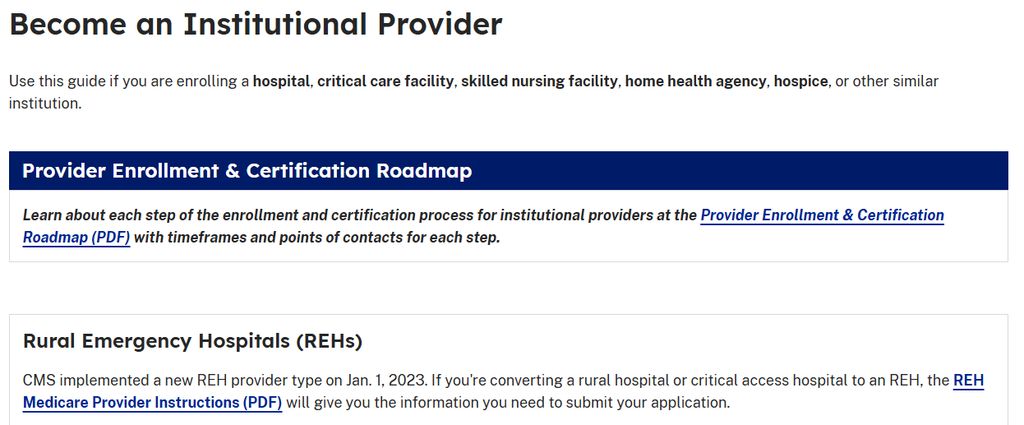
Medicare enrollment requirements depend on the provider or supplier type. CMS uses different enrollment applications and requirements for individual practitioners, clinics, group practices, institutional providers, ordering and certifying professionals, and DMEPOS suppliers.
Depending on the category, the process may apply to:
- Physicians
- Nurse practitioners
- Physician assistants
- Behavioral health professionals
- Clinics
- Group practices
- Hospitals
- Institutional providers
- Other Medicare suppliers
- DMEPOS suppliers
- Ordering and certifying professionals
Individual Providers
Individual physicians and eligible non-physician practitioners generally need their own Medicare enrollment record.
A practitioner joining a Medicare-enrolled group does not simply inherit the group’s enrollment. The individual provider may also need to establish the appropriate reassignment of Medicare benefits to the group.
Group and Organizational Providers
Clinics, group practices, hospitals, and other organizations may require separate organizational enrollment in addition to individual practitioner enrollment.
Because CMS uses different enrollment forms for different provider categories, identifying the correct provider type before starting the application is essential.
Basic Requirements for Medicare Provider Enrollment
Before starting a Medicare provider enrollment application, providers should make sure their information is accurate and consistent across PECOS, NPPES, licensing records, and other relevant systems.
Common requirements include:
- National Provider Identifier (NPI)
- Active professional license
- Tax identification information
- Practice locations
- Provider specialty
- Ownership information
- Group affiliations
- Reassignment information, when applicable
- EFT information
- Applicable certifications and supporting documentation
The NPI is a core provider identifier, so information associated with it should match the details submitted during Medicare enrollment.
Medicare enrollment also requires ongoing maintenance. Providers must report applicable changes within required timeframes rather than waiting until their next revalidation.
Documents Required for Medicare Provider Enrollment
The documentation required for Medicare provider enrollment varies by provider type and enrollment situation. PECOS helps identify applicable requirements and allows supporting documents to be submitted electronically.
| Documents | Why It Matters |
|---|---|
| NPI Information | Identifies the provider or organization |
| Professional License | Verifies authorization to practice |
| Tax Identification Information | Supports Medicare enrollment and payment records |
| Practice Location Details | Identifies Medicare service locations |
| Ownership Information | Supports required ownership disclosures |
| Group Affiliation | Establishes applicable organizational relationships |
| Reassignment Information | Supports reassignment of Medicare benefits when applicable |
| EFT Information | Supports electronic payment setup |
| Certifications | Provides applicable provider qualifications |
| CMS-855 Information | Establishes the Medicare enrollment record |
| Additional MAC Documents | Addresses information requested during application review |
The specific documentation package should always be based on the provider’s enrollment category and the requirements associated with the applicable CMS-855 application.
Step-by-Step Medicare Provider Credentialing & Enrollment Process
Medicare enrollment can generally be completed electronically through PECOS or through the applicable CMS-855 paper application. The required steps and documentation depend on the provider or supplier type.

Step 1: Secure an NPI
If the provider does not already have one, obtain a National Provider Identifier (NPI) through NPPES.
Before beginning Medicare enrollment, verify that the provider’s NPI information is accurate and matches the information that will be submitted to CMS.
Step 2: Set Up PECOS Access
For online Medicare enrollment, establish the appropriate access through CMS’s Identity & Access Management (I&A) system.
Organizations should pay particular attention to Authorized Official and other user roles before beginning an application. Resolving access issues early can prevent unnecessary administrative delays.
Step 3: Identify the Correct CMS-855 Form
The appropriate CMS-855 application depends on the provider or supplier category.
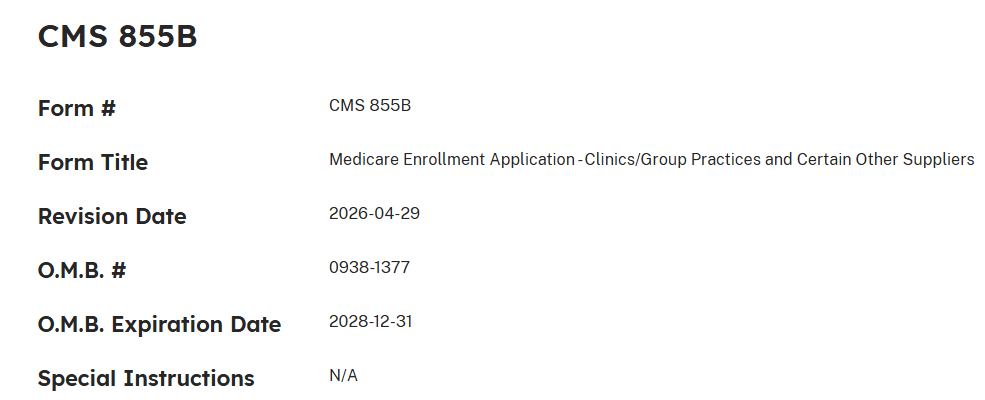
Common forms include:
- CMS-855A: Institutional providers
- CMS-855B: Clinics, group practices, and certain suppliers
- CMS-855I: Physicians and non-physician practitioners
- CMS-855O: Ordering and certifying professionals
- CMS-855S: DMEPOS suppliers
PECOS can guide online applicants through the appropriate enrollment information, while paper applicants must select the correct form themselves.
Step 4: Complete the Medicare Enrollment Application
Enter the required information in PECOS or on the applicable CMS-855 form.
Depending on the enrollment type, this may include:
- Provider information
- NPI
- Specialty
- Licensure
- Practice locations
- Ownership
- Tax information
- Group affiliations
- Certifications
- Other provider-specific information
Review the application carefully before submission because inconsistent or incomplete information can result in additional requests from the MAC.
Step 5: Complete Reassignment, If Applicable
Providers joining a group practice may need to establish reassignment of Medicare benefits to that organization.
The individual practitioner still maintains an individual Medicare enrollment record even when Medicare payments are reassigned to the group.
Completing the appropriate reassignment information helps ensure that the individual provider and group relationship are accurately reflected in Medicare records.
Step 6: Pay the Medicare Application Fee, If Required
Certain Medicare providers and suppliers are required to pay an enrollment application fee.
For 2026, the fee is $750 for applicable institutional providers and suppliers, while certain provider categories are generally exempt. Qualifying applicants may also be able to request a hardship exception.
Because fee requirements depend on the enrollment category, providers should confirm whether the fee applies before submitting the application.
Step 7: Submit the Application to the Correct MAC
Submit the completed enrollment application to the appropriate Medicare Administrative Contractor (MAC).
The MAC responsible for processing the application depends on the provider’s circumstances, including practice location and enrollment type.
Using the correct MAC from the beginning helps prevent unnecessary routing and processing delays.
Step 8: Complete MAC Pre-Screening
The MAC reviews the application for completeness and may request additional information or supporting documentation.
Providers should monitor PECOS and MAC communications closely and respond within the requested timeframe. Delayed responses can extend processing or affect the status of the application.
Step 9: Complete a Site Visit, If Required
CMS may conduct an unannounced site visit as part of Medicare enrollment screening and program-integrity requirements.
Depending on the provider or supplier type, the site visit may be used to verify that the practice location exists and corresponds with the information reported in the enrollment record.
Providers should therefore ensure that practice-location information remains accurate throughout the enrollment process.
Step 10: Receive Approval and PTAN Assignment
Once the Medicare enrollment application is approved, the provider receives enrollment approval information and a Provider Transaction Access Number (PTAN).
The PTAN is associated with the provider’s Medicare enrollment and serves as an important identifier in the Medicare billing environment.
Keep the approval information and PTAN records available for future enrollment management.
Step 11: Confirm Active Medicare Billing Status
Before submitting Medicare claims, verify that the provider’s enrollment and billing privileges are active.
An application approval should be followed by confirmation that the enrollment record is active and accurately reflects the provider’s current information.
This is particularly important after adding providers, changing locations, updating group affiliations, or making other enrollment changes.
Step 12: Track the Revalidation Date
Medicare enrollment is an ongoing responsibility rather than a one-time application.
Most Medicare providers and suppliers generally revalidate every five years, while DMEPOS suppliers generally revalidate every three years. CMS may also require off-cycle revalidation.
Tracking the revalidation date from the beginning can help prevent missed deadlines and interruptions to Medicare billing privileges.
How Long Does Medicare Provider Enrollment Take?
There is no single Medicare provider enrollment timeline for every provider or supplier. Processing time can depend on provider type, application completeness, MAC workload, screening requirements, and whether additional information is requested.
A complete application with accurate information is generally easier to process than one requiring repeated corrections. Issues involving signatures, access credentials, supporting documentation, or inconsistent provider data can add time to the review.
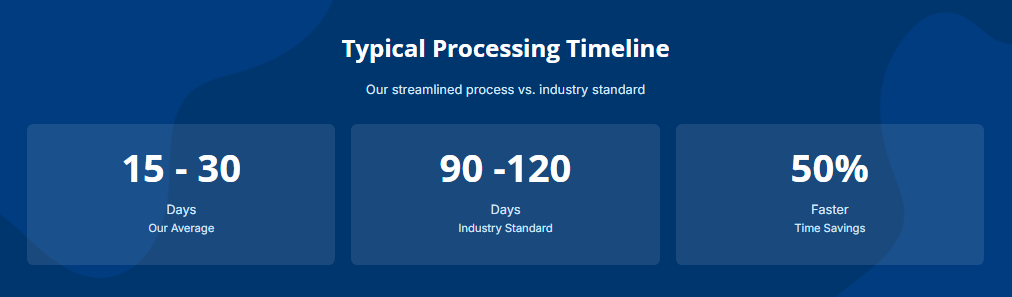
The MAC may also request additional information during processing. Responding promptly to those requests helps prevent unnecessary pauses in the application.
Using PECOS can make enrollment administration more efficient by allowing providers to submit information electronically, upload documents, electronically sign applications, and track enrollment activity.
Medicare Provider Credentialing Services
Managing Medicare enrollment becomes more challenging as organizations add providers, locations, group relationships, and enrollment changes.
A Medicare credentialing service can help organizations manage:
- PECOS enrollment information
- CMS-855 applications
- Provider documentation
- NPI and practice data
- Group affiliations
- Reassignment information
- MAC correspondence
- Application tracking
- Revalidation dates
- Enrollment updates
For organizations managing multiple providers, a provider group solution can help centralize provider information, credentialing, enrollment, and ongoing payer management.
How MantraComply Can Help With Medicare Credentialing
Managing Medicare Provider Credentialing and Enrollment across multiple providers can create significant administrative work. MantraComply brings provider data, enrollment, documents, application tracking, and ongoing monitoring into one workflow.
- Provider Data: Keep Medicare enrollment information organized and current.
- Application Management: Prepare and track enrollment applications and requirements.
- Document Management: Organize licenses, certifications, and supporting documents.
- Enrollment Tracking: Monitor application progress, outstanding requirements, and payer requests.
- Revalidation Monitoring: Track Medicare revalidation deadlines and ongoing requirements.
- Multi-Payer Management: Manage Medicare alongside other payer credentialing and enrollment workflows.
With MantraComply’s credentialing and enrollment platform, organizations can streamline Medicare enrollment and payer credentialing while reducing repetitive administrative work.
Conclusion
Medicare provider credentialing is primarily incorporated into the Medicare enrollment process rather than handled as a separate commercial-style credentialing stage. PECOS and the applicable CMS-855 application collect and verify the information needed to establish Medicare participation.
The process generally involves obtaining an NPI, setting up PECOS access, selecting the correct CMS-855 form, completing the application, submitting it to the appropriate MAC, responding to additional requests, and confirming active Medicare billing status.
Medicare enrollment also requires ongoing maintenance. Providers must keep their information current, report applicable changes within required timeframes, and complete revalidation when due.
For organizations managing multiple providers, locations, and payer relationships, healthcare credentialing automation can help centralize provider data, enrollment applications, documents, MAC follow-ups, and revalidation requirements.
Frequently Asked Questions
Medicare enrollment processing times vary by provider type, application completeness, screening requirements, MAC workload, and whether additional review or verification is required, so there is no single processing timeframe that applies to every application.
Not really – CMS doesn’t run a separate credentialing stage the way commercial and Medicaid payers do. PECOS enrollment itself covers the verification work most people associate with credentialing.
Paper forms are still accepted, but CMS strongly recommends PECOS since it’s faster and the MAC would otherwise have to manually enter a paper submission into PECOS anyway.
Most Medicare providers and suppliers generally revalidate every five years, while DMEPOS suppliers generally revalidate every three years; CMS may also require an off-cycle revalidation.
The 2026 Medicare enrollment application fee is $750 and generally applies to institutional providers and suppliers, while physicians, non-physician practitioners, physician organizations, and non-physician organizations generally do not pay the fee.
View Sources
- Centers for Medicare & Medicaid Services (CMS). Medicare Enrollment for Providers & Suppliers. Accessed 10/7/2026.
- Centers for Medicare & Medicaid Services (CMS). Enrollment Applications. Accessed 10/7/2026.
- Centers for Medicare & Medicaid Services (CMS). Medicare Provider Enrollment. Accessed 10/7/2026.
- Centers for Medicare & Medicaid Services (CMS). Revalidations (Renewing Your Enrollment). Accessed 10/7/2026.
- Centers for Medicare & Medicaid Services (CMS). Medicare Enrollment Assistance & Contacts. Accessed 10/7/2026.
- Centers for Medicare & Medicaid Services (CMS). Who are the MACs. Accessed 10/7/2026.
- MantraComply. Healthcare Provider Credentialing Services. Accessed 10/7/2026.
- MantraComply. MantraComply. Accessed 10/7/2026.