Are you planning to join a Centene health plan network and want to complete the credentialing process without unnecessary delays? Healthcare providers must meet specific professional, administrative, and payer-related requirements before they can participate in applicable Centene networks.
Centene provider credentialing involves reviewing a provider’s qualifications, licenses, education, professional history, and other relevant information. Depending on the health plan, state, and provider specialty, the process may use CAQH ProView or require additional applications and supporting documentation. Centene-affiliated health plans may have different submission procedures, so providers should always confirm the requirements for the specific plan they want to join.
Completing the application accurately, maintaining current credentials, and responding promptly to requests can help providers manage the credentialing process more efficiently. This guide explains the key requirements, documents, and steps involved in completing Centene provider credentialing successfully.
What Is Centene Provider Credentialing?
Centene provider credentialing is the process of reviewing and verifying a healthcare professional’s qualifications before they are approved to participate in an applicable Centene health plan network. The review helps confirm that providers meet the professional, regulatory, and quality standards established by the relevant plan.

The credentialing process may involve verifying:
- Current professional licenses
- Education and clinical training
- Board certification, where applicable
- Professional liability insurance
- Hospital privileges
- DEA or CDS registration, where applicable
- Work history and professional experience
- Malpractice claims and adverse actions
- Sanctions, exclusions, and other regulatory information
Centene and its affiliated organizations use credentialing standards supported by quality and regulatory requirements. Centene also identifies credentialing among the areas covered by its NCQA-related accreditation activities
The exact requirements may differ based on the provider’s specialty, state, organization type, and Centene-affiliated health plan. Therefore, providers should review the applicable plan’s provider manual and credentialing instructions before submitting an application.
Centene Provider Credentialing vs. Centene Provider Enrollment
Although provider credentialing and enrollment are connected, they serve different purposes. The key differences are summarized below:
| Centene Provider Credentialing | Centene Provider Enrollment |
|---|---|
| Verifies a healthcare professional’s qualifications and eligibility. | Registers the provider with the applicable Centene health plan. |
| Reviews professional licenses, education, training, work history, and other credentials. | Establishes administrative information needed for participation and claims processing. |
| Determines whether the provider meets applicable network credentialing standards. | May include NPI, TIN, specialty, service locations, contract details, and payment information. |
| Focuses primarily on professional qualifications and network eligibility. | Focuses primarily on payer participation, provider setup, and administrative requirements. |
| May involve CAQH information and credential verification. | May require enrollment confirmation before the provider begins servicing members. |
| Credentialing approval does not necessarily mean enrollment is complete. | Enrollment does not replace the credentialing process when credentialing is required. |
Providers may need to complete both processes before they can begin treating members under a specific Centene plan. Completing a CAQH profile or credentialing application does not automatically guarantee network participation or enrollment. For example, Sunshine Health states that practitioners should not begin servicing members until they receive a provider enrollment confirmation letter, and its enrollment process may take up to 60 days.
To avoid confusion, providers should confirm whether the applicable Centene health plan requires separate credentialing, contracting, enrollment, or demographic update submissions.
Who Is Eligible for Centene Provider Credentialing?
Eligibility depends on the Centene-affiliated health plan, the provider’s location, specialty, and the type of services offered. Individual practitioners, behavioral health professionals, allied health providers, facilities, and healthcare organizations may be required to complete credentialing when seeking network participation.
Potentially eligible provider categories may include:
- Physicians and specialists
- Nurse practitioners and physician assistants
- Behavioral health professionals
- Dentists and dental specialists
- Allied health professionals
- Clinics and medical groups
- Hospitals and other healthcare facilities
- Home health and durable medical equipment providers
- Other provider types recognized by the applicable health plan
Not every provider type follows the same credentialing process. Some providers may be required to submit information through CAQH, while others may need to complete plan-specific forms or state enrollment requirements.
Before beginning, providers should verify that Centene or the relevant affiliated health plan is accepting applications for their specialty and service area.
Basic Requirements for Centene Provider Credentialing
Providers should prepare their credentialing information before starting the application. Incomplete information, inconsistent records, or expired documents can create additional follow-up requests and delay the review.
Common requirements include:
- An active professional license: Providers should maintain a valid license in each state where they intend to provide services, when required.
- A complete credentialing application: All applicable fields should be completed, signed, and dated.
- A current CAQH profile: If the health plan uses CAQH, providers should complete the profile, upload the required documents, and authorize the appropriate Centene entity to access the information.
- Accurate professional history: Work history, education, training, and specialty information should be consistent across the application and supporting records.
- Current insurance coverage: Providers should maintain professional liability insurance that meets the plan’s requirements.
- Accurate enrollment details: NPI, TIN, service location, and legal entity information should match the relevant records.
- Timely responses: Providers should respond to requests for clarification or additional documents as quickly as possible.
For certain Centene-affiliated plans, CAQH information must be attested within a specific period. For example, Sunshine Health states that credentialing information should be attested within the previous 120 days and that Centene may retrieve documents directly from the provider’s CAQH profile. However, providers should verify the current attestation period required by their specific plan.
Documents Required for Centene Provider Credentialing
The documents required for Centene provider credentialing vary according to the provider type, state, specialty, and health plan. The following table outlines common documents that providers may need to prepare.
| Required Document | Why It Matters |
|---|---|
| Completed credentialing application | Provides the information required for credentialing review. |
| Current professional license | Confirms authorization to practice in the applicable state. |
| CAQH ProView profile and authorization | Allows the payer to access and verify credentialing information. |
| Education and training details | Supports verification of professional qualifications and specialty. |
| Board certification or professional training records | Verifies specialty credentials or applicable professional training. |
| DEA or CDS certificate | Confirms controlled substance registration, where applicable. |
| Professional liability insurance | Verifies current malpractice coverage and policy details. |
| Current CV or work history | Documents professional experience and required employment dates. |
| Hospital privilege information | Confirms current hospital privileges, where applicable. |
| NPI and tax information | Supports administrative processing and enrollment-related activities. |
| W-9 form | Confirms tax identification and legal entity information for administrative and contracting purposes. |
| Additional state or plan-specific forms | Satisfies requirements established by the applicable Centene health plan or regulatory authority. |
Providers should check the relevant application instructions before submitting documents. For example, Centene Dental lists professional liability insurance, state licensure, DEA or CDS documentation, and a W-9 among its submission requirements, while additional documents may depend on the state and provider type.beginning the credentialing process.
Step-by-Step Centene Provider Credentialing Process
The sequence below provides a general framework for Centene-affiliated provider credentialing. The exact steps, forms, documentation, and participation requirements can vary by health plan, state, product line, and provider type.
Where state Medicaid enrollment is required, confirming that status early can help providers avoid submitting an incomplete plan application or missing a prerequisite.
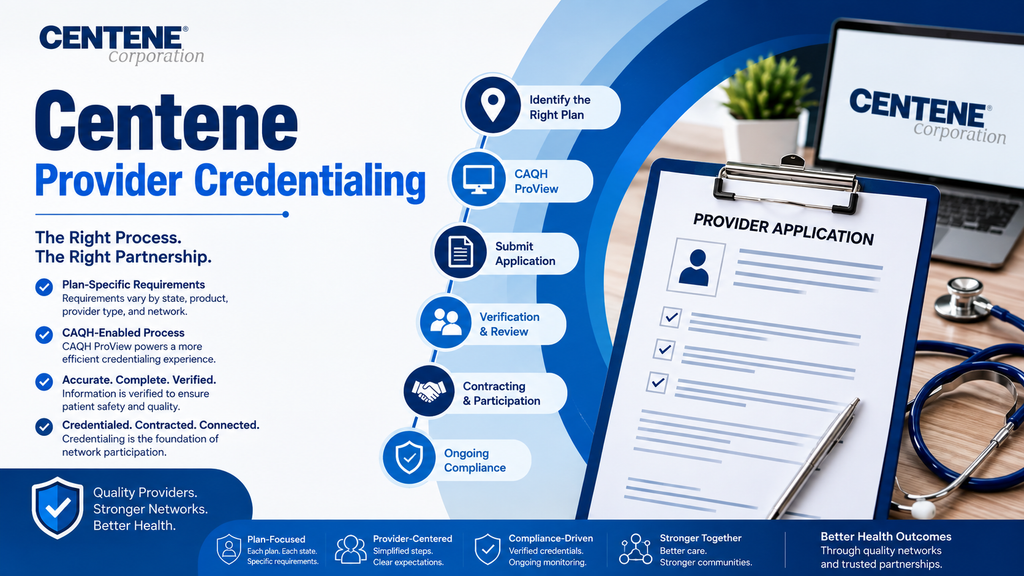
Step 1: Identify the Relevant Centene Health Plan
Centene operates through different health plans and affiliated organizations, including Medicaid, Medicare, marketplace, specialty, dental, and vision-related networks. Each plan may have its own provider portal, application process, participation criteria, and document requirements.
Start by identifying:
- The Centene-affiliated health plan you want to join
- The state where you will provide services
- Your provider specialty
- Whether you are applying as an individual or organization
- Whether you are requesting initial credentialing or recredentialing
This step helps ensure that you use the correct application and contact the appropriate provider network or enrollment team.
Step 2: Confirm Provider Eligibility and Network Availability
Before investing time in the application, confirm whether the plan is accepting providers in your specialty and geographic area. Some health plans may have network participation requirements, service area limitations, or specific contracting priorities.
Review the plan’s official provider website for information about:
- Network participation
- Provider types accepted
- Credentialing requirements
- Application forms
- Provider relations contacts
- Contracting instructions
If the plan does not provide clear instructions, contact its provider services or network management department for clarification.
Step 3: Register With CAQH, If Applicable
Many credentialing processes use the CAQH Provider Data Portal to collect and maintain provider information. If you do not have a CAQH profile, follow the registration instructions provided by the applicable payer.
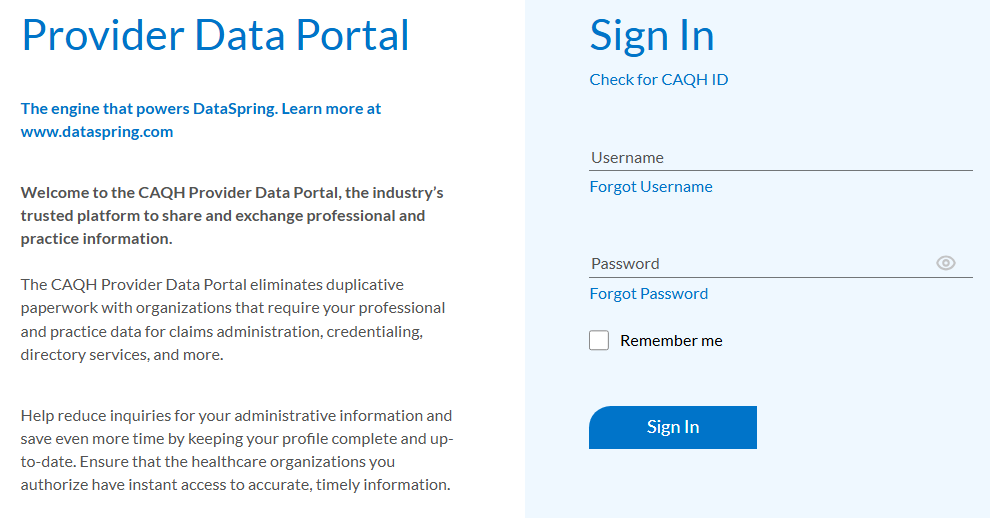
If you already have a profile, review it carefully before authorizing access. Confirm that your information is current, including your:
- Professional license
- Education and training
- Work history
- Practice locations
- Liability insurance
- Hospital privileges
- Specialty information
- DEA or CDS details, where applicable
CAQH authorization does not automatically establish participation with a payer. Providers must still follow the specific plan’s application and contracting requirements. Centene-affiliated plans may also require the provider to authorize Centene or a particular plan entity to access the profile
Step 4: Complete and Attest to the Application
Complete every applicable section of the credentialing application. Avoid leaving required fields blank or providing inconsistent information.
Before attesting, review the following:
- Legal name and professional name
- NPI and tax identification information
- License numbers and expiration dates
- Practice addresses and contact details
- Education and training history
- Employment history
- Professional liability coverage
- Hospital affiliations and privileges
- Disclosure questions
- Sanctions, claims, or adverse action information
If the application asks for explanations, provide clear and accurate responses with supporting documentation when required. The information submitted should match the provider’s CAQH profile and official records.
Step 5: Submit the Required Supporting Documents
Upload or submit the required documents through the designated portal or application channel. The submission method depends on the Centene-affiliated plan.
Some plans may retrieve documents directly from CAQH, while other provider types or specialties may require documents to be uploaded separately. Sunshine Health, for example, instructs credentialed specialties to maintain documents in CAQH and states that its credentialing department will retrieve them directly from the profile
Use a document checklist to confirm that each required item is:
- Current
- Legible
- Complete
- Properly signed, where applicable
- Consistent with the application
- Uploaded to the correct location
Keep a copy of the submitted application and supporting documents for future reference.
Step 6: Respond to Verification and Follow-Up Requests
After submission, the credentialing team may verify the information through primary sources and request clarification or additional documents. The review may include license verification, professional history, sanctions checks, and other qualification checks.
Respond promptly if the payer requests:
- Updated licenses
- Missing work history
- Clarification regarding disclosures
- Additional insurance information
- Hospital privilege details
- Corrected demographic information
- Additional state-specific forms
Delays in responding to requests may extend the overall review timeline. Providers should monitor their email, payer portal, and designated contact channels throughout the process.
Step 7: Complete Contracting and Enrollment Requirements
Credentialing approval and contracting or enrollment may be separate steps. Once credentialing requirements are satisfied, the provider may need to complete a participation agreement, submit enrollment information, or finalize administrative setup.
Depending on the plan, this stage may involve confirming:
- Contracted specialties
- Service locations
- Billing arrangements
- NPI and TIN alignment
- Effective dates
- Provider roster information
- Electronic funds transfer details
- Claims submission configuration
Providers should not assume that submitting a credentialing application means they are immediately active in the network. Confirm the official participation and enrollment status before serving members under the plan.
Step 8: Confirm Approval and Maintain Credential Information
Once the process is completed, retain the approval notice, effective date, contract documentation, and other relevant records. Confirm that the provider’s information appears correctly in the payer’s system or provider directory when applicable.
Credentialing does not end after initial approval. Providers must maintain active licenses, insurance, certifications, and accurate demographic information. Centene Dental states that providers must notify the organization of relevant changes to credentialing information and undergo recredentialing at least every 36 months in accordance with NCQA standards
How Long Does Centene Provider Credentialing Take?
The Centene credentialing timeline varies depending on the health plan, provider specialty, state requirements, application completeness, and verification process. There is no single timeline that applies to every Centene-affiliated network.
Applications may take longer when documents are missing, licenses require additional verification, work history contains gaps, or the provider does not respond promptly to follow-up requests. The contracting and enrollment stages may also have separate processing timelines after credentialing review is completed.
Some Centene-affiliated plans publish specific processing information. For example, Sunshine Health states that its enrollment process can take up to 60 days, while Centene Dental indicates that applicants receive a confirmation email within 24–72 hours after submitting a credentialing application and that a network representative will contact them within 30 days of application completion. These timeframes should not be treated as universal timelines for every Centene plan.
To reduce avoidable delays, providers should submit complete information, maintain an updated CAQH profile where applicable, monitor communication channels, and respond to credentialing requests without unnecessary delays. The most accurate timeline should be confirmed directly with the applicable Centene health plan.
Centene Provider Credentialing Services
Managing credentialing manually can require significant coordination between providers, administrative teams, health plans, and verification sources. Credentialing support services can help organizations organize documentation, monitor deadlines, and manage payer-related requirements.
Depending on the service provider, support may include:
- Credentialing application preparation
- CAQH profile management
- Document collection and verification
- Initial credentialing and recredentialing support
- Payer enrollment assistance
- Provider roster updates
- License and certification monitoring
- Application status tracking
Organizations should select a credentialing partner based on its experience with their provider types, payers, locations, and operational requirements.
How MantraComply Can Help With Centene Credentialing
MantraComply helps healthcare organizations manage credentialing and payer enrollment workflows through a technology-driven platform. Its healthcare credentialing services can support organizations that need a more structured approach to provider documentation and credentialing administration.
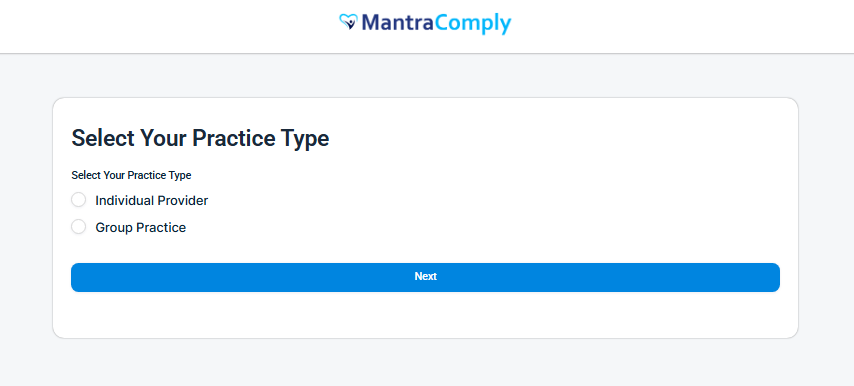
MantraComply can help providers and healthcare organizations with:
- Credentialing workflow management: Organize credentialing activities and track application progress.
- Document management: Centralize important provider documents and application information.
- Payer enrollment support: Coordinate credentialing and enrollment-related requirements across applicable payers.
- Provider group support: Manage provider information, roster updates, and related administrative workflows through provider group credentialing services.
- Ongoing monitoring: Support the tracking of credential expiration dates and required updates.
- Process automation: Explore AI-driven credentialing and enrollment automation to reduce repetitive administrative work.
The appropriate service approach depends on the organization’s provider volume, payer participation requirements, internal resources, and workflow needs.
Conclusion
Completing Centene provider credentialing successfully requires accurate information, current documentation, and compliance with the requirements of the applicable Centene-affiliated health plan. Providers should begin by identifying the correct network, reviewing eligibility criteria, completing CAQH requirements where applicable, and preparing all necessary documents.
Following each step carefully can help reduce administrative issues and improve visibility throughout the credentialing process. Because credentialing, contracting, and enrollment may involve separate stages, providers should confirm their official approval and effective participation status before serving plan members.
Frequently Asked Questions
Processing times vary by health plan, state, product line, provider type, application completeness, and credentialing review requirements. Providers should use the timeframe provided by the applicable health plan rather than rely on a universal Centene timeline.
CAQH ProView is available to providers at no cost. Providers can create and maintain their credentialing profile through the CAQH Provider Data Portal. When applicable, providers should review and re-attest to their information every 120 days, or every 180 days for Illinois providers.
Recredentialing requirements vary by health plan and provider type. Some Centene-affiliated plans require applicable providers to be recredentialed at least every 36 months, but providers should follow the schedule specified by their participating health plan.
Not necessarily. Credentialing and participation requirements can vary by health plan, state, product line, and provider type. Some Centene-affiliated plans may recognise existing credentialing for certain products, while others may require additional steps. Providers should confirm exactly which products and networks their existing credentialing covers before submitting a new application.
For Medicaid-facing products, state Medicaid enrollment may be required before or as part of plan participation, depending on the state and health plan. Providers should confirm the applicable state Medicaid enrollment requirements and the plan’s participation requirements before applying.