How long does it take to become an Aetna network provider through CVS Health, and why can the credentialing process differ depending on your specialty, location, and provider category?
The answer starts with understanding CVS Health’s structure. Aetna is the primary CVS Health entity involved in network participation for most medical, behavioral health, dental, and facility providers seeking Aetna health plan participation. CVS Caremark operates as a pharmacy benefit manager, while MinuteClinic operates retail healthcare locations. Each business has a different operational focus, so providers should identify the appropriate participation pathway before beginning the application process.
For professional providers, CAQH ProView is an important part of the credentialing process in many markets. However, specific requirements, application forms, credentialing vendors, and timelines may vary by provider type and location. Facilities, groups, and ancillary providers may also follow separate organizational requirements.
This guide explains CVS Health Provider Credentialing and Enrollment through the Aetna network participation process, including eligibility, basic requirements, required documents, credentialing steps, timelines, common mistakes, and how healthcare organizations can manage ongoing credentialing activities.
What Is CVS Health Provider Credentialing?
CVS Health provider credentialing primarily refers to the process through which Aetna evaluates a healthcare provider’s professional qualifications for participation in an applicable Aetna network.
The credentialing process may involve reviewing and verifying:
- Professional licenses and registrations
- Education and training
- Board certification, where applicable
- Professional work history
- Malpractice information
- Practice locations
- Professional affiliations
- Other qualifications required for the provider type and network
Aetna’s credentialing materials state that its Credentialing Verification Organization meets NCQA standards. The specific requirements applicable to a provider depend on the relevant state, specialty, network, and participation pathway.
Credentialing is different from contracting. Credentialing evaluates a provider’s qualifications, while contracting establishes the provider’s participation relationship with the health plan.
Completing a credentialing application does not automatically mean that a provider is active in the Aetna network. Providers should wait for confirmation of the applicable participation requirements and effective date.
For organizations managing multiple payer relationships, a centralized credentialing and enrollment platform can help organize provider information, documents, applications, and recurring deadlines.
CVS Health Provider Credentialing vs. CVS Health Provider Enrollment
CVS Health provider credentialing and provider enrollment are two separate but related processes involved in joining healthcare networks and establishing payer participation. Credentialing focuses on verifying a healthcare provider’s professional qualifications, licenses, and clinical background, while enrollment involves registering the provider with the payer for administrative processing and reimbursement. Understanding the difference can help providers navigate participation requirements, particularly when working with Aetna, a CVS Health company.
| CVS Health Provider Credentialing | CVS Health Provider Enrollment |
|---|---|
| Verifies a provider’s qualifications, licenses, education, and professional experience. | Registers a provider with the payer for participation and reimbursement. |
| Evaluates whether the provider meets professional and quality requirements. | Establishes the administrative and billing relationship with the payer. |
| Reviews licenses, certification, education, work history, and malpractice history, where applicable. | May include NPI, tax identification number, practice details, and billing information. |
| Includes primary source verification of professional credentials. | Involves reviewing and validating information required for payer registration. |
| Credentialing and contracting are separate processes that may both be required for network participation. | Supports the administrative setup associated with payer participation and billing. |
| Does not independently guarantee claims-processing eligibility. | Helps establish the payer details required for claims submission and reimbursement. |
| Confirms that the provider meets applicable credentialing requirements. | Completion of the payer registration does not replace credentialing requirements. |
| Reviews provider qualifications as part of network participation. | Supports registration and administrative setup, subject to payer approval. |
| May require periodic recredentialing and updated professional information. | May require updates to provider, practice, tax, billing, or participation information. |
Who Is Eligible for CVS Health Provider Credentialing?
CVS Health provider credentialing generally applies to eligible healthcare professionals and organizations seeking participation in an applicable Aetna network.
Eligibility and application requirements may vary by state, provider type, specialty, and network.
Professional Providers
Providers who may need to complete the applicable Aetna credentialing process include:
- Physicians
- Primary care providers
- Specialty physicians
- Behavioral health providers
- Psychologists
- Therapists and counselors
- Nurse practitioners
- Physician assistants
- Other advanced practice providers
- Dental professionals
- Other eligible healthcare professionals
The exact categories supported by a particular Aetna network may differ. Providers should review the relevant participation requirements before submitting an application.
Institutional and Ancillary Providers
Aetna may also have separate participation and credentialing requirements for organizations such as:
- Hospitals
- Healthcare facilities
- Imaging centers
- Urgent care clinics
- Ancillary providers
- Group practices
- Other eligible healthcare organizations
Institutional and ancillary providers may need to complete organizational applications rather than relying solely on an individual practitioner’s CAQH profile.
A group or facility’s participation status also does not necessarily replace the need for individual practitioner credentialing.
Basic Requirements for CVS Health Provider Credentialing
Before starting CVS Health Provider Credentialing, providers should ensure that their professional and organizational information is complete, current, and consistent.
Depending on the provider type and applicable Aetna network, common requirements may include:
- Active professional license
- National Provider Identifier (NPI)
- CAQH ProView profile, where applicable
- Current malpractice insurance information
- Board certification details, where applicable
- Education and training information
- Professional work history
- Practice location information
- Group affiliation details
- Tax identification information
- Medicare or Medicaid information, where applicable
- Current provider contact information
Aetna may use CAQH information as part of its credentialing process for applicable providers. Providers should confirm whether CAQH is the required pathway for their specific market and provider category.
Before submitting an application, compare the information in the CAQH profile with licensing records, NPI information, malpractice documentation, and practice details. Consistency can help reduce unnecessary verification requests.
Documents Required for CVS Health Provider Credentialing
Preparing documents before beginning the application can help providers respond to payer requests more efficiently.
The exact documentation may vary depending on provider type, state, specialty, and network requirements.
Common documents and information may include:
| Document or Information | Why It Matters |
|---|---|
| Active state license | Confirms authorization to practice in the applicable state. |
| DEA registration | May be required for providers who prescribe controlled substances. |
| Board certification | Supports verification of specialty qualifications, where applicable. |
| Education and training history | Helps verify professional background. |
| Work history | Supports review of employment and practice experience. |
| Malpractice information | Supports professional liability review. |
| CAQH profile | Provides credentialing information for authorized health plans where applicable. |
| NPI information | Helps identify the individual or organization. |
| Practice locations | Confirms where covered services will be delivered. |
| Group affiliation details | Connects the individual practitioner with the applicable organization. |
| Professional references or additional documents | May be requested depending on provider type or market. |
Providers should use the specific document list supplied by the applicable Aetna team or participation process rather than assuming that the same requirements apply to every provider.
Step-by-Step CVS Health Provider Credentialing Process
The sequence below reflects what Aetna generally expects from providers pursuing CVS Health provider credentialing across most states and specialties.
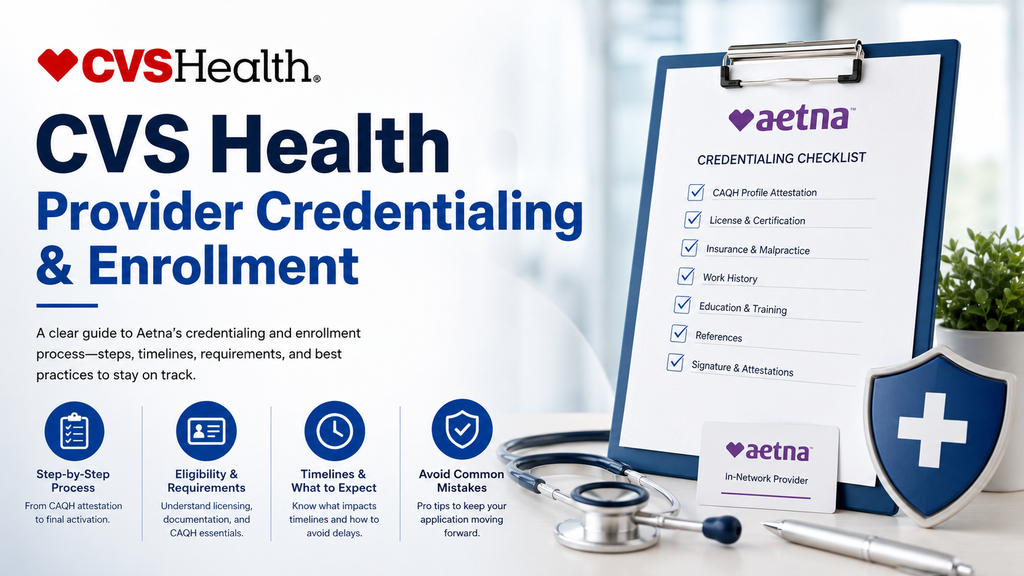
Step 1: Confirm the Correct CVS Health Entity and Aetna Network
Before submitting an application, determine which CVS Health business and network handle the services you want to provide.
For most providers seeking participation in an Aetna health network, Aetna is the relevant organization. CVS Caremark and MinuteClinic operate separately and should not automatically be treated as alternatives to Aetna’s medical provider credentialing process.
Confirm:
- The relevant Aetna network
- The provider’s specialty
- The service location
- The provider category
- Whether the application is individual or organizational
- Whether CAQH or another credentialing vendor applies
Starting with the correct pathway can help reduce routing errors and unnecessary administrative delays.
Step 2: Check Whether You Are Already Contracted
Before submitting a new participation request, determine whether the provider or group already has an existing relationship with the applicable Aetna network.
This may be important when:
- A provider is joining an existing group
- A practice is adding a new practitioner
- A group is opening another location
- A provider is changing affiliations
- An existing contract needs to be updated
An existing group contract does not necessarily mean that a newly added practitioner is already credentialed. Individual providers may still need to complete their own application and review.
Confirm the appropriate process with Aetna before submitting a duplicate application.
Step 3: Submit the Applicable Aetna Participation Request
If the provider or organization is not already participating, submit the applicable Aetna Request for Participation or designated network inquiry.
The information requested may vary, but can include:
- Provider name
- Specialty
- NPI
- CAQH number, where applicable
- License number
- Tax identification details
- Practice address
- Group information
- Professional contact details
- Other information relevant to the network
The participation request may be reviewed for network need and eligibility before the applicable credentialing and contracting process proceeds.
Submitting a participation request does not guarantee network acceptance or credentialing approval.
Step 4: Register With CAQH ProView
Many applicable professional providers use CAQH ProView during credentialing.
If CAQH is required for the provider’s network and category, the provider should create or update the profile with accurate and complete information.
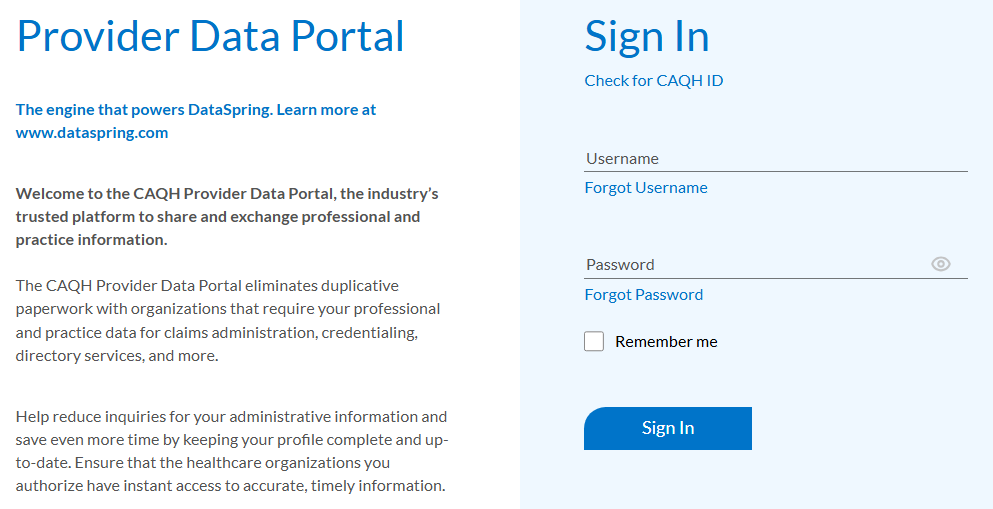
The profile may include:
- Licensure
- Education
- Training
- Work history
- Malpractice coverage
- Practice locations
- Professional affiliations
- Other professional credentials
Providers should ensure that their CAQH profile is complete, current, and properly attested before the payer attempts to access it.
An incomplete or outdated profile can lead to additional follow-up requests and may delay credentialing.
Step 5: Authorize Aetna to Access the CAQH Profile
Where CAQH applies, providers must complete the relevant authorization requirements so that Aetna can access the applicable credentialing information.
Before proceeding, verify that:
- The CAQH profile is complete.
- Required documents have been uploaded.
- The information is current.
- Aetna has been appropriately authorized.
- The profile has been attested within the applicable CAQH cycle.
CAQH generally requires re-attestation every 120 days, with specific exceptions or different requirements potentially applying to certain providers and jurisdictions. Providers should confirm the current requirements applicable to their situation.
Step 6: Choose the Correct Application Path
After the initial participation request, the applicable Aetna process determines the credentialing pathway.
Professional providers may follow an individual credentialing process, while facilities, groups, and ancillary organizations may need separate organizational documentation.
This distinction matters because:
- An individual CAQH profile may not replace a facility application.
- A group contract may not replace individual practitioner credentialing.
- Facility participation may involve organizational qualifications.
- Different provider categories may use different application processes.
Providers should confirm the applicable requirements before submitting documents.
Step 7: Submit Supporting Documentation
Once the application is underway, Aetna or its designated credentialing organization may request supporting documentation.
Depending on the provider category, this may include:
- Professional license
- Malpractice insurance information
- Board certification
- Education and training records
- Work history
- Professional registrations
- Facility documentation
- Other applicable credentials
Responding promptly is important. Missing, expired, or inconsistent information can lead to additional review and may affect the progress of the application.
Providers should monitor their email and other communication channels for documentation requests and maintain an organized record of submitted materials.
Step 8: Complete Primary-Source Verification
After the application is sufficiently complete, Aetna or its designated credentialing organization performs primary-source verification as required.
Verification may include:
- Professional licenses
- Education
- Training
- Board certification
- Malpractice history
- Professional registrations
- Other applicable qualifications
The information provided in CAQH and supporting documents should match the information held by the original issuing sources.
For example, a mismatched license number, outdated practice address, or inconsistent provider name may lead to additional clarification.
Primary-source verification is a core part of the credentialing process and may also be relevant during recredentialing.
Step 9: Complete Credentialing Review
Aetna evaluates the provider against applicable credentialing and participation standards.
The review may consider:
- Professional qualifications
- Licensure
- Education and training
- Board certification
- Professional history
- Malpractice information
- Other required documentation
Aetna states that its Credentialing Verification Organization meets NCQA standards. The exact review requirements and decision procedures may vary by provider category, state, and network.
Providers should not assume that completing CAQH or submitting documents means that credentialing has already been approved.
Step 10: Complete Aetna Contracting
Credentialing and contracting are separate components of network participation.
Credentialing addresses:
Does the provider meet the applicable professional and participation requirements?
Contracting addresses:
Is the provider participating under the applicable network agreement?
The sequence between these activities may vary depending on the relevant Aetna process. Providers should follow the instructions provided by the applicable contracting and credentialing teams.
Before treating the provider as active in-network, confirm:
- The contract has been finalized.
- Any required signatures have been completed.
- The applicable participation decision has been issued.
- The effective date has been confirmed.
- Any additional activation or enrollment requirements have been completed.
Step 11: Receive Formal Participation Notification
Once the applicable credentialing and contracting requirements are complete, the provider should receive the appropriate participation notification or confirmation.
Do not assume that network participation has started simply because:
- The CAQH profile is complete.
- The application has been submitted.
- Supporting documents have been accepted.
- Credentialing is under review.
- The provider has received a credentialing decision.
The applicable Aetna confirmation and effective date should determine when participation begins.
Providers should retain relevant approval communications, contract documents, and effective-date information for their records.
Step 12: Set Up Provider Portal Access
After participation is established, providers may use the applicable Aetna provider tools for ongoing administrative activities.
Depending on the network and provider category, resources may include:
- Claims-related tools
- Eligibility resources
- Provider information management
- Administrative transactions
- Enrollment-related functions
- Other provider support resources
Available tools and access requirements may vary. Providers should use the applicable Aetna provider portal and follow the instructions provided for their network.
Step 13: Verify the Provider Directory Listing
Once the provider is active, review the applicable Aetna provider directory.
Check the following information:
- Provider name
- Specialty
- Practice address
- Phone number
- Group affiliation
- Service locations
- Other demographic details
Accurate directory information helps members locate participating providers and access services.
If the information is incorrect or incomplete, contact the appropriate Aetna team to request a correction.
Step 14: Maintain Credentialing and Recredentialing Information
Credentialing does not end when the initial application is approved.
Providers should continue monitoring:
- CAQH re-attestation
- License renewals
- Board certification
- Malpractice insurance
- Practice locations
- Group affiliations
- Specialty changes
- Provider contact details
- Recredentialing deadlines
Aetna generally recredentials providers every three years, unless applicable state or federal requirements or accrediting standards require a different interval.
How Long Does CVS Health Provider Credentialing Take?
There is no single timeline that applies to every CVS Health or Aetna provider credentialing application.
Processing time may depend on:
- Provider type
- State
- Network
- Application completeness
- CAQH status
- Primary-source verification
- Documentation requests
- Contracting requirements
- Network participation review
The previously described Aetna onboarding stages may include participation review, contracting, credentialing, and final activation. However, providers should not treat a generalized timeline as a guaranteed completion period for every application.
A more reliable approach is to:
- Submit complete and accurate information.
- Maintain an updated CAQH profile, where applicable.
- Respond quickly to payer requests.
- Track contracting and credentialing separately.
- Confirm the effective participation date directly with Aetna.
Processing may take longer when documents are incomplete, credentials are expired, external verification is delayed, or additional information is requested.
CVS Health Provider Credentialing Services
Managing CVS Health provider credentialing manually can become difficult when a healthcare organization has multiple providers, locations, specialties, and payer relationships.
Credentialing services may help organizations manage:
- CAQH profiles
- Provider applications
- Supporting documents
- License expirations
- Malpractice insurance
- Application status
- Payer communications
- Contracting milestones
- Provider directory information
- Recredentialing deadlines
This coordination can be especially useful for organizations managing individual practitioners alongside group and facility requirements.
A centralized credentialing and enrollment workflow can help teams organize payer-specific requirements while maintaining visibility into outstanding tasks and upcoming deadlines.
How MantraComply Can Help With CVS Health Credentialing
Managing CVS Health Provider Credentialing and Enrollment requires more than submitting an initial application. Healthcare organizations must also maintain provider data, monitor supporting documents, respond to payer requests, track participation milestones, and manage recurring credentialing requirements.
MantraComply’s credentialing and enrollment platform can help healthcare organizations centralize these administrative workflows.
- CAQH Management – Organize provider information used in applicable credentialing processes and support ongoing data maintenance.
- Application Preparation – Use centralized provider data to help teams prepare payer-specific applications and reduce repetitive information collection.
- Document Management – Manage licenses, malpractice insurance, certifications, and other credentialing documents while monitoring expiration dates.
- Payer Enrollment – Coordinate payer enrollment workflows alongside credentialing and contracting activities.
- Application Tracking – Monitor application status, outstanding requirements, and payer communications through a centralized workflow.
- Recredentialing Management – Track recurring recredentialing requirements and deadlines to help teams prepare before credentials expire or reviews become urgent.
Organizations should confirm the specific capabilities, integrations, and workflow coverage offered by any credentialing platform before implementation.
Conclusion
CVS Health Provider Credentialing is primarily managed through Aetna for providers seeking participation in applicable Aetna health networks. The process is not necessarily identical for every provider, state, specialty, or network.
The overall process generally involves identifying the correct Aetna pathway, confirming existing participation, submitting the applicable request, maintaining CAQH where required, providing supporting documentation, completing primary-source verification, finalizing contracting, receiving formal notification, and reviewing provider information after activation.
Credentialing also does not end with the initial approval. Providers and healthcare organizations need to maintain licenses, insurance information, practice details, directory data, and recredentialing requirements throughout the participation relationship.
For organizations managing multiple providers and payer relationships, a centralized credentialing and enrollment workflow may help improve visibility into applications, documents, payer requests, and recurring deadlines.
Frequently Asked Questions
Aetna’s published onboarding timeline spans several stages rather than one fixed credentialing period: approximately 1–30 days for the initial participation request, 30–60 days for contracting, 60–90 days for credentialing, and 90–120 days for final contracting and activation. Actual timing can vary by provider type, state, network need, and application completeness.
No. CAQH ProView is free for providers. Re-attestation is generally required every 120 days, although CAQH specifies a 180-day interval for providers practising in Illinois. An expired CAQH status can prevent authorised organisations from receiving current profile information.
Aetna generally recredentials providers every three years, unless state or federal regulations or accrediting standards require a different interval. Keeping CAQH information current can help support a smoother recredentialing process.
Aetna is the primary CVS Health organisation involved when providers seek participation in Aetna health networks. Aetna’s network process covers medical, behavioral health, dental, facility, and other provider categories, with requirements varying by provider type and market. CVS Caremark and MinuteClinic operate separate businesses and should not be treated as interchangeable with Aetna’s network credentialing process.
Most individual providers use CAQH ProView, but Aetna identifies exceptions. Washington providers, physicians in Arkansas, and providers joining the Allina Health | Aetna joint venture network in Minnesota use different credentialing vendors. Providers in these markets should confirm the applicable pathway with Aetna before submitting their application.