Which state plan is actually reviewing the file – Illinois, Texas, New Mexico, Oklahoma, or Montana? That question matters more than most providers realize. HCSC provider: How does HCSC provider credentialing work across Illinois, Texas, New Mexico, Oklahoma, and Montana? The answer depends on the specific Blue Cross and Blue Shield plan, provider type, and participation requirements. Although the five plans operate under Health Care Service Corporation (HCSC), their credentialing and enrollment processes can vary by state.
HCSC provider credentialing involves more than submitting a CAQH profile or completing a provider application. Providers must prepare accurate documentation, authorize access to their credentialing information, complete primary-source verification, and satisfy the contracting and enrollment requirements of the applicable state plan.
A complete or accurate application can help reduce avoidable delays, particularly when providers manage multiple licenses, practice locations, malpractice documents, and state-specific requirements. This guide explains HCSC provider credentialing, eligibility, required documents, the step-by-step process, timelines, common mistakes, and how credentialing services can support healthcare organizations.
What Is HCSC Provider Credentialing?
HCSC provider credentialing is the process of reviewing and verifying a healthcare provider’s professional qualifications before the provider can participate in an applicable HCSC network. HCSC, or Health Care Service Corporation, operates Blue Cross and Blue Shield health plans in Illinois, Texas, New Mexico, Oklahoma, and Montana, with provider-network processes handled through the applicable state plan.
The credentialing process generally involves reviewing information such as:
- Professional licenses
- Education and training
- Work history
- Malpractice or professional liability information
- Board certification, where applicable
- Other professional credentials and qualifications
HCSC’s credentialing functions also involve compliance with applicable NCQA, URAC, CMS, state, and federal requirements, depending on the provider and plan.
A key point for providers is that HCSC credentialing is not necessarily the same as enrollment or contracting. Credentialing verifies whether the provider meets applicable professional and network standards, while enrollment involves administrative setup and participation in the payer’s systems. HCSC-operated plans may have different processes and requirements by state, so providers should identify the appropriate Blue Cross and Blue Shield plan before beginning the application.
For an HCSC credentialing blog, I would specifically emphasize the five state plans rather than presenting HCSC as one single uniform credentialing process.
HCSC Provider Credentialing vs. HCSC Provider Enrollment
HCSC provider credentialing and enrollment are connected but serve different purposes.
Credentialing focuses on verifying whether a provider meets the applicable professional and credentialing standards. Enrollment involves administrative activities needed to establish the provider’s participation, load the provider record into the relevant systems, and confirm when the provider can become active and billable under the applicable agreement.
| HCSC Provider Credentialing | HCSC Provider Enrollment |
|---|---|
| Verifies professional qualifications and credentials. | Completes administrative participation requirements. |
| May include license, education, training, and malpractice verification. | May include provider record setup and claims system loading. |
| Involves primary-source verification. | May involve tax, practice, contract, and effective-date information. |
| Determines whether applicable credentialing standards are met. | Helps establish active participation and billing status. |
| May involve credentialing committee review. | May follow or occur alongside credentialing and contracting. |
A provider can complete one stage without completing the other. For example, submitting a CAQH profile and signing a contract does not necessarily mean that enrollment is complete.
Providers should confirm:
- Whether credentialing has been approved
- Whether contracting is complete
- Whether the provider record has been loaded
- Whether the effective date has been established
- Whether active network participation has been confirmed
Tracking credentialing and enrollment as separate but connected processes can help practices understand which requirements remain outstanding.
HCSC Provider Credentialing Eligibility
To qualify for HCSC provider credentialing, healthcare professionals and organizations must meet the applicable state plan, specialty, licensing, and participation requirements. Eligibility may vary across HCSC’s five Blue Cross and Blue Shield plans, so providers should confirm the criteria for their specific location and provider type.
Providers may generally need to meet the following requirements:
- Valid professional license: Hold an active license to practice in the relevant state.
- Professional qualifications: Meet the education, training, certification, and specialty requirements applicable to the provider type.
- CAQH profile: Maintain a complete and accurate CAQH ProView profile, where required.
- Malpractice insurance: Provide current professional liability insurance documentation.
- DEA registration: Submit a valid DEA registration when applicable to the provider’s scope of practice.
- Board certification: Provide board certification details or other specialty qualifications, where required.
- Hospital privileges: Meet applicable hospital affiliation or admitting-privilege requirements.
- Accurate practice information: Submit current practice addresses, contact details, group affiliations, and tax information.
- Supporting documentation: Provide all documents required by the applicable HCSC state plan.
- Primary-source verification: Complete verification of professional credentials and other required information.
Meeting these requirements does not guarantee credentialing approval. HCSC may apply additional criteria based on the provider’s specialty, state, network, and participation arrangement.
Documents Required for HCSC Provider Credentialing
The documents required for HCSC credentialing can vary by state plan, provider type, specialty, and applicable participation requirements. Providers should confirm the specific checklist issued by the relevant HCSC plan before submitting an application.
Common documents and information may include:
| Document Checklist | Why It Matters |
|---|---|
| Professional License | Confirms the provider is legally authorized to practice in the applicable state. |
| CAQH Information | Provides standardized provider information and supports credentialing verification where applicable. |
| Malpractice Insurance | Verifies that the provider maintains required professional liability coverage. |
| NPI Information | Identifies the provider for healthcare transactions and supports accurate provider records. |
| Tax Information | Supports accurate tax reporting, contracting, and payment setup. |
| DEA Registration | Confirms authorization to prescribe controlled substances when applicable. |
| Education and Training | Verifies the provider’s educational background, residency, fellowship, and professional training. |
| Board Certification | Confirms specialty certification when required or applicable. |
| Hospital Privileges | Provides information about hospital affiliations or clinical privileges where relevant. |
| Practice Information | Ensures accurate practice locations, contact details, and specialty information. |
| Facility Documentation | Verifies applicable facility certifications, such as CLIA certification for laboratory testing. |
| Contractual Documents | Supports completion of provider agreements, disclosures, and other required contracting documentation. |
Not every provider will need to submit every document listed above. The applicable HCSC plan may request additional documentation based on the provider’s specialty, organization type, or state-specific requirements.
Document Preparation Checklist
Before submitting an HCSC provider application, providers should:
- Confirm that all licenses are current.
- Check the expiration date of malpractice coverage.
- Review CAQH information for accuracy.
- Confirm NPI and taxonomy information.
- Prepare a signed W-9 where required.
- Check whether DEA registration applies.
- Gather board certification and hospital privilege information where relevant.
- Confirm practice locations and contact details.
- Prepare facility-specific documentation, such as a CLIA certificate, where applicable.
- Keep copies of all submitted documents.
Accurate and consistent documentation can help reduce clarification requests during primary-source verification and credentialing review.
Step-by-Step HCSC Provider Credentialing Process
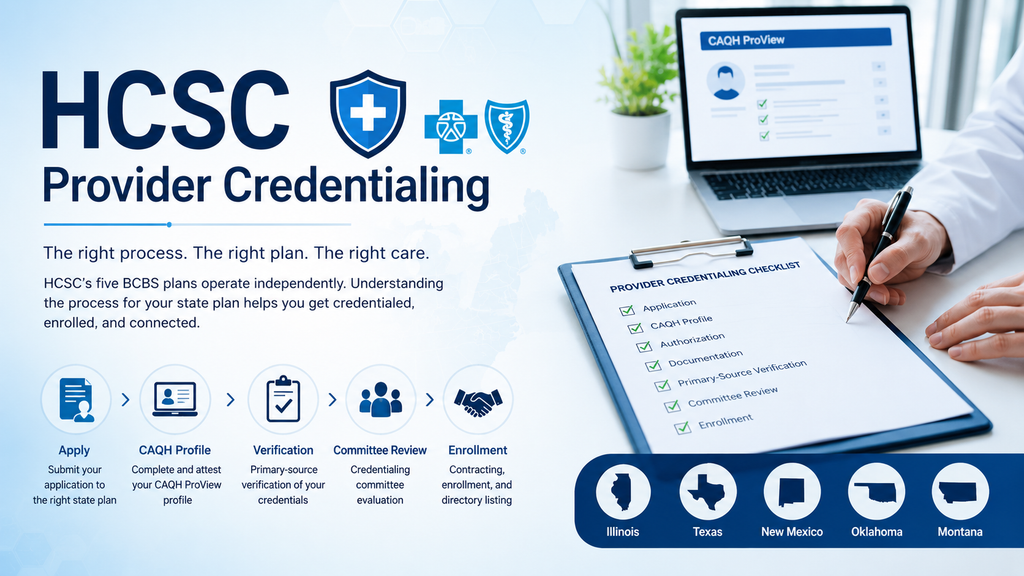
The HCSC credentialing process varies by state plan, provider type, and applicable requirements. However, providers generally move through a sequence involving state plan identification, CAQH preparation, application submission, document verification, credentialing review, contracting, and enrollment.
Step 1: Confirm the Correct HCSC State Plan
Begin by identifying which HCSC-operated Blue Cross and Blue Shield plan covers the provider’s state.
The five HCSC plans serve:
- Illinois
- Texas
- New Mexico
- Oklahoma
- Montana
Each plan may have its own application process, portal, contact procedure, and credentialing requirements.
Before submitting any documents, confirm:
- The applicable state plan
- Provider type and specialty
- Participation pathway
- Required application
- Applicable network requirements
- State-specific deadlines
Selecting the correct plan at the beginning can help prevent unnecessary application errors and delays.
Step 2: Register With CAQH ProView
Where the applicable HCSC plan uses CAQH ProView, providers should create and maintain a complete profile.
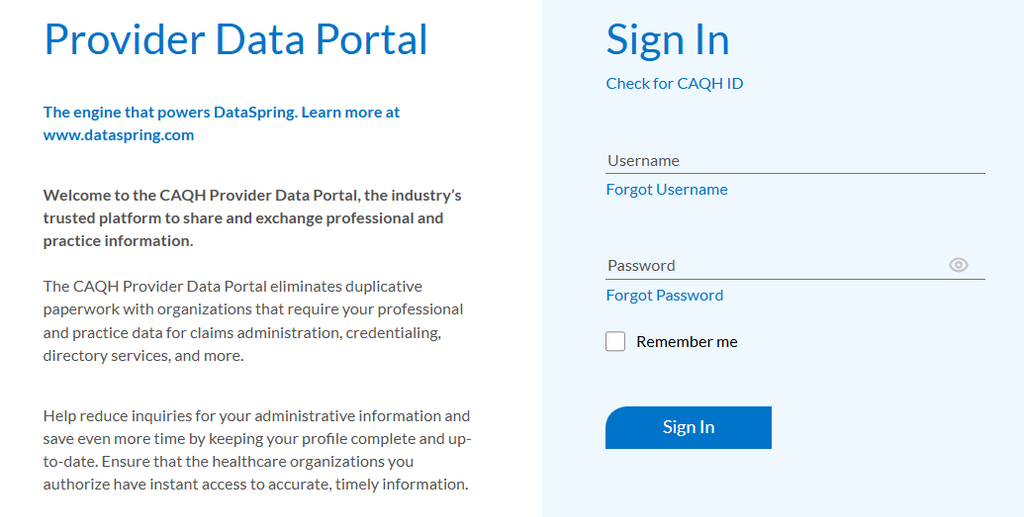
The profile may include:
- Professional license information
- Education and training
- Work history
- Malpractice information
- Practice locations
- Professional identification details
- Other credentialing information
CAQH registration is free, and providers receive a unique provider identification number after registration, according to the source material.
Before authorizing access, review the profile carefully to ensure that all relevant information is complete, current, and consistent with the supporting documents.
Step 3: Authorize HCSC Access to the CAQH Profile
Completing a CAQH profile alone may not be sufficient. Where required, providers must authorize the relevant HCSC state plan to access their CAQH information.
Providers should:
- Complete the applicable CAQH profile.
- Review all required information.
- Complete the necessary attestation.
- Authorize the relevant HCSC plan to access the profile.
- Confirm that the authorization is active.
Without the required authorization, the state plan may be unable to access the information needed for its credentialing review.
Providers should also monitor their CAQH profile for updates, attestation requirements, and requests for additional information.
Step 4: Submit the HCSC Provider Application
Complete the applicable HCSC state plan’s provider onboarding, participation, or credentialing application.
The application may require information such as:
- Provider name
- NPI
- Tax identification details
- Practice information
- Specialty
- Practice locations
- Professional license details
- CAQH identification number
- Contact information
Review all information carefully before submission. Details in the application should match the provider’s CAQH profile and supporting documents.
Providers should avoid assuming that an application used for one HCSC state plan can be reused without modification for another.
Step 5: Submit Supporting Documents
After completing the application, submit the documentation required by the applicable state plan.
Depending on the provider type and specialty, this may include:
- Current malpractice certificate
- Active professional license
- DEA registration
- Signed W-9
- Board certification evidence
- Hospital privilege information
- Facility documents
- Other state-specific forms
Before submitting documents, confirm that they are:
- Current
- Complete
- Readable
- Correctly attached
- Consistent with the application
- Submitted through the requested channel
An incorrect attachment, expired document, or missing form can result in additional requests and extend the review process.
Step 6: Complete Primary-Source Verification
The applicable HCSC plan conducts primary-source verification of the provider’s credentials.
This may include verifying:
- Professional licensure
- Education
- Training
- Malpractice coverage
- Board certification
- Other professional qualifications
Verification may require communication with licensing boards, educational institutions, insurers, or other authorized sources.
Providers can help reduce avoidable clarification requests by ensuring that the information in their CAQH profile matches their submitted documentation.
Licenses and certifications should also remain valid during the credentialing process. If a credential is close to expiration, providers should take appropriate steps to renew it in advance.
Step 7: Complete Credentialing Committee Review
Once the required information and verification activities are completed, the provider’s file may proceed to credentialing committee review.
The committee evaluates the file against the applicable HCSC credentialing standards, state requirements, and regulatory expectations.
During this stage:
- The file should be complete.
- Credentials should remain current.
- Requested clarifications should be addressed.
- Provider communications should be monitored.
- Additional documents should be submitted promptly.
A credentialing file may remain pending if information is incomplete or if the plan needs additional clarification before reaching a final decision.
Step 8: Receive the Credentialing Decision
The provider receives written notification after the applicable HCSC credentialing process is completed.
The notification may outline:
- The credentialing outcome
- Any additional requirements
- Next steps
- Contracting instructions
- Other applicable participation information
Providers should retain the notification and related correspondence for future reference.
If the plan requests missing or updated information, respond within the specified timeframe. Failure to respond may affect the status of the application and could lead to the file being closed before a final decision.
Step 9: Complete Contracting Requirements
After credentialing approval, the applicable HCSC plan may issue a provider agreement covering participation terms and reimbursement arrangements.
Providers should carefully review:
- Contract terms
- Reimbursement rates
- Participation requirements
- Effective dates
- Applicable responsibilities
- Additional administrative provisions
Contract terms can differ between HCSC state plans. Providers should review the agreement specific to the plan with which they intend to participate.
Return signed documents promptly and retain copies of the completed agreement.
Step 10: Complete HCSC Provider Enrollment
Following or alongside credentialing and contracting, providers may need to complete administrative enrollment activities.
Enrollment may involve:
- Loading the provider record
- Confirming practice information
- Establishing system records
- Verifying the effective date
- Completing participation-related requirements
Credentialing approval does not automatically confirm that every enrollment requirement has been completed.
Providers should continue monitoring communications until the applicable HCSC plan confirms that the provider is active within the relevant systems.
Step 11: Confirm Directory Listing and Active Network Status
After credentialing, contracting, and enrollment requirements are completed, the provider’s information may be added to the applicable HCSC systems and provider directory.
The effective date determines when network participation begins according to the plan’s requirements.
Providers should confirm:
- Provider name
- Specialty
- Practice address
- Contact details
- Network participation status
- Panel status
- Effective date
- Directory accuracy
A directory review can help identify errors before members attempt to schedule appointments based on incorrect information.
Step 12: Verify That All Information Is Accurate
After activation, review the provider’s listing through the applicable state plan’s provider portal or directory.
Report incorrect information, such as an outdated address, incorrect specialty, or inaccurate panel status, to the relevant HCSC plan.
Providers should also continue updating information when changes occur to:
- Professional licenses
- Malpractice coverage
- Practice locations
- Provider affiliations
- Contact information
- Credentialing details
Maintaining accurate information after enrollment supports ongoing participation and future recredentialing activities.
How Long Does HCSC Provider Credentialing Take?
HCSC credentialing timelines vary according to the applicable state plan, provider type, application completeness, primary-source verification, and additional documentation requirements.
There is no single national timeline that applies to all five HCSC plans. Providers should follow the timeframe communicated by the relevant state plan rather than relying on a general estimate.
Factors that may affect processing time include:
- Incomplete application information
- Outdated CAQH details
- Missing authorization to access CAQH
- Expired licenses or malpractice documents
- Additional verification requirements
- Delayed responses to clarification requests
- Missing signatures or forms
- Contracting requirements
- State-specific enrollment procedures
Providers may not be able to control the time required for external verification, but they can reduce avoidable delays by submitting complete and accurate information.
Recredentialing is also an ongoing responsibility. The applicable cycle and deadlines can vary by HCSC plan, provider type, and regulatory requirements.
HCSC Credentialing for Group Practices and Facilities
Group practices and facilities may have organizational credentialing requirements in addition to individual practitioner credentialing.
Depending on the applicable HCSC plan and provider type, organizations may need to provide information about:
- Group practice details
- Facility information
- Practice locations
- Organizational credentials
- Tax identification information
- Participating practitioners
- Supporting documentation
- Applicable contractual arrangements
Individual practitioners may still need separate credentialing even when they join an existing group.
Some organizations may qualify for delegated credentialing arrangements where permitted by the applicable HCSC plan. These arrangements can involve separate eligibility, oversight, and contractual requirements.
Organizations should confirm whether their group, facility, or delegated credentialing pathway requires additional documentation beyond individual provider credentialing.
Working With an HCSC Credentialing Service
Managing HCSC provider credentialing across multiple states can create a significant administrative workload. Practices may need to monitor separate state-plan requirements, CAQH attestation deadlines, document expiration dates, application statuses, and payer communications.
A credentialing service can support administrative coordination by helping practices:
- Identify the correct HCSC state plan.
- Organize provider documents.
- Monitor CAQH information and attestation requirements.
- Track application progress.
- Identify missing or expired documentation.
- Follow up on outstanding requirements.
- Prepare for recredentialing.
- Coordinate group provider onboarding.
- Monitor provider enrollment activities.
- Review directory information after activation.
Credentialing support does not replace the provider’s responsibility to complete personal attestations, sign provider agreements, or approve information requiring their direct authorization.
The value of a credentialing service is primarily in coordinating the administrative workflow, maintaining organized records, and helping practices identify outstanding requirements.
How MantraComply Can Help With HCSC Credentialing and Enrollment
Managing HCSC credentialing across multiple state plans requires ongoing attention to provider records, documentation, deadlines, and payer communication.
MantraComply can help healthcare organizations organize credentialing and enrollment activities through a centralized workflow.
- CAQH Management: Maintain provider information and help identify inconsistencies across payer records.
- Application Preparation: Organize state-specific HCSC requirements and support application coordination.
- Document Management: Store licenses, malpractice certificates, certifications, and other supporting documents.
- Payer Enrollment: Coordinate credentialing, contracting, enrollment, and participation-related activities.
- Application Tracking: Monitor application progress, outstanding documents, and follow-up requirements.
- Credential Monitoring: Track credential expiration dates and upcoming renewal requirements.
- Group Provider Onboarding: Organize credentialing information for multiple practitioners joining a group.
- Recredentialing Support: Track recurring requirements and help practices prepare for upcoming recredentialing activities.
Healthcare organizations looking for broader support can explore credentialing and enrollment services to organize provider information and manage payer participation requirements.
Conclusion
HCSC provider credentialing is state-specific because its five Blue Cross and Blue Shield plans have different requirements. While the process generally includes CAQH preparation, application submission, verification, contracting, and enrollment, requirements vary by state and provider type.
Providers should identify the correct state plan, maintain accurate records, submit complete documentation, respond to requests promptly, and confirm enrollment, network status, directory information, and recredentialing deadlines. Structured credentialing support can help practices manage documents, applications, and deadlines efficiently.
Frequently Asked Questions
There is no single HCSC credentialing timeline. Processing time can vary by state plan, provider type, application completeness, verification requirements, and outstanding documentation. Providers should follow the timeframe provided by the applicable HCSC plan.
CAQH requirements vary by HCSC plan and provider type. Many providers may use CAQH ProView as part of the credentialing process, while certain provider types or delegated arrangements may follow different requirements. Providers should confirm the applicable process with their state plan.
Recredentialing generally occurs on a recurring cycle, but the applicable interval and timing can vary by HCSC plan, provider type, and regulatory requirements. Providers should follow the recredentialing schedule communicated by their state plan.
No. The five HCSC plans share a parent organisation, but credentialing requirements and processes can vary by state, provider type, and product line. Providers should confirm the specific requirements of the applicable HCSC plan rather than assuming one process applies across all five states.
An incomplete or outdated CAQH profile can delay the review if the applicable HCSC plan cannot obtain the information required for credentialing. Providers should complete all required fields, attest to the profile, authorise the applicable plan to access it, and respond promptly to any requests for additional information.