“I didn’t realize I could start credentialing before my contract even arrived. I’d been waiting on the wrong document.” That’s a common misstep in BCBS Massachusetts provider credentialing, and it costs providers real time for no good reason. Blue Cross Blue Shield of Massachusetts states that the contract is not required to begin credentialing. Providers can start the CAQH process while contracting is still underway.
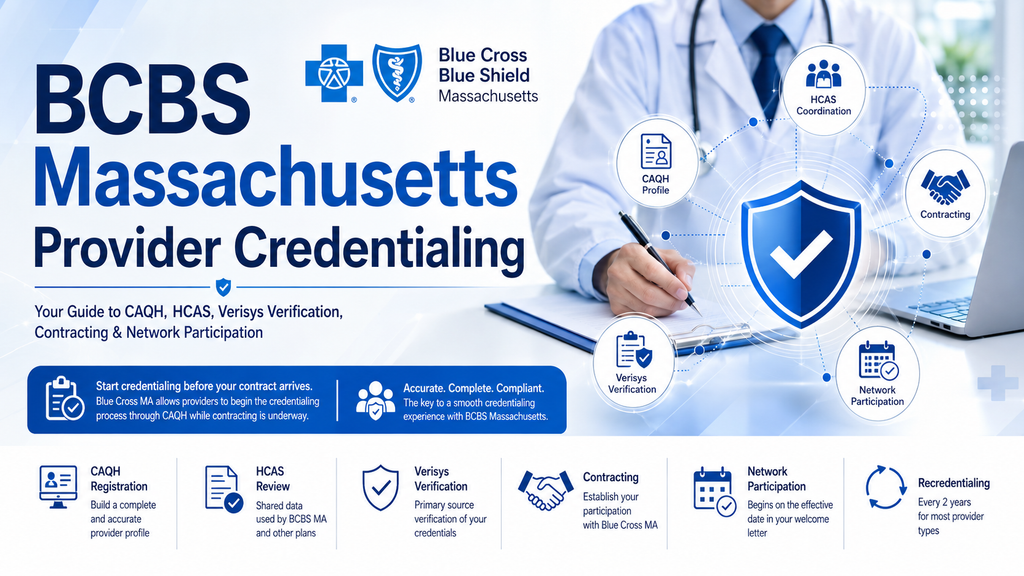
Massachusetts also runs credentialing a little differently than most states, thanks to Health Care Administrative Solutions, or HCAS — a consortium several Massachusetts health plans participate in together. Once a practitioner registers with CAQH and submits their information, HCAS-participating plans, including Blue Cross, pick up that data for their own review rather than requiring a separate submission to each individual plan from scratch.
What follows reflects Blue Cross Blue Shield of Massachusetts’s published credentialing and recredentialing guidelines, its HCAS-based intake process, and its contracting requirements for professional, institutional, and behavioral health providers.
What Is BCBS of Massachusetts Provider Credentialing?
BCBS Massachusetts provider credentialing is the process through which the payer evaluates a healthcare provider’s professional qualifications and determines whether the provider meets applicable credentialing criteria.
The official BCBSMA provider application indicates that the evaluation considers the completeness of the application, established credentialing criteria, and network need. It also identifies information that may be reviewed from submitted documents and external primary sources, such as malpractice insurance carriers and state licensing boards.

Credentialing may involve reviewing:
- Professional licenses and certifications
- Education and training
- Professional work history
- Malpractice insurance
- Practice locations
- Provider identifiers
- Specialty and professional qualifications
- Other information relevant to the payer’s requirements
Credentialing should be distinguished from contracting and enrollment. A provider may need to complete more than one administrative stage before participation is confirmed.
BCBS of Massachusetts Provider Credentialing vs. Enrollment
Credentialing and enrollment are related but address different parts of payer participation.
| Credentialing | Enrollment |
|---|---|
| Reviews the provider’s professional qualifications. | Establishes the provider’s administrative participation information. |
| Includes verification of licenses, education, training, and professional history. | May include provider identifiers, tax information, practice locations, and billing details. |
| Supports the payer’s evaluation of credentialing eligibility. | Supports provider setup and participation in the applicable arrangement. |
| May involve information from primary sources and supporting documents. | May involve application processing, contracting, and administrative setup. |
| Requires ongoing maintenance and recredentialing when applicable. | Requires updates when provider or organization information changes. |
The precise sequence and requirements may depend on the provider type, organization, service location, and participation arrangement.
BCBS of Massachusetts Provider Credentialing Eligibility
Before beginning the application, providers should review the applicable requirements and confirm that their professional and practice information is current.
Common eligibility considerations include:
- Active Professional License: Providers should hold the appropriate license for their professional practice and specialty.
- Relevant Qualifications: Education, training, certifications, and specialty qualifications should meet applicable requirements.
- Valid NPI: The provider should have the appropriate National Provider Identifier for payer and healthcare transactions.
- Professional Liability Coverage: Current malpractice insurance information may be required during credentialing.
- Accurate Practice Information: Practice addresses, contact information, and group affiliations should be complete and consistent.
- Complete Professional History: Work history and other professional information should be accurate and sufficiently documented.
- Credentialing Criteria: Applicants must meet the applicable credentialing standards and any participation conditions.
- Network Need: BCBSMA’s application states that network need is considered as part of its evaluation. Meeting baseline qualifications does not necessarily guarantee acceptance.
Providers should confirm the current criteria directly through the official BCBSMA application and provider resources before submitting their information.
Documents Required for BCBS of Massachusetts Provider Credentialing and Enrollment
The precise documents required can vary by provider type, specialty, organization, and application. Providers should use the current BCBSMA application and payer instructions to confirm the final checklist.
| Document Checklist | Why It Matters |
|---|---|
| Completed Provider Application | Supplies the information required for BCBSMA to evaluate the application. |
| Active Professional License | Helps verify authorization to practice. |
| NPI Information | Supports accurate provider identification and administrative processing. |
| CAQH Profile, if Applicable | May support standardized credentialing data management where required. |
| Education and Training Records | Documents academic, residency, fellowship, or relevant professional training. |
| Board Certification Details | Supports verification of specialty qualifications, where applicable. |
| Professional Liability Insurance | Provides information about current malpractice coverage. |
| Curriculum Vitae or Work History | Helps document professional experience and identify potential gaps. |
| Practice Location Details | Supports accurate service information and payer records. |
| Tax and Billing Information | Supports administrative setup and payment-related processing. |
| Group Affiliation Information | Connects individual providers with the relevant organization or practice. |
| Disclosure and Attestation Forms | Helps confirm the accuracy and completeness of submitted information. |
BCBSMA’s online application includes service-site details and asks for information such as tax identification, NPI, Medicare information, and MassHealth information where applicable. Applicants should complete only the fields relevant to their situation and follow the official instructions.nd the contract effective date — that date is what actually determines when a provider may begin treating members, not the date credentialing itself was approved.
Step-by-Step BCBS Massachusetts Credentialing Process
The steps below reflect what Blue Cross has published for professional, institutional, and behavioral health applicants working through the HCAS-based intake system.
Starting CAQH before contracting is complete can help providers avoid making the contract a prerequisite for credentialing.
Step 1: Identify the Appropriate Participation Request
Determine whether you are applying for a new agreement, adding service locations, or relocating an existing service site. The BCBSMA provider application lists these request types.
Review the participation requirements that apply to your provider type and organization before preparing the submission.
Step 2: Gather Your Provider Information
Collect the information needed for the application, including:
- Legal provider or organization name
- NPI and tax identification information
- Professional license details
- Specialty and qualifications
- Practice addresses
- Group affiliations
- Liability insurance information
- Relevant enrollment identifiers
Ensure that all information matches your official records. Differences between the application, supporting documents, and payer records may result in clarification requests.
Step 3: Review Credentialing Requirements
Review the current BCBSMA credentialing criteria and identify the supporting documentation required for your specialty and practice setting.
The payer’s application states that the submission is evaluated against pre-established credentialing criteria and network need. Consequently, submitting an application does not necessarily guarantee acceptance into the network.
Step 4: Complete the BCBSMA Provider Application
Use the official BCBSMA Provider Application to begin the application request.
Complete the form carefully, including:
- Primary service-site information
- Tax ID and NPI details
- Provider or organization information
- Requested participation or service-site change
- Supporting documentation
- Contact details for application communication
The official application identifies 1-800-316-BLUE (2583) for application questions and credentialing-related support.
Step 5: Submit Supporting Documents
Review the application for missing fields, expired documents, and inconsistent information before submitting it.
Maintain a copy of the submitted application and supporting documents. A centralized credentialing document management workflow can help organizations organize provider records and monitor outstanding documentation.
Step 6: Complete the Payer’s Review
BCBSMA evaluates the application according to its applicable criteria, the completeness of the submission, and network need. The payer may also review information from external primary sources, including state licensing boards and malpractice insurance carriers.
Respond promptly if the payer requests additional information or clarification. Keep records of submitted documents, communications, and application updates.
Step 7: Monitor the Credentialing Decision
The BCBSMA provider application states that the organization will notify applicants of the credentialing decision within 60 days at the contact address provided in the application.
Treat this as the payer’s stated notification period, not as a universal guarantee of complete contracting, enrollment, or effective participation within 60 days.
Step 8: Confirm Participation and Effective Details
After receiving the payer’s decision, verify the relevant participation information, including:
- Provider or organization name
- Approved service locations
- Network or product participation
- Contracting status, where applicable
- Effective date
- Billing and administrative information
Do not assume that an application submission alone confirms active in-network status.
Step 9: Maintain Provider Information
Update BCBSMA when relevant information changes, such as:
- Practice address
- Tax identification details
- Group affiliation
- Professional license
- Specialty
- Contact information
- Provider availability or service details
Use the payer’s current provider resources and instructions to determine how changes must be reported.
Step 10: Prepare for Recredentialing
Credentialing is an ongoing administrative responsibility. Monitor payer communications and maintain updated records so that future recredentialing or information requests can be addressed on time.
The applicable recredentialing schedule and requirements should be confirmed directly with BCBSMA for the provider’s specific participation arrangement.
How Long Does BCBS of Massachusetts Provider Credentialing Take?
The official BCBSMA provider application states that applicants will be notified of the credentialing decision within 60 days at the contact address provided in the application.
The actual end-to-end process may depend on application completeness, verification, network considerations, additional information requests, contracting, and enrollment-related activities.
Potential causes of delay include:
- Missing or incomplete application fields
- Expired professional documents
- Inconsistent provider information
- Delayed responses to payer questions
- Additional verification requirements
- Pending service-site or organization details
Providers should begin the process early and confirm current timelines with BCBSMA rather than relying on a fixed completion date.
How BCBS of Massachusetts Credentialing Support Services Can Help
Credentialing support services can help healthcare organizations organize and monitor the administrative work involved in payer participation.
Key areas of support include:
- Provider Data Management: Organize NPI details, licenses, specialties, locations, and group affiliations.
- Document Management: Track required documents, expiration dates, and missing information.
- Application Tracking: Monitor submission status, follow-ups, and outstanding payer requests.
- Credentialing Coordination: Support communication between providers, internal teams, and payer representatives.
- Recredentialing Preparation: Help maintain current records and monitor recurring requirements.
- Administrative Visibility: Improve coordination between credentialing, billing, operations, and provider management teams.
These services can support administrative organization, but providers and organizations remain responsible for submitting accurate information and following official BCBSMA requirements.
How MantraComply Can Support BCBS of Massachusetts Provider Credentialing and Enrollment
MantraComply’s BCBS of Massachusetts credentialing and enrollment service can be used as a relevant internal link for readers seeking payer-specific credentialing support.
Potential support areas include:
- Centralized Provider Information: Organize provider records, licenses, NPI details, and practice information.
- Credentialing Document Management: Track required documentation and renewal dates.
- Enrollment Workflow Tracking: Monitor application progress, follow-ups, and outstanding tasks.
- Credentialing Coordination: Help teams organize payer-related information and administrative activities.
- Recredentialing Support: Maintain updated provider records and prepare for recurring credentialing requirements.
- Administrative Visibility: Improve coordination across credentialing, billing, and provider management functions.
Important: Confirm MantraComply’s exact features, integrations, and BCBSMA-specific capabilities before making detailed product claims. The official payer instructions remain the authoritative source for participation and credentialing requirements.
Conclusion
BCBS of Massachusetts provider credentialing and enrollment require accurate documentation, professional qualification verification, and completion of the payer’s applicable participation process. Providers should carefully review the official application, meet credentialing criteria, and monitor communications throughout the review.
The BCBSMA provider application states that credentialing decisions are communicated within 60 days, although the overall enrollment and participation timeline may vary.
Using a structured provider credentialing and enrollment workflow can help organizations manage documents, monitor application progress, and maintain accurate provider information.
Frequently Asked Questions
The overall timeline varies by provider type and application circumstances. Blue Cross communicates the credentialing determination after reviewing the completed file, while contracting and the effective participation date are separate parts of the process.
No. Blue Cross explicitly states the contract is not required to begin the credentialing process, so registering with CAQH right away is worth doing regardless of contract status.
No. CAQH registration is free. Applicable professional and dental providers must review, update, and attest to their CAQH information every 90 days.
Credentialing verifies a provider’s qualifications through CAQH and HCAS-coordinated review. Enrollment follows that approval, when Blue Cross executes the contract and sends a welcome letter confirming the effective date.
Professional and dental providers generally recredential every two years, while institutional providers follow a separate recredentialing cycle. Providers should follow the applicable Blue Cross Massachusetts notice and submission requirements.