How does a healthcare provider become credentialed with Blue Shield of California, and what steps must a practitioner complete to participate in the network? The answer depends on the provider’s specialty, contracting arrangement, and the Blue Shield line of business involved.
Blue Shield of California manages credentialing across its Commercial, Medicare, and Blue Shield Promise Medi-Cal networks. Providers may need to complete the California Participating Practitioner Application (CPPA), maintain an updated CAQH ProView profile, submit supporting documentation, and complete applicable contracting requirements before they can participate in the network.
Understanding how credentialing, contracting, provider enrollment, and ongoing recredentialing relate can help healthcare professionals and provider organizations manage the process more efficiently. This guide explains Blue Shield of California credentialing requirements, the application process, required documents, timelines, common challenges, and how credentialing support services can help.
What Is Blue Shield of California Provider Credentialing?
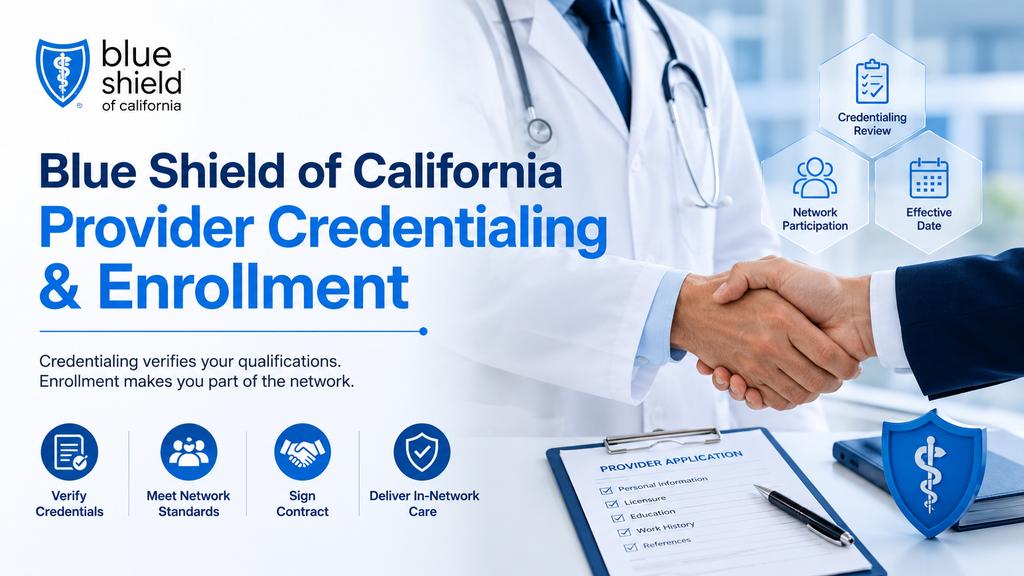
Blue Shield of California provider credentialing involves reviewing and verifying a healthcare professional’s qualifications before network participation.
The process may include reviewing:
- Professional license and specialty qualifications
- Education, training, and work history
- Board certification, where applicable
- Malpractice coverage and claims history
- DEA registration, where applicable
- Hospital privileges or admitting arrangements
- Professional references and supporting documents
Providers applying through a direct contract must submit the required application and documentation. Credentialing approval is separate from contracting and does not automatically establish in-network status.
Blue Shield generally uses CAQH ProView as a preferred credentialing pathway for applicable providers, while eligible providers may use the California Participating Practitioner Application (CPPA). Requirements vary by provider type, specialty, line of business, and contracting arrangement.
For the latest information, providers should review Blue Shield of California’s credentialing requirements and prospective provider resources.
Blue Shield of California Credentialing vs. Provider Enrollment
Credentialing and provider enrollment are related activities, but they serve different purposes.
Credentialing focuses on verifying whether a healthcare professional meets the applicable professional and network participation requirements. This may include reviewing licenses, training, malpractice information, work history, and other qualifications.
Provider enrollment and contracting focus on the administrative and contractual requirements associated with participating in a health plan network. These activities may include confirming tax information, NPIs, contracts, participation effective dates, and payer-specific records.
For direct-contract providers, Blue Shield of California states that credentialing approval does not automatically provide participating status. The participation effective date is assigned based on approval from the Credentialing Committee and the Contracting Department. Services provided before the effective date may be processed as out-of-network.
| Credentialing | Provider Enrollment and Contracting |
|---|---|
| Verifies professional qualifications. | Establishes applicable administrative and contractual participation. |
| Reviews licenses, training, and professional history. | May involve tax information, NPI details, and contract documents. |
| Determines whether the provider meets credentialing requirements. | Supports participation with the applicable network or payer. |
| May involve a credentialing committee. | May involve contracting and provider information teams. |
| Must be completed according to applicable requirements. | Does not necessarily begin or end at the same time as credentialing. |
Keeping both workflows coordinated can help reduce delays between credentialing approval and network participation.
Blue Shield of California Provider Credentialing Eligibility
Blue Shield of California credentialing eligibility depends on the provider’s professional qualifications, specialty, line of business, and contracting arrangement. Healthcare professionals may join through a contracted medical group or IPA, or they may apply for a direct contract depending on their circumstances.
Potential applicants may include:
- Physicians
- Primary care providers
- Specialists
- Nurse practitioners
- Physician assistants and other mid-level practitioners
- Psychologists
- Licensed therapists
- Licensed clinical social workers
- Licensed professional clinical counselors
- Behavioral health professionals
- Mental health and substance use disorder providers
- Other eligible healthcare professionals
Blue Shield’s provider resources identify separate pathways for general network providers, behavioral health providers, and Blue Shield Promise Medi-Cal providers.
Providers Joining an Existing Medical Group
An individual practitioner joining a medical group that already has a Blue Shield contract may still need to complete individual credentialing.
Blue Shield Promise states that credentialing is determined by the applicable line of business, including Commercial, Medicare, and Medi-Cal. Providers joining groups with existing contracts are directed to use the provider credentialing intake process.
Direct-Contracted Providers
Providers seeking a direct contract may need to submit a Letter of Intent and the applicable record application form before Blue Shield begins the review process.
The requirements can differ between:
- Individual practitioners
- Provider groups
- Facilities
- Behavioral health organizations
- Other healthcare delivery organizations
Blue Shield provides separate record application forms for individual practitioners and provider groups or facilities. Providers should review the direct contract provider information before submitting an application.
Documents Required for a Blue Shield of California Provider Application
The documentation required for credentialing depends on the provider’s specialty, line of business, contracting arrangement, and application pathway. A complete application should include accurate information and all supporting documents required by the applicable checklist.
| Document / Checklist | Why It Matters |
|---|---|
| Professional license | Confirms that the provider is legally authorized to practice in California. |
| Current CV or résumé | Verifies education, training, employment, and professional work history. |
| Education and training records | Confirms the provider’s qualifications and specialty-related training. |
| Board certification, where applicable | Supports verification of specialty expertise and professional qualifications. |
| Malpractice insurance certificate | Confirms that the provider maintains the required professional liability coverage. |
| Malpractice claims history | Helps evaluate the provider’s professional liability background. |
| DEA registration, where applicable | Verifies authorization to prescribe controlled substances. |
| Hospital privileges or admitting arrangements | Confirms applicable hospital affiliation or coverage arrangements. |
| Signed and dated application | Ensures the credentialing application is formally completed and valid. |
| Provider attestation | Confirms that the information submitted is accurate and up to date. |
| Professional references and supporting documents | Provides additional information for credential verification and review. |
Blue Shield’s credentialing requirements identify professional licensing, malpractice coverage, malpractice claims information, DEA registration where applicable, and hospital privileges or admitting arrangements among the relevant requirements.
Step-by-Step Blue Shield of California Provider Credentialing Process
The exact process may vary depending on whether the provider is applying through CAQH, submitting a CPPA, joining an existing group, or seeking a direct contract. The following steps outline the typical stages involved.
Step 1: Identify the Applicable Blue Shield Network
Before beginning the application, determine which Blue Shield network or line of business applies to the provider.
The process may differ for:
- Blue Shield Commercial
- Blue Shield Medicare
- Blue Shield Promise Medi-Cal
- Behavioral health networks
- Direct contracts
- Existing medical group or IPA arrangements
Credentialing is not necessarily a single approval that applies automatically across every Blue Shield line of business. Blue Shield Promise specifically states that credentialing is determined by line of business.
Identifying the correct pathway at the beginning can help prevent submission of the wrong form or supporting documents.
Step 2: Confirm the Contracting Arrangement
The provider should determine whether they will:
- Join an IPA or medical group that already contracts with Blue Shield.
- Apply for a direct contract.
- Join an existing provider group roster.
- Apply as part of a facility or healthcare organization.
- Apply through a behavioral health network.
Direct-contract providers may need to submit a Letter of Intent and a record application form. Existing groups generally use the applicable provider management or roster process rather than submitting a new Letter of Intent for every roster addition.
Confirming the contracting arrangement early can help the provider identify the correct forms, contacts, and submission process.
Step 3: Complete or Update the CAQH Profile
CAQH ProView is Blue Shield’s preferred credentialing pathway for applicable providers.
Providers using CAQH should ensure that their profile includes current and accurate information, including:
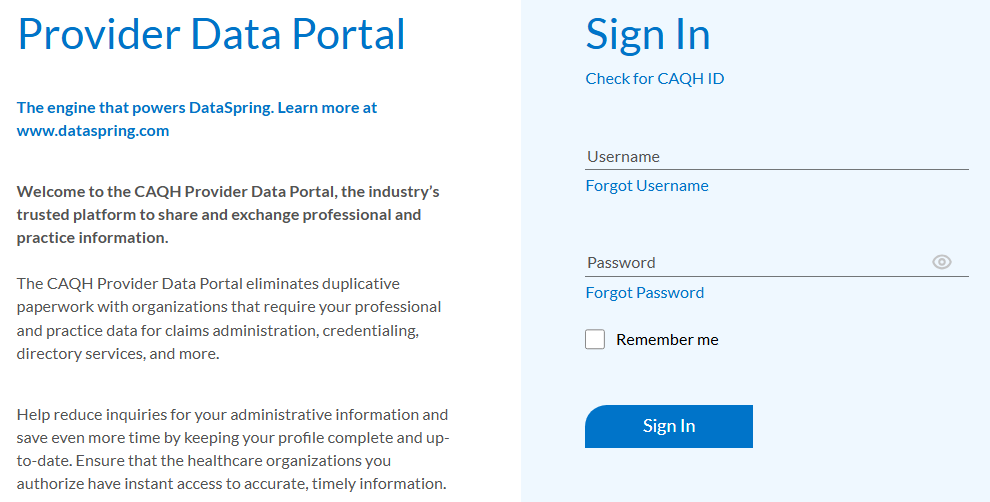
- Personal and professional details
- License information
- Education and training
- Work history
- Malpractice information
- Practice locations
- Specialty information
- Supporting documentation
- Current attestation
The provider should also confirm that Blue Shield has the necessary authorization to access the relevant CAQH information.
An incomplete, outdated, or unauthenticated CAQH profile may delay the credentialing review.
Step 4: Complete the CPPA, Where Applicable
Providers who do not use CAQH, or who are directed to use an alternative application, may need to complete the California Participating Practitioner Application.
The application should be:
- Fully completed
- Accurate and consistent
- Signed and dated
- Supported by the required documents
- Submitted through the applicable Blue Shield process
Blue Shield Promise allows applicants to use CAQH or CPPA, depending on the selected pathway. Providers should confirm which application method applies to their network and provider type before submitting the information.
Step 5: Submit the Credentialing Intake Information
Depending on the provider’s situation, the applicant may need to submit a provider credentialing intake form along with the CAQH details or applicable application.
The Blue Shield credentialing intake form may capture information such as:
- Application type
- CAQH number, where applicable
- Contract status
- Requested line of business
- Provider type
- Specialty
- NPI
- Practice location
- Contact information
- Supporting documentation
The form may also identify documents that are required for the review, including malpractice insurance information, a curriculum vitae, and applicable agreements.
Providers should review the intake requirements carefully to ensure that the submitted information is complete and consistent with the CAQH profile or application.
Step 6: Collect and Submit Supporting Documents
The credentialing team or provider should confirm that all required documents have been included before submitting the application.
Missing or outdated documents may lead to follow-up requests and delay the review process. Providers should check that:
- The license is current and unrestricted.
- Malpractice coverage meets applicable requirements.
- The application is signed and dated.
- Claims history information is complete.
- The CV includes relevant work history.
- DEA documentation is included when applicable.
- Hospital privileges or admitting arrangements are documented where required.
Submitting a complete file at the beginning can help reduce avoidable administrative delays.
Step 7: Primary Source Verification
After receiving the application, the credentialing team reviews and verifies relevant information against appropriate sources.
Verification may involve:
- State licensing boards
- Educational institutions
- Training programs
- Specialty certification organizations
- Malpractice information
- Regulatory and exclusion databases
- Other applicable professional sources
Blue Shield’s credentialing program includes verification and review requirements designed to support network participation decisions. The exact verification process may vary by provider type and line of business.
The provider should respond promptly if additional information is requested during the verification process.
Step 8: Follow Up on Missing Information
If the application is incomplete, Blue Shield may contact the provider or credentialing contact to request additional information.
The provider should respond within the timeframe specified in the communication. Delays may occur when:
- Documents are missing.
- Information conflicts across forms.
- The application is not signed or dated correctly.
- A license or insurance document has expired.
- The provider does not respond to follow-up requests.
- Additional clarification is required for malpractice or work history information.
For Blue Shield Promise, repeated failure to provide requested information may result in voluntary withdrawal of the application.
Maintaining a centralized record of requests, responses, and submission dates can help credentialing teams manage follow-ups more effectively.
Step 9: Credentialing Committee Review
Once the file is complete and the required verification activities have been performed, the application may be submitted for credentialing committee review.
The committee’s responsibilities may include reviewing:
- Professional qualifications
- Verified credentials
- License status
- Malpractice information
- Professional history
- Relevant compliance or quality concerns
- Applicable credentialing criteria
Blue Shield Promise identifies its Credentials Committee as responsible for decisions involving initial credentialing, recredentialing, changes to credentials, and inactivation or termination of directly contracted practitioners and providers.
Committee review is an important stage in the credentialing process, but it does not by itself establish the provider’s final participation effective date.
Step 10: Contracting and Participation Effective Date
Credentialing approval does not automatically mean that the provider is active as an in-network participant.
For direct-contract providers, Blue Shield assigns the participation effective date based on the required credentialing and contracting approvals. Services delivered before the effective date may be processed as out-of-network.
Providers should therefore confirm:
- Credentialing approval status
- Contract execution status
- Participation effective date
- Network and line-of-business participation
- Provider directory information
- Applicable billing and enrollment requirements
Providers should avoid assuming that they can bill as in-network immediately after receiving credentialing approval. The applicable contract and participation effective date should be confirmed before services are delivered under the network arrangement.
Step 11: Provider Enrollment and Roster Updates
Once credentialing and contracting requirements are addressed, provider enrollment and roster activities may need to be completed.
Existing groups should follow Blue Shield’s process for adding practitioners to their provider roster. Blue Shield notes that the Letter of Intent is not intended for roster edits and directs existing groups to use Provider Connection for roster additions.
Depending on the arrangement, the organization may also need to confirm:
- Provider demographic information
- Practice locations
- NPI and tax identification details
- Billing information
- Network participation
- Directory listings
- Group and individual provider associations
Keeping enrollment and roster information accurate can help reduce administrative issues after credentialing approval.
Step 12: Ongoing Monitoring and Recredentialing
Credentialing does not end after initial approval. Providers must continue to maintain accurate professional information and complete recredentialing when required.
Blue Shield of California requires participating practitioners to complete recredentialing every three years. Providers receiving a recredentialing notice are instructed to submit the updated application and attestation within 30 days.
Ongoing monitoring may involve changes to:
- Licenses
- Malpractice coverage
- Professional certifications
- Practice locations
- Hospital privileges
- Sanctions or exclusions
- Professional status
- Other credentialing information
Providers should monitor expiration dates and update their records when changes occur. Information that is not maintained accurately may create issues during recredentialing or other payer reviews.
For additional information, providers can review Blue Shield’s network participation and recredentialing guidelines.
How Long Does Blue Shield of California Credentialing Take?
The Blue Shield of California credentialing timeline varies by application type, line of business, provider specialty, and application completeness. Blue Shield publishes the following general timelines for certain application pathways:
- Blue Shield Promise CAQH or CPPA applications: Approximately 90–120 days
- Direct-contract applications: Up to 120 days
- Certain behavioral health applications: Approximately 45–60 days
These timelines are not guaranteed and may increase due to:
- Missing documents
- Delayed responses
- Additional verification requirements
- Malpractice history clarification
- Contracting requirements
- Credentialing committee schedules
- Incomplete or inconsistent application information
Providers should confirm the applicable timeline with the relevant Blue Shield team and track credentialing approval separately from the contract effective date. Credentialing approval does not automatically establish in-network participation.
How Blue Shield Credentialing Services Can Help Healthcare Organizations
Managing provider credentialing requires coordination among providers, credentialing professionals, medical groups, practice administrators, contracting teams, and payer representatives.
Credentialing support services can assist with administrative activities such as:
- Identifying the applicable credentialing pathway
- Coordinating provider applications
- Reviewing application completeness
- Tracking CAQH information
- Organizing supporting documents
- Monitoring license and insurance expiration dates
- Coordinating follow-up requests
- Tracking credentialing status
- Supporting provider enrollment activities
- Monitoring recredentialing deadlines
- Maintaining provider records
External credentialing support does not replace the provider’s responsibility to provide accurate information, sign applications, complete attestations, or respond to payer requests.
How MantraComply Can Support Your Blue Shield Credentialing Process
Blue Shield of California credentialing involves multiple administrative steps, from application preparation and documentation to verification, contracting coordination, and ongoing recredentialing.
MantraComply can support healthcare providers and organizations with structured credentialing and enrollment assistance, including:
- Provider application coordination
- CAQH profile support
- Credentialing document organization
- Application completeness checks
- Provider information tracking
- Credentialing status follow-up
- Payer enrollment assistance
- Recredentialing deadline monitoring
- Support with maintaining accurate provider records
A centralized and organized approach can help reduce administrative workload and improve visibility into the status of each provider’s credentialing and enrollment requirements.
Healthcare organizations seeking additional assistance can explore MantraComply’s credentialing and enrollment services to learn more about available support.
Conclusion
Blue Shield of California provider credentialing involves more than submitting an application. Providers may need to identify the correct network, complete CAQH or CPPA requirements, submit supporting documentation, respond to follow-up requests, complete credentialing review, and finalize contracting requirements before participating in the network.
Because credentialing requirements vary by line of business and provider type, maintaining accurate information and tracking each stage of the process is important. Organized credentialing support can help providers and healthcare organizations manage documentation, timelines, enrollment requirements, and ongoing recredentialing more effectively.
By preparing complete applications, confirming the appropriate contracting pathway, and tracking credentialing and participation milestones separately, providers can better manage the administrative requirements associated with Blue Shield of California network participation.
Frequently Asked Questions
Blue Shield does not publish one fixed timeline, since the review depends on the line of business, how complete the application is, and how quickly any missing documentation comes back. A clean, complete Blue Shield CA provider application submitted with every checklist item tends to move noticeably faster than an incomplete one.
No, though it is preferred. CAQH participants complete a standardized intake form, while providers who prefer not to use CAQH can complete the California Participating Practitioner Application and Checklist instead, submitting all required supporting documentation directly to the Credentialing Department.
Blue Shield requires participating practitioners to complete recredentialing every three years. Providers receiving a recredentialing notice should submit the updated application and attestation within 30 days of receiving the notice.
Not necessarily. For direct contract providers, credentialing approval alone does not grant participating status. Services rendered before the contract effective date still process as out-of-network, so confirming that date before seeing Blue Shield members is an important extra step.
No. Credentialing is determined separately by line of business. A provider seeking to join Commercial, Medicare, and Blue Shield Promise Medi-Cal networks should expect each line of business to be reviewed on its own track rather than under one combined approval.