How does a healthcare provider become credentialed and enrolled with Florida Blue? The process typically involves provider registration, network participation requests, credential verification, supporting documentation, and ongoing maintenance of provider information.
Florida Blue uses Availity® for provider registration and network participation workflows, while CAQH ProView is the preferred application data source for applicable practitioners. Specific requirements may vary by provider type, specialty, network, contracting arrangement, and whether the applicant is an individual practitioner, group, facility, or ancillary provider.
Understanding the difference between credentialing and enrollment helps healthcare organizations prepare accurate applications, reduce administrative delays, and stay active in the appropriate Florida Blue networks.
This guide explains the Florida Blue provider credentialing and enrollment process, required documents, key steps, common challenges, and how credentialing support services can assist providers and organizations.
What Is Florida Blue Provider Credentialing?
Florida Blue provider credentialing is the process of reviewing and verifying a healthcare professional’s qualifications before the provider is considered for participation in an applicable network.
The credentialing process helps Florida Blue assess professional qualifications and meet relevant regulatory and network requirements. According to the Florida Blue Manual for Physicians and Providers, credential verification is an integral part of the network participation process.

Credentialing may involve reviewing:
- Professional licenses
- Education and training
- Work history
- Specialty certifications
- Hospital admitting privileges, where applicable
- Professional liability insurance
- Malpractice history
- Disciplinary actions
- DEA registration, where applicable
- Other supporting information
Florida Blue states that completing and submitting an application does not guarantee inclusion in a network. Network participation depends on applicable contracting criteria, network needs, and completion of the required review process.
The organization also notes that participation in one Florida Blue network does not automatically mean that a provider participates in every Florida Blue network. Providers should confirm the specific network and products covered by their agreement.
Florida Blue Provider Credentialing vs. Enrollment
Credentialing and provider enrollment are connected but distinct processes. Credentialing focuses primarily on verifying a provider’s qualifications, while enrollment and contracting involve establishing the administrative and contractual arrangements needed to participate in a payer network.
| Florida Blue Credentialing | Florida Blue Provider Enrollment |
|---|---|
| Verifies the provider’s professional qualifications and eligibility for network participation. | Establishes the provider’s administrative and participation records with Florida Blue. |
| Reviews licenses, education, training, work history, certifications, and other credentials. | May involve provider registration, contracting, NPI information, tax details, and network records. |
| Uses CAQH data for applicable practitioners. | May require registration and participation requests through Availity. |
| Includes primary-source verification and credentialing committee review. | Supports the provider’s operational participation and payer administration. |
| May require additional information or clarification during the review. | May involve maintaining provider demographics, group affiliations, and billing-related information. |
| Must be completed according to applicable credentialing requirements. | Must be completed within the applicable Florida Blue agreement and network requirements. |
Important: Credentialing approval or completion of an application does not independently guarantee network participation. Florida Blue evaluates providers based on network needs and applicable participation criteria.
For organizations managing multiple providers, coordinating provider credentialing and enrollment services can help maintain consistency between credentialing records, payer enrollment information, and provider data.
Who Can Apply for Florida Blue Provider Credentialing?
Florida Blue has different requirements for individual practitioners, advanced non-physician practitioners, facilities, ancillary providers, suppliers, and ambulatory surgery centers.
Potential applicants may include:
- Physicians
- Primary care providers
- Specialists
- Advanced practice registered nurses
- Certified nurse midwives
- Clinical nurse specialists
- Physician assistants
- Registered nurse first assistants
- Hospitals and facilities
- Ancillary providers
- Suppliers
- Ambulatory surgery centers
- Other eligible healthcare organizations
Florida Blue’s provider manual identifies specific requirements for advanced non-physician practitioners, including obtaining a Florida Blue provider number and registering the practitioner’s NPI with Florida Blue. Credentialing requirements may also depend on whether the practitioner is independently contracted or practices under a physician group or facility.
Confirm the Applicable Florida Blue Network
Before beginning the process, providers should determine which network or product they want to join. Florida Blue states that some networks may be closed or open only in specific locations or for certain provider types.
Providers should review the available network status information and confirm whether Florida Blue is accepting new participation requests for their specialty and service area.
The official Florida Blue provider portal provides access to provider resources, forms, tools, and network-related information.
Documents Required for Florida Blue Provider Credentialing and Enrollment
The documents required depend on the provider category and application pathway. Florida Blue’s practitioner credentialing requirements include CAQH information and supporting documents, while facility and ancillary applications may require additional licensing, insurance, accreditation, and site-related documentation.
The following table provides a general overview. Providers should verify the current requirements for their specific application before submitting documents.
| Document or Information | Why It Matters |
|---|---|
| Signed practitioner agreement | Confirms that the provider’s submitted information is accurate and current. |
| Florida professional license | Verifies authorization to practice in Florida. |
| CAQH ProView profile | Provides credentialing information for applicable practitioners. |
| Education and training details | Supports verification of professional qualifications and specialty. |
| Five-year work history | Documents professional experience and explains employment gaps of six months or more. |
| Specialty board certification | Supports verification of specialty qualifications, where applicable. |
| Hospital admitting privileges | Confirms hospital access when required by the provider’s specialty or arrangement. |
| Professional liability insurance | Verifies current coverage, expiration dates, and applicable coverage amounts. |
| Malpractice and disciplinary history | Clarifies relevant disclosures or adverse history. |
| DEA license | Confirms authorization to prescribe controlled substances, where applicable. |
| NPI information | Supports accurate provider identification and payer record matching. |
| Florida registration or facility documentation | Verifies regulatory compliance for applicable facilities and organizations. |
| Accreditation documentation | Supports verification of facility standards and specialized service requirements. |
| Medicare certification or participation letter | Confirms Medicare certification or participation for applicable organizations. |
| Site survey documentation | Supports facility compliance verification based on Florida Blue’s requirements. |
Florida Blue’s provider manual distinguishes between practitioner requirements and requirements for ancillary, facility, supplier, and ambulatory surgery center applications. Facility requirements may include additional insurance details, accreditation documentation, Medicare information, and site survey records.
Important Document Preparation Tips
Before submitting an application, providers should:
- Check that all licenses are current.
- Confirm that the CAQH profile is complete and attested, where applicable.
- Review the accuracy of the work history.
- Explain employment gaps when required.
- Verify that malpractice insurance documentation is current.
- Confirm that the attestation meets the applicable timeframe.
- Ensure that all forms are signed and dated.
- Keep copies of submitted documents and correspondence.
- Respond promptly to requests for clarification or additional information.
Incomplete or inconsistent documentation can delay the credentialing process. Florida Blue may request additional information through its credentialing verification process, including through an external credentialing vendor.
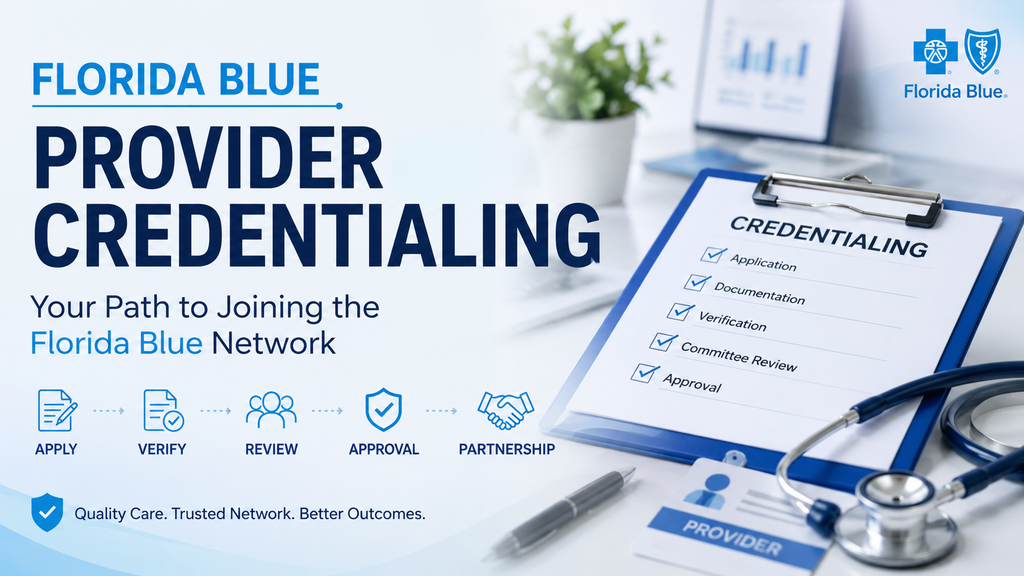
Florida Blue Provider Credentialing and Enrollment: Step-by-Step Process
The following steps provide a practical overview of the Florida Blue credentialing and enrollment workflow. The exact process may differ depending on the provider type, network, and application pathway.
Step 1: Identify the Provider Type and Applicable Network
Start by identifying the provider’s category and the Florida Blue network or product the provider wants to join.
The process may differ for:
- Individual physicians
- Advanced non-physician practitioners
- Provider groups
- Facilities
- Ancillary providers
- Suppliers
- Ambulatory surgery centers
- Other healthcare organizations
Florida Blue has multiple networks and products, and participation in one network does not automatically establish participation in every other network.
Before submitting an application, confirm:
- Provider type
- Specialty
- Service location
- Network requested
- Applicable Florida Blue or Florida Blue HMO arrangement
- Whether the network is accepting new providers
- Whether the application is individual or organizational
This initial review can help prevent providers from submitting an application through the wrong pathway.
Step 2: Register as a Florida Blue Provider Through Availity
Florida Blue requires providers to register before moving forward with a request to participate in its networks.
The provider manual states that providers who are not already registered should complete the Provider Registration Form through the Availity portal. After registration, the provider can proceed with the applicable request to join a network.
The registration process may require information such as:
- Provider or organization details
- NPI
- Tax identification information
- Contact details
- Practice information
- Administrative user information
Providers can visit the official Florida Blue provider resources page to access Availity and other available tools.
Registration is an important preliminary step, but it does not automatically establish credentialing approval or network participation.
Step 3: Submit a Request to Join the Florida Blue Network
After completing registration, the provider may submit a request to join the applicable Florida Blue network through Availity.
Florida Blue states that the request to join its networks initiates the credentialing process for applicable practitioners.
Before submitting the request, the provider should verify:
- The correct provider type
- The requested network
- Specialty and service information
- Practice locations
- Group affiliation, if applicable
- Contact details
- Availability of supporting documents
Florida Blue may assess the request based on network needs and participation criteria. Completing an application does not guarantee acceptance into the requested network.
Step 4: Create or Update the CAQH Profile
Florida Blue identifies CAQH as its preferred method of application data for applicable practitioners.
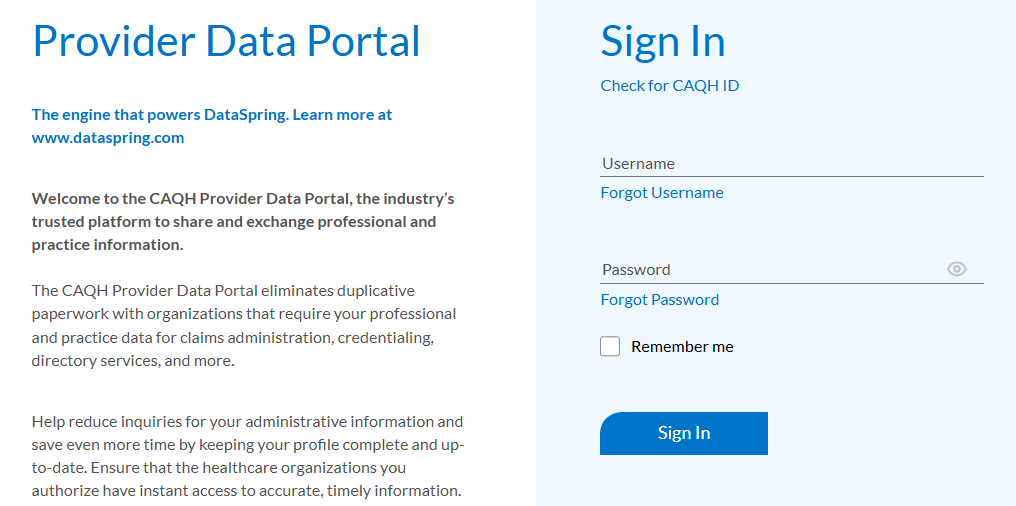
Providers using CAQH should make sure their profile is:
- Complete
- Accurate
- Current
- Attested
- Authorized for access by the applicable payer, where required
The profile should include updated information about:
- Professional licenses
- Education and training
- Work history
- Specialty certifications
- Practice locations
- Malpractice information
- Hospital privileges, where applicable
- DEA registration, where applicable
- Other required credentialing details
CAQH information should match the provider’s other submitted records. Inconsistencies between the CAQH profile and supporting documents may lead to additional questions or verification delays.
Providers can access the CAQH ProView website to create or update their credentialing profile.
Step 5: Submit the Required Credentialing Documentation
Florida Blue’s credentialing process may use the information available in CAQH for applicable practitioners. The organization may also contact the provider or request additional information through its credentialing verification process.
Florida Blue identifies Medversant as a credentialing verification vendor in its provider manual, while also noting that it may change the vendor it uses. Providers should follow the current instructions received from Florida Blue or its authorized credentialing representative.
Depending on the provider category, required documents may include:
- Signed attestation
- Florida license
- Education and training records
- Work history
- Board certification
- Hospital privileges
- Professional liability insurance
- Malpractice history explanations
- Disciplinary action explanations
- DEA license, where applicable
Ancillary providers, facilities, suppliers, and ambulatory surgery centers may need to submit a separate credentialing application and additional organizational documentation.
Step 6: Complete Primary Source Verification
Once the application and required documents are received, the credentialing team verifies the information against appropriate primary sources.
Verification may include reviewing:
- State licensing records
- Education and training
- Specialty certification
- Hospital privileges
- Professional liability information
- Malpractice history
- Disciplinary disclosures
- Other relevant credentialing records
Florida Blue explains that completed provider files are subject to primary source verification according to applicable regulatory requirements. After verification, the file is forwarded to the Credentialing Committee for review and recommendation.
The provider should ensure that any requested clarifications are returned within the specified timeframe.
Step 7: Respond to Additional Information Requests
During credentialing, Florida Blue or its credentialing vendor may request additional information or clarification.
Common reasons for follow-up may include:
- Missing documents
- Expired licenses
- Incomplete work history
- Unexplained employment gaps
- Inconsistent provider information
- Missing malpractice explanations
- Outdated insurance details
- Unclear specialty or practice information
Providers should maintain a record of:
- The date of each request
- The information requested
- The person responsible for responding
- The submission date
- Any confirmation received
Florida Blue advises providers to respond to additional credentialing information requests promptly because delays may affect the application process.
Step 8: Credentialing Committee Review
After the application has completed the required verification process, it is forwarded to the Credentialing Committee for review and a participation decision.
The committee may consider:
- Verified professional qualifications
- License status
- Education and training
- Specialty certification
- Professional history
- Malpractice information
- Disciplinary information
- Applicable credentialing standards
- Network participation requirements
Florida Blue’s provider manual states that applicants receive a written response regarding the Credentialing Committee’s decision within 30 business days. It also indicates that providers who have submitted all required documentation and have not received communication within 90 days may contact the Network Management Service Unit for assistance.
These stated timeframes should not be treated as a guaranteed overall application duration, because the complete process can depend on the application’s completeness, verification requirements, contracting, and other factors.
Step 9: Complete Contracting and Provider Enrollment Activities
Credentialing and contracting should be tracked as related but separate administrative activities.
Depending on the provider’s arrangement, enrollment-related activities may involve confirming:
- Provider NPI
- Group NPI, where applicable
- Tax identification number
- Practice locations
- Group affiliations
- Billing information
- Provider participation status
- Network and product participation
- Provider directory information
The exact requirements may differ for individual practitioners, group providers, facilities, and ancillary organizations.
Providers should confirm that the applicable agreement has been completed and that the provider’s participation status is accurately reflected before billing services as an in-network provider.
Step 10: Verify Provider Data and Directory Information
Maintaining accurate provider data is an ongoing responsibility.
Florida Blue states that provider demographic information affects claims processing, provider directories, referrals, and authorizations. Its provider manual instructs providers to report changes in address and other practice information electronically and indicates that providers must notify Florida Blue 30 days before the effective date of changes to help maintain accurate records.
Information that may require review includes:
- Provider name
- Practice location
- Mailing address
- Telephone number
- Office hours
- Accessibility information
- Hospital privileges
- Website URL
- New-patient acceptance status
- Languages spoken
- Group affiliation
- Provider data administrator details
Florida Blue also states that providers should review and validate key demographic information at least quarterly, as required by applicable CMS requirements.
Providers can use Availity to view and manage relevant provider records and submit applicable demographic updates.
Step 11: Monitor Credentialing Status and Follow Up
Credentialing teams should track each provider application from submission through the final participation decision. This process involves recording essential information, including the provider’s name, National Provider Identifier (NPI), specialty, application date, and CAQH status to support accurate identification and ensure credentialing information remains current. Teams should also monitor document status to identify missing or expired records and track verification status throughout the primary source verification process.
The tracker should also record follow-up requests, outstanding payer questions, and committee review status to ensure each application progresses smoothly. In addition, tracking contracting status helps confirm whether applicable contracting requirements have been completed, while participation status provides visibility into the provider’s network approval and participation stage. Credentialing teams should also maintain the recredentialing date to support ongoing compliance and timely renewals.
A centralized tracking process improves visibility across multiple provider applications, helps reduce missed deadlines, and allows credentialing teams to identify pending tasks and follow up on outstanding requirements efficiently.
Step 12: Complete Ongoing Recredentialing
Credentialing is not a one-time activity. Florida Blue states that recredentialing is performed every three years or as otherwise required by law or applicable regulations.
Recredentialing may require updated:
- Credentialing applications
- Attestation statements
- Professional licenses
- Work history
- Insurance documentation
- Specialty certifications
- Hospital privilege information
- Malpractice history
- Other supporting documents
Florida Blue notes that failure to supply requested documentation may result in contract termination. Providers should monitor recredentialing notices and submit updated information within the required timeframe.
Regular CAQH maintenance and timely provider data updates can help organizations prepare for future credentialing and recredentialing activities.
How Long Does Florida Blue Provider Credentialing Take?
Florida Blue does not provide one universal processing timeline that applies to every provider type and network request in the referenced provider manual.
The overall timeline may depend on:
- Provider category
- Network availability
- Application completeness
- CAQH profile status
- Primary source verification
- Additional documentation requests
- Credentialing committee schedules
- Contracting requirements
- Facility or site review requirements
Florida Blue’s provider manual states that, after receipt of a complete application, credential verification is performed and the file is forwarded to the Credentialing Committee. It also states that applicants receive a written response regarding the committee’s decision within 30 business days. Providers who have submitted all required documentation and have not received communication within 90 days may contact the Network Management Service Unit.
These details relate to specific stages of the process and should not be interpreted as a guaranteed total turnaround time from initial registration to active network participation.
How Florida Blue Credentialing Support Services Can Help
Managing Florida Blue credentialing and enrollment can involve multiple administrative activities, including application preparation, CAQH maintenance, documentation tracking, payer communication, and provider data updates.
Credentialing support services may help healthcare organizations with:
- Provider registration coordination
- Credentialing application preparation
- CAQH profile monitoring
- Document collection and organization
- Application completeness reviews
- License and insurance expiration tracking
- Follow-up request management
- Credentialing status tracking
- Provider enrollment coordination
- Provider data maintenance
- Recredentialing deadline monitoring
- Reporting and administrative oversight
External credentialing support does not replace the provider’s responsibility to submit accurate information, complete required attestations, maintain professional credentials, and respond to payer requests.
A structured process can help organizations improve documentation visibility and manage multiple provider applications more consistently.
How MantraComply Can Support Florida Blue Provider Credentialing and Enrollment
Florida Blue provider credentialing involves several connected stages, including registration, network participation requests, CAQH maintenance, documentation submission, credential verification, contracting coordination, and ongoing provider data management.
MantraComply’s credentialing and enrollment services can support healthcare providers and organizations with administrative coordination across the credentialing lifecycle.
Support may include:
- Provider application coordination
- CAQH profile assistance
- Credentialing document organization
- Application completeness checks
- License and insurance tracking
- Provider information management
- Credentialing status follow-up
- Payer enrollment assistance
- Recredentialing deadline monitoring
- Provider record maintenance
A centralized credentialing workflow can help organizations monitor outstanding requirements, coordinate payer communication, and improve visibility into the status of each provider.
Healthcare organizations seeking support with credentialing and enrollment can explore MantraComply’s credentialing services for additional information. way to keep a file moving toward committee review.
Conclusion
Florida Blue provider credentialing and enrollment requires more than completing an application. Providers may need to register through Availity, submit a request to join the appropriate network, maintain an accurate CAQH profile, provide supporting documentation, complete primary source verification, and respond to additional information requests.
The process varies according to the provider type, network, specialty, and contracting arrangement. Providers should also understand that completing credentialing requirements does not automatically guarantee network participation.
Maintaining accurate provider records, tracking application progress, monitoring recredentialing requirements, and responding promptly to payer requests can help healthcare organizations manage the process more effectively.
With a structured credentialing and enrollment workflow, providers and organizations can improve administrative coordination and maintain better visibility into their Florida Blue participation requirements.
Frequently Asked Questions
Most sources point to 60 to 120 days overall, depending on submission completeness, application volume, and whether a site visit is required. Once a file reaches the Credentialing Committee, Florida Blue commits to a written decision within 30 business days of that specific review.
No. Physicians and advanced non-physician practitioners generally complete an application through CAQH ProView, but facilities, ancillary providers, and ambulatory surgical centers are not required to use CAQH and instead receive an application dispatched directly by Florida Blue.
Florida Blue uses credentialing verification organizations, including Medversant and Verisys. These organizations may access CAQH information or contact providers for additional credentialing or recredentialing information. Providers should respond promptly to whichever organisation contacts them.
Florida Blue performs recredentialing every three years, or as otherwise required by applicable law or regulations. Providers should also keep their CAQH information current and re-attested at least every 120 days where CAQH applies.
Once credentialing clears, Florida Blue provider enrollment moves into contracting, followed by EFT setup through the Availity Essentials Enrollments Center and ERA registration through Availity. The NPI must be registered with Florida Blue before ERA enrollment can be completed.