How long does it take to become an Ambetter network provider, and why does the process vary by state? Ambetter Health is Centene’s Marketplace brand, and state-specific health plans manage provider participation. As a result, applications, forms, contacts, and requirements may differ by state. Professional providers commonly use CAQH ProView, while facilities and ancillary providers may follow separate application pathways. After submission, the health plan completes credentialing and primary-source verification before participation. This guide covers Ambetter provider credentialing and enrollment, including requirements, documents, timelines, and ongoing credentialing management.
What Is Ambetter Provider Credentialing?
Ambetter Provider Credentialing is the process used to verify that a healthcare professional or organization meets the qualifications required to participate in an applicable Ambetter provider network.
The credentialing process can involve reviewing and verifying:
- Professional licenses
- Education and training
- Board certification
- Professional history
- Malpractice information
- Sanctions and exclusions
- Other qualifications relevant to network participation
Ambetter provider manuals describe primary-source verification as part of the credentialing process and identify professional and institutional providers that are subject to credentialing requirements.
Credentialing is different from contracting. Credentialing verifies the provider’s qualifications, while contracting establishes the provider’s participation relationship with the health plan.
This distinction matters because completing a credentialing application does not automatically mean that a provider is active in the Ambetter network.
For healthcare organizations managing several payer relationships, a centralized credentialing and enrollment platform can help organize provider data, applications, documents, and payer workflows in one place.
Ambetter Provider Credentialing vs. Ambetter Provider Enrollment
Credentialing and enrollment are closely connected, but they address different parts of the payer participation process.
Credentialing focuses on verifying a provider’s qualifications. Provider enrollment focuses on establishing the provider’s relationship with the payer and completing the administrative requirements needed for participation and reimbursement.
| Credentialing | Provider Enrollment |
|---|---|
| Verifies professional qualifications | Establishes the provider’s payer relationship |
| Reviews licenses, education, training, and other credentials | Completes payer-specific enrollment requirements |
| Includes primary-source verification | Connects provider information with payer records |
| Often uses CAQH for professional providers | May involve payer forms, contracts, and enrollment systems |
| Determines whether credentialing requirements are met | Supports network participation and administrative setup |
The two processes can overlap, but one should not automatically be treated as proof that the other is complete.
For example, an Ambetter network inquiry can collect information such as NPI, CAQH number, license number, Medicare and Medicaid numbers, and practice information, but the inquiry itself does not guarantee network participation.
If your organization manages multiple payer applications, healthcare credentialing services can help centralize credentialing and enrollment workflows.
Who Is Eligible for Ambetter Provider Credentialing?
Ambetter credentialing applies to eligible healthcare professionals and organizations seeking participation in an applicable Ambetter network.
Professional Providers
Ambetter provider manuals identify professional providers such as:
- Physicians
- Behavioral health providers
- Psychologists
- Advanced practice providers
- Physician assistants
- Nurse practitioners
- Chiropractors
- Optometrists
- Podiatrists
- Dietitians
- Other eligible specialty providers
The exact provider categories can vary by state and network. Ambetter’s current provider manual, for example, identifies a broad range of professional providers subject to credentialing.
Institutional and Ancillary Providers
Ambetter also credentials institutional and ancillary providers, including organizations such as:
- Hospitals
- Ancillary facilities
- Other eligible healthcare organizations
These providers may follow a separate organizational credentialing application rather than the individual practitioner’s CAQH pathway.
Because provider eligibility and application requirements can vary by state, providers should review the applicable Ambetter Provider Resources before beginning the process.
Basic Requirements for Ambetter Provider Credentialing
Before starting Ambetter Provider Credentialing, providers should make sure their information is complete, current, and consistent across their records.
Depending on provider type and state, common requirements may include:
- Active professional license
- NPI
- CAQH ProView profile
- Current malpractice insurance
- Board certification information, when applicable
- Education and training information
- Professional work history
- Practice location information
- Group information
- Tax identification information
- Medicare or Medicaid information, when applicable
- Current provider contact information
Ambetter provider manuals instruct applicable practitioners to register with CAQH ProView and maintain the information required for credentialing.
Before submitting an application, providers should compare the information in their CAQH profile with their licenses, NPI records, malpractice coverage, and practice information. Consistency can help prevent unnecessary verification issues.
Documents Required for Ambetter Provider Credentialing
Preparing your documents before starting the application can make the Ambetter Provider Enrollment process more efficient
| Document | Purpose |
|---|---|
| CAQH ProView Profile | Provides standardized provider information for credentialing |
| Professional License | Verifies that the provider is authorized to practice |
| NPI Information | Identifies the individual provider or organization |
| Malpractice Insurance | Verifies applicable professional liability coverage |
| Certificate of Insurance | Provides evidence of current coverage when required |
| Board Certification | Supports specialty verification where applicable |
| Education & Training Records | Verifies professional qualifications |
| CV / Work History | Documents professional experience and employment history |
| DEA Registration | May be required for applicable prescribing providers |
| Tax Information / W-9 | Supports applicable enrollment and payment processes |
| Practice Information | Confirms locations, specialty, and contact information |
| Facility Documentation | May be required for institutional or ancillary providers |
The exact documents can differ based on provider type and state. Ambetter’s provider materials distinguish professional credentialing requirements from the documentation required for institutional and ancillary providers.
Step-by-Step Ambetter Provider Credentialing Process
The exact workflow can vary by state, but the process generally follows the same core sequence.

Step 1: Confirm the Correct Ambetter State Plan
Before submitting anything, determine which Ambetter health plan serves your state and manages your provider network.
This is one of the most important steps because Ambetter’s provider resources are organized by state. For example, Ambetter provides separate network participation resources for Washington, Florida, New Jersey, Pennsylvania, Alabama, and other states.
Do not assume that a form or process used by one Ambetter state plan applies to another.
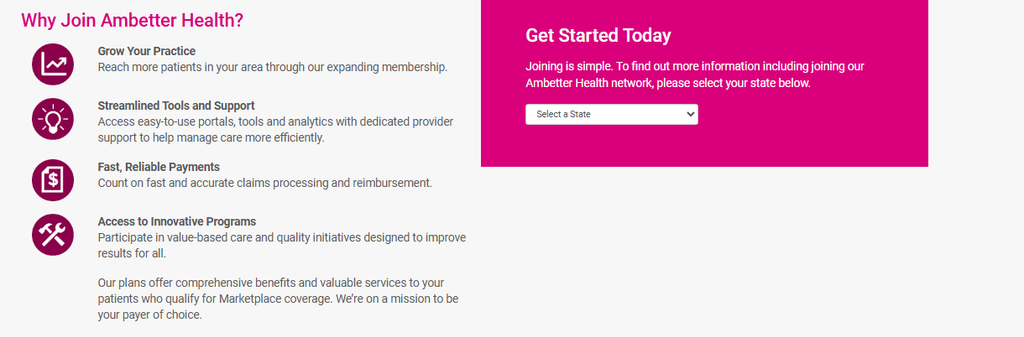
Start with the applicable Ambetter Provider Resources and identify the correct state-specific network page.
Step 2: Check Whether You Are Already Contracted
Before starting a new credentialing application, determine whether your practice or group already has a relationship with the applicable Ambetter health plan.
This can be important because some state plans provide processes for existing participating providers to add practitioners or make other changes to an existing relationship.
For example, Ambetter Alabama provides an Add Practitioner to Existing Contract resource that requests information such as the provider’s CAQH ID, NPI, tax ID, group information, and practice details.
Checking your existing participation status first can help prevent duplicate applications and unnecessary credentialing work.
Step 3: Submit the “Join Our Network” Inquiry
If you are not already contracted, use the applicable state plan’s Join Our Network process.
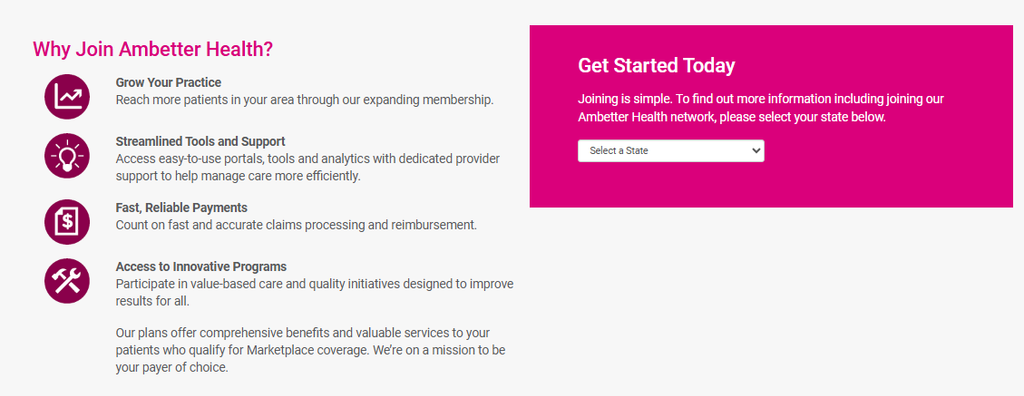
The information requested varies by state, but can include:
- Provider name
- Specialty
- NPI
- CAQH number
- License number
- Tax ID
- Practice address
- Group information
- Medicare number
- Medicaid number
- Primary contact information
For example, Ambetter’s New Jersey network inquiry requests NPI, CAQH number, Medicare and Medicaid numbers, license information, and primary contact details. It also states that the inquiry does not guarantee participation and that incomplete information can delay evaluation.
This step starts the network participation process; it is not itself a credentialing approval.
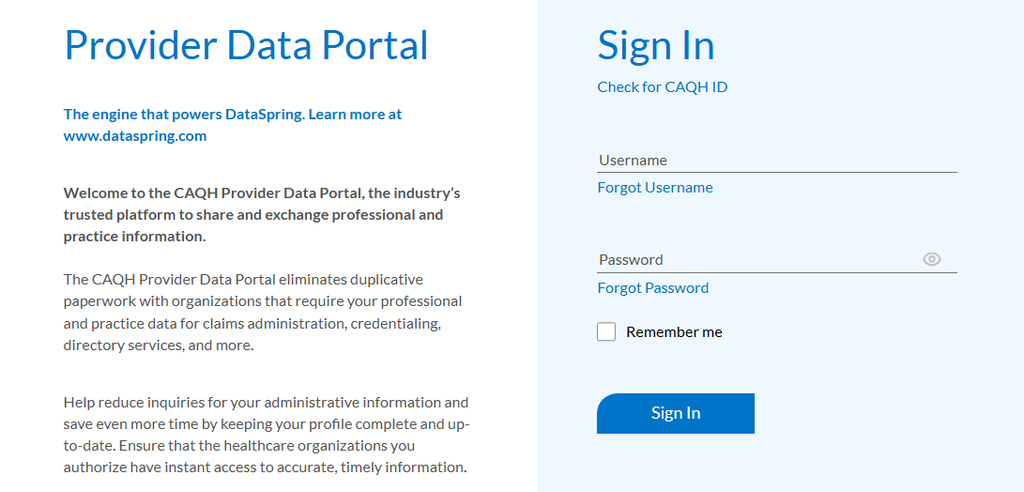
Step 4: Register With CAQH ProView
Most applicable professional providers use CAQH ProView during credentialing.
If you do not already have a CAQH profile, you can register through CAQH ProView.
Your profile should contain current information related to:
- Licensure
- Education
- Training
- Work history
- Malpractice coverage
- Practice locations
- Professional credentials
Ambetter provider manuals direct practitioners to self-register with CAQH ProView and maintain their information.
Make sure your profile is complete and properly attested before the payer attempts to access it.
An outdated or incomplete profile can create additional follow-up and delay the credentialing process.
Step 5: Choose the Correct Application Path
After the initial inquiry, the applicable Ambetter plan determines the appropriate credentialing pathway.
Professional providers generally use the individual credentialing process, while hospitals and ancillary organizations may need a separate facility or organizational application.
Ambetter’s provider manuals specifically distinguish professional providers from institutional providers and identify separate application requirements for facilities.
This means an individual practitioner’s CAQH profile should not be treated as a substitute for an organization’s credentialing application.
Step 6: Submit Supporting Documentation
Once the application is underway, the Ambetter health plan may request documentation supporting the information in the credentialing file.
Depending on provider type, this may include:
- Professional license
- Malpractice insurance
- Board certification
- Education and training records
- Professional history
- Facility documentation
- Other applicable credentials
Responding promptly is important.
Ambetter’s provider manual states that failure to adequately respond to requests for missing or expired information may result in termination of the application process before a credentialing decision is made.
Keeping documents organized and monitoring expiration dates can therefore reduce avoidable interruptions.
Step 7: Complete Primary-Source Verification
After the application is sufficiently complete, the applicable Ambetter plan performs primary-source verification.
This may include verifying:
- Professional licenses
- Education
- Board certification
- Malpractice history
- Sanctions
- Exclusions
Ambetter’s provider manuals describe verification as a core part of credentialing and recredentialing. The information submitted should therefore match the information available from the source.
A mismatched license number, outdated address, or inconsistent provider name can create additional verification work even when the provider otherwise meets the credentialing requirements.
Step 8: Complete Ambetter Contracting
Credentialing and contracting are separate components of network participation.
- Credentialing answers: Does the provider meet the plan’s qualification requirements?
- Contracting answers: Is the provider participating under the applicable network agreement?
Completing credentialing does not necessarily mean the contracting process is complete. Providers should therefore wait for the applicable health plan to confirm network participation and the effective date before treating themselves as active in-network providers.
Step 9: Receive Formal Notification
Once the applicable credentialing and contracting requirements are complete, the provider receives the appropriate network participation notification.
Do not assume that participation has begun simply because:
- Your CAQH profile is complete
- Your application was submitted
- Documents were accepted
- Credentialing is under review
- You have received a credentialing decision
The applicable Ambetter plan’s formal notification and effective date should determine when network participation begins.
Ambetter’s provider materials also make clear that providers must be fully credentialed before accepting member assignments in applicable circumstances.
Step 10: Set Up Provider Portal Access
After participation is established, providers can use the applicable Ambetter provider tools for ongoing administrative work.
Depending on the state, these resources can include:
- Claims tools
- Eligibility resources
- Provider information management
- Enrollment-related functions
- Administrative transactions
Ambetter maintains state-specific provider resource pages with current manuals, forms, secure portal information, and other provider tools.
Step 11: Verify Your Provider Directory Listing
Once you are active, review your Ambetter provider directory information.
Check:
- Provider name
- Specialty
- Practice address
- Phone number
- Group affiliation
- Other demographic information
Accurate provider information is important for members searching for participating providers.
Ambetter’s provider guidance specifically emphasizes the importance of accurate provider-directory information and asks providers to notify the plan when demographic information changes.
How Long Does Ambetter Provider Credentialing Take?
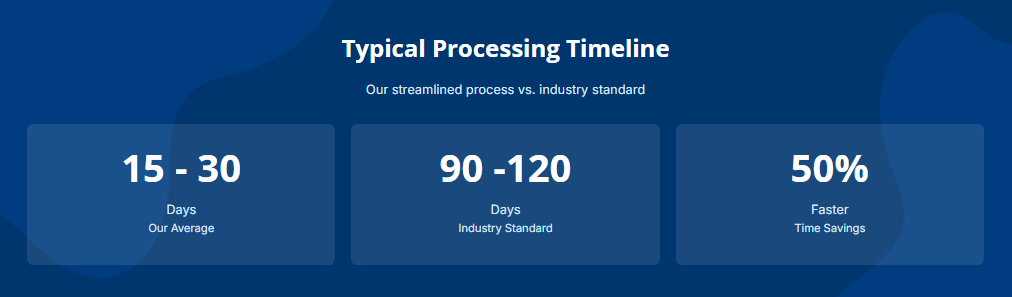
Ambetter credentialing does not follow a single nationwide timeline. Processing can vary based on the state health plan, provider type, application completeness, CAQH status, primary-source verification, and credentialing committee schedules. Once a clean application is received, the Credentialing Committee generally makes a decision during its next scheduled meeting. As a result, 60 to 90 days should be viewed as an estimate, not a guaranteed timeline. Keeping CAQH information current, providing complete documentation, and responding quickly to requests can help keep the process moving.
Ambetter Provider Credentialing Services
Managing Ambetter credentialing manually can become difficult when a practice has multiple providers, locations, specialties, and payer relationships.
Credentialing services can help organizations manage:
- CAQH profiles
- Provider applications
- Supporting documents
- License expirations
- Malpractice insurance
- Application status
- Payer communications
- Contracting milestones
- Provider-directory information
- Recredentialing deadlines
This becomes especially important for organizations working across multiple Ambetter state plans, because each plan can maintain its own provider resources and processes.
A centralized provider credentialing and enrollment solution can help bring these activities into one workflow.
How MantraComply Can Help With Ambetter Provider Credentialing
Managing Ambetter Provider Credentialing and Enrollment requires more than submitting an initial application. Practices also need to maintain provider information, monitor documents, respond to payer requests, and stay ahead of recredentialing deadlines.
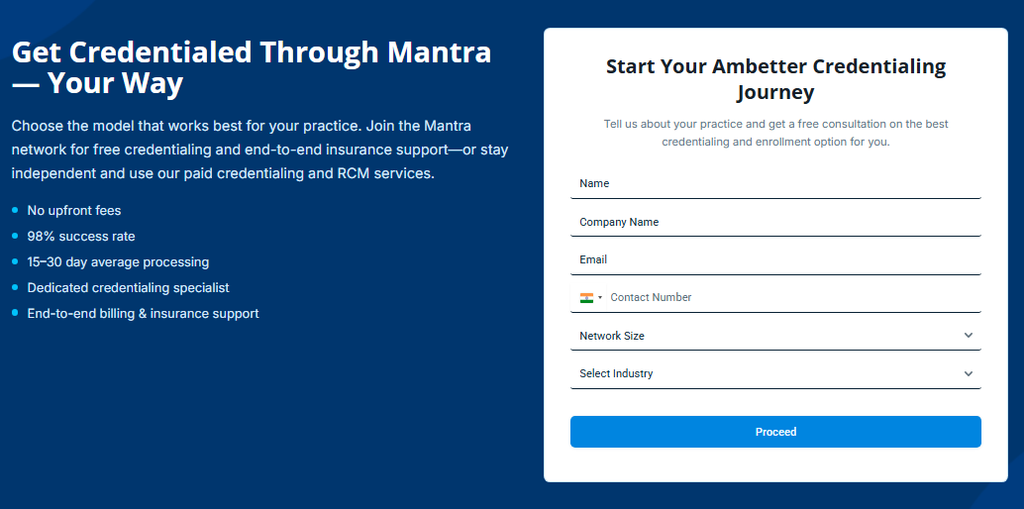
MantraComply helps healthcare organizations centralize these activities through its credentialing and enrollment platform.
- CAQH Management – Keep provider information organized and make it easier to maintain the data used across payer credentialing workflows.
- Application Preparation – Centralized provider data can help teams prepare payer-specific applications without repeatedly collecting the same information.
- Document Management – Organize licenses, malpractice insurance, certifications, and other credentialing documents while keeping track of expiration dates.
- Payer Enrollment – Manage payer enrollment workflows alongside credentialing instead of treating them as disconnected administrative processes.
- Application Tracking – Monitor application progress, outstanding requirements, and payer follow-ups from a centralized workflow.
- Recredentialing Management – Ambetter provider manuals state that participating providers must be recredentialed at least every 36 months. This applies to professional providers as well as facilities and ancillary providers covered by the credentialing program.
A centralized credentialing management workflow can help teams track these recurring requirements before they become urgent.
Conclusion
Ambetter Provider Credentialing and Enrollment is not an identical process across every state. The applicable Ambetter health plan determines the relevant provider resources, network participation process, application requirements, and administrative workflow.
The overall process is easier to manage when providers follow a clear sequence: identify the correct state plan, check existing participation, submit the network inquiry, maintain CAQH where applicable, provide supporting documents, complete primary-source verification, finalize contracting, receive formal notification, and verify provider information after activation.
Credentialing also does not end when the initial application is approved. Provider information, licenses, insurance, directory data, and recredentialing requirements need ongoing attention. Ambetter’s provider manuals require recredentialing at least every 36 months.
For practices managing multiple providers and payers, healthcare credentialing automation can reduce repetitive administrative work while giving credentialing teams greater visibility into applications, documents, payer requirements, and renewal deadlines.
Frequently Asked Questions
Most providers can expect the process to take roughly 60 to 90 days from a complete application, though this varies by state and how quickly supporting documents and verifications come back.
Most individual practitioners do, through CAQH ProView. Facilities and ancillary providers typically use a separate organizational application instead.
No. Ambetter operates through state-specific subsidiaries, so the application path, contact points, and exact timeline can vary by state even though the overall structure is similar.
Providers generally need to recredential with Ambetter at least every 36 months, depending on the state plan.
In many cases, you won’t need a separate credentialing review for Ambetter – you may only need to add it as a product line to your existing contract.
View Sources
- Ambetter Health. Provider Resources . Accessed 10/5/2026.
- Ambetter Health. Join the Ambetter Health Provider Network . Accessed 10/5/2026.
- Ambetter Health. Provider Network Participation . Accessed 10/5/2026.
- Ambetter Health. Providing Quality Care and Provider Credentialing Rights . Accessed 10/5/2026.
- CAQH. CAQH ProView . Accessed 10/5/2026.
- MantraComply. Healthcare Credentialing Services . Accessed 10/5/2026.