For healthcare providers, joining a health insurance network involves more than completing an application. BCBS of North Carolina (Blue Cross NC) provider credentialing and enrollment require providers to demonstrate that they meet applicable professional standards, submit accurate information, and complete the payer’s participation process.
Blue Cross NC introduced a credentialing and enrollment workflow using CAQH ProView for initial credentialing and recredentialing, along with online enrollment forms for individual practitioners and provider groups. A 2022 announcement about the process change stated that enrollment forms should be submitted 60 days before the intended effective date, based on the processing time identified at that time. Providers should confirm whether the current process, forms, and timelines have changed before applying.
This guide explains the major stages of BCBS of North Carolina provider credentialing and enrollment, from eligibility and documentation to application submission, verification, approval, and ongoing maintenance.
What Is BCBS of North Carolina Provider Credentialing?
BCBS of North Carolina provider credentialing is the process of reviewing and verifying a healthcare professional’s qualifications and professional background before the payer approves participation in an applicable network.
Credentialing may involve reviewing information such as:
- Professional licenses and certifications
- Education, training, and work history
- Professional liability insurance
- Specialty qualifications
- Practice locations and professional affiliations
- Other information required for the provider’s specialty or participation arrangement
Blue Cross NC’s CAQH-based process is designed to use standardized provider information for credentialing. CAQH ProView allows providers to maintain a profile that can be shared with participating health plans, subject to the relevant authorization and payer requirements.
Credentialing should not be confused with contracting or enrollment. Completing a credentialing application does not, by itself, establish an effective participation date or guarantee that a provider may begin billing as an in-network provider.
BCBS of North Carolina Provider Credentialing vs. Enrollment
Credentialing and enrollment are connected but serve different purposes. Credentialing primarily focuses on professional qualification and verification, while enrollment focuses on establishing the provider’s participation and administrative information with the payer.
| Credentialing | Enrollment |
|---|---|
| Verifies the provider’s professional qualifications and credentials. | Establishes the provider’s participation and administrative records with the payer. |
| Reviews licenses, education, training, specialty, and other professional requirements. | Includes provider information, group affiliation, practice locations, and billing-related information. |
| May require a complete and authorized CAQH ProView profile. | May require an individual practitioner or provider group enrollment request. |
| Supports the payer’s credentialing eligibility review. | Supports the administrative process for participation and payer setup. |
| May include primary-source verification and applicable credentialing committee review. | May involve enrollment processing, contracting, and provider data updates. |
| Must be maintained through periodic recredentialing and updates. | Must be maintained through timely updates to provider, group, tax, and participation information. |
The exact sequence between credentialing, contracting, and enrollment can depend on the provider type and the network or product involved. Providers should follow the instructions associated with their specific Blue Cross NC application.
BCBS of North Carolina Provider Credentialing Eligibility
Before applying for BCBS of North Carolina (Blue Cross NC) provider credentialing, healthcare professionals should confirm that they meet the applicable payer and professional requirements.
Key eligibility considerations include:
- Active Professional License: The provider must hold a valid license to practice in the applicable state and specialty.
- Relevant Qualifications: Providers should meet the education, training, certification, and specialty requirements for their practice.
- Valid NPI: An active National Provider Identifier is required for accurate provider identification and healthcare transactions.
- Updated CAQH Profile: Providers may need a complete and current CAQH ProView profile for credentialing and recredentialing.
- Professional Liability Insurance: Current malpractice insurance documentation may be required, depending on the provider type and payer requirements.
- Accurate Practice Information: Providers must submit current practice addresses, contact details, group affiliations, and billing information.
- Complete Professional History: Education, training, employment history, and applicable disclosures should be accurate and up to date.
- Required Attestations: Providers must complete applicable disclosures and attestations as requested by Blue Cross NC.
Documents Required for BCBS of North Carolina Provider Credentialing and Enrollment
Preparing the required documents before submitting an application can help reduce avoidable delays. The exact checklist depends on the provider type and the payer’s current instructions. The following table represents commonly requested credentialing and enrollment information and should be validated against the applicable Blue Cross NC requirements.
| Document Checklist | Why It Matters |
|---|---|
| Completed Individual Practitioner Enrollment Form | Provides the information needed to process an individual provider’s enrollment request. |
| Completed Provider Group Enrollment Form, if applicable | Supports enrollment of a medical group or other eligible provider organization. |
| Active Professional License | Verifies authorization to practice in the applicable state and specialty. |
| National Provider Identifier (NPI) | Supports accurate provider identification for claims and administrative transactions. |
| CAQH ProView Profile | Provides standardized professional information for credentialing review, where required. |
| CAQH Attestation and Authorization | Allows the payer to access the provider’s credentialing information and confirms the profile is current. |
| Curriculum Vitae or Work History | Helps document professional experience and identify gaps or inconsistencies in the provider’s history. |
| Education and Training Records | Supports verification of the provider’s education, residency, fellowship, or other relevant training. |
| Board Certification Information | Documents specialty certification when applicable to the provider’s qualifications. |
| Professional Liability Insurance Certificate | Confirms current malpractice insurance coverage subject to applicable requirements. |
| DEA Registration or Controlled Substance Registration, if applicable | Supports verification of prescribing authority relevant to the provider’s role. |
| Practice Location and Contact Information | Ensures accurate records for communication, directories, and patient access. |
| Tax Identification Information and W-9 | Supports tax reporting, payment setup, and administrative record accuracy. |
| Disclosure and Attestation Forms | Allows the provider to disclose relevant information and confirm the accuracy of the application. |
| Group Affiliation and Billing Information | Helps connect the individual practitioner with the appropriate organization and billing arrangement. |
Important: Do not submit expired licenses, outdated insurance certificates, incomplete CAQH information, or inconsistent practice details. Review the current Blue Cross NC instructions to confirm which documents must be uploaded, entered online, or supplied separately..
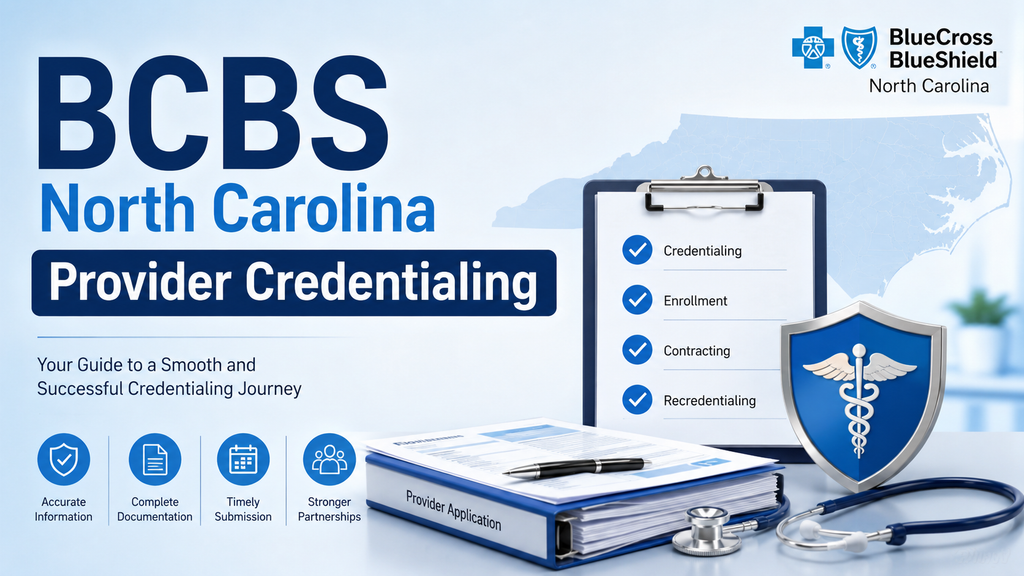
BCBS of North Carolina Provider Credentialing and Enrollment: Step-by-Step Process
Provider credentialing and enrollment with BCBS of North Carolina (Blue Cross NC) help healthcare professionals join applicable insurance networks and receive reimbursement for covered services. The process includes verifying qualifications, submitting required documents and forms, and completing payer-specific enrollment requirements.
This guide covers the step-by-step credentialing and enrollment process, required documents, timelines, and credentialing support options.
Step 1: Confirm Network and Participation Requirements
Begin by identifying the Blue Cross NC network or product in which you want to participate. Network participation requirements may differ for individual practitioners, facilities, provider groups, behavioral health providers, and other specialties.
Review the applicable payer instructions and determine whether you need to complete credentialing, enrollment, contracting, or a combination of these processes.
Step 2: Prepare Your Provider Information
Gather your professional and administrative information before starting the application. This may include your NPI, license details, specialty, practice addresses, tax information, work history, insurance details, and group affiliations.
Check that the information is consistent across your license records, CAQH profile, enrollment forms, and practice management systems. Inconsistencies can lead to requests for clarification or additional documentation.
Step 3: Create or Update Your CAQH ProView Profile
Blue Cross NC’s announced process change requires providers to use CAQH ProView for initial credentialing and recredentialing, subject to applicable exceptions or updated payer instructions.
If you already have a CAQH profile, review it carefully before authorizing access. Confirm that your license, education, work history, liability coverage, practice locations, and other relevant fields are current.
If you do not have a CAQH profile, follow the current CAQH registration and profile-completion instructions. Completing the profile is only one part of the payer process; the provider must also follow Blue Cross NC’s participation and enrollment instructions.
Step 4: Authorize Access and Complete Required Attestations
After reviewing the CAQH profile, complete the required attestation and authorize the applicable health plan to access the information.
Pay attention to profile expiration, missing fields, unanswered disclosure questions, and documents that need renewal. A profile that is incomplete or not properly authorized may prevent the payer from completing its review.
Step 5: Complete the Appropriate Enrollment Form
Submit the enrollment form that corresponds to your application type. The 2022 Blue Cross NC process announcement identified separate online forms for individual practitioners and provider groups.
When completing the form:
- Use the legal name associated with the provider or organization.
- Enter the correct NPI and tax identification information.
- Provide all applicable practice locations.
- Confirm group affiliations and billing arrangements.
- Review the effective-date request.
- Attach or submit supporting information as instructed.
Do not assume that submitting a CAQH profile automatically completes the payer enrollment process.
Step 6: Submit the Application Within the Required Timeframe
Submit the enrollment and credentialing information according to the current Blue Cross NC timeline. The 2022 announcement advised providers to submit enrollment forms 60 days before the requested effective date because the process was identified as taking approximately 60 days at that time.
Because processing times and requirements can change, applicants should confirm the current lead time and avoid scheduling in-network services based solely on an application submission.
Step 7: Respond to Verification Requests
During the review, Blue Cross NC or its credentialing representatives may request clarification, updated documents, or additional information.
Respond promptly and ensure that any revised information is consistent with the CAQH profile and enrollment submission. Maintain a record of submitted documents, correspondence, reference numbers, and outstanding requests.
Step 8: Complete Contracting and Participation Requirements
Depending on the application, network, and provider type, contracting may be a separate stage from credentialing and enrollment. Carefully review any agreement or participation documentation provided by Blue Cross NC.
Pay attention to:
- Contract terms
- Participating network or product
- Provider and group details
- Reimbursement provisions
- Effective date
- Required signatures
- Additional administrative obligations
A signed agreement or submitted application should not be treated as confirmation of active participation unless Blue Cross NC has provided the applicable approval or effective-date notice.
Step 9: Confirm Approval and Effective Date
Before treating the provider as participating, verify the outcome of the application and the effective date communicated by the payer.
Confirm that the provider’s name, specialty, locations, group affiliation, and participation status are accurate. Keep the approval documentation for internal records and coordinate the information with billing and scheduling teams.
Step 10: Maintain Credentialing and Enrollment Information
Credentialing and enrollment do not end with initial approval. Providers should maintain accurate records and respond to recredentialing requests, profile attestations, license renewals, address changes, and other payer updates.
Regular maintenance can help reduce administrative issues and support the accuracy of payer records.
How Long Does BCBS of North Carolina Provider Credentialing Take?
The time required for BCBS of North Carolina provider credentialing and enrollment depends on factors such as provider type, application completeness, verification requirements, contracting, and payer workload.
A 2022 Blue Cross NC process announcement stated that new enrollment processing took approximately 60 days and recommended submitting enrollment forms 60 days before the intended effective date. This is a historical process reference rather than a guaranteed current turnaround time.
Applicants should account for additional time if:
- The CAQH profile is incomplete or outdated.
- A license or insurance document has expired.
- The payer requests clarification.
- The application contains inconsistent provider or tax information.
- Contracting or group setup is still pending.
- The requested effective date requires additional coordination.
For accurate planning, confirm the current processing estimate directly with Blue Cross NC and submit well before the date on which participation is needed.
How BCBS of North Carolina Credentialing Support Services Can Help
Managing provider credentialing internally can require significant administrative coordination. Credentialing support services can help healthcare organizations organize documentation, monitor application progress, and maintain accurate provider information.
Common areas of support include:
- Provider Enrollment Assistance – Credentialing specialists can help identify the appropriate enrollment forms, collect provider information, and coordinate the submission process.
- CAQH Profile Management – Support teams can assist with reviewing CAQH profiles, identifying missing information, tracking attestations, and ensuring that the data provided to the payer is consistent.
- Document Collection and Verification – A structured document workflow can help teams track licenses, certifications, insurance documents, work history, and other required information before submission.
- Application Tracking – Credentialing support services can maintain application trackers that record submission dates, outstanding requests, follow-ups, and payer responses.
- Recredentialing and Ongoing Maintenance – Support teams can help monitor renewal dates, update provider records, and prepare for recurring credentialing requirements. However, the provider or organization remains responsible for ensuring that all information submitted is accurate and complete.
How MantraComply Can Support BCBS of North Carolina Provider Credentialing and Enrollment
MantraComply can help organizations streamline healthcare credentialing and enrollment workflows through:
- Improved Administrative Visibility: Coordinate credentialing, operations, billing, and provider management activities through a structured workflow.
- Centralized Provider Information: Organize licenses, NPI numbers, specialties, practice locations, and group affiliations.
- Credentialing Document Management: Track required documents, missing information, and renewal dates.
- Enrollment Workflow Tracking: Monitor applications, payer follow-ups, pending requests, and completion status.
- CAQH Coordination: Track profile readiness, authorizations, and information updates.
- Recredentialing Support: Maintain updated provider records and monitor recurring credentialing requirements.
Conclusion
BCBS of North Carolina provider credentialing and enrollment require careful preparation, accurate provider information, and timely completion of payer-specific requirements. Using CAQH ProView where required, preparing supporting documents, completing the appropriate enrollment forms, and responding promptly to verification requests can help organizations manage the process more efficiently.
The 2022 Blue Cross NC process announcement identified CAQH ProView for credentialing and online enrollment forms for individual practitioners and provider groups. However, providers should verify the latest payer instructions, submission deadlines, and participation requirements before beginning the process.
A structured credentialing workflow can also help healthcare organizations track applications, maintain documentation, and prepare for ongoing provider record updates.
Frequently Asked Questions
Blue Cross NC has stated that initial credentialing can take up to 60 days after a completed application is received. Providers should allow additional time for enrollment and contracting because these are separate stages.
Yes. Blue Cross NC requires a separate email to credentialing@bcbsnc.com with the CAQH ID number before it begins reviewing the file, even after the CAQH profile itself is complete.
Blue Cross NC states that providers are recredentialed at least every three years. Providers should follow the notice and submission instructions provided for their applicable recredentialing cycle.
Individual credentialing is still required for practitioners joining an existing group. Where applicable, the Enrollment Pending Claims Filing Exception form may help facilitate claims processing while the individual file is under review.
Providers should check the current North Carolina-specific CAQH requirements before completing or reattesting to their profile. Blue Cross NC requires practitioners and provider groups to use CAQH ProView for credentialing and recredentialing.